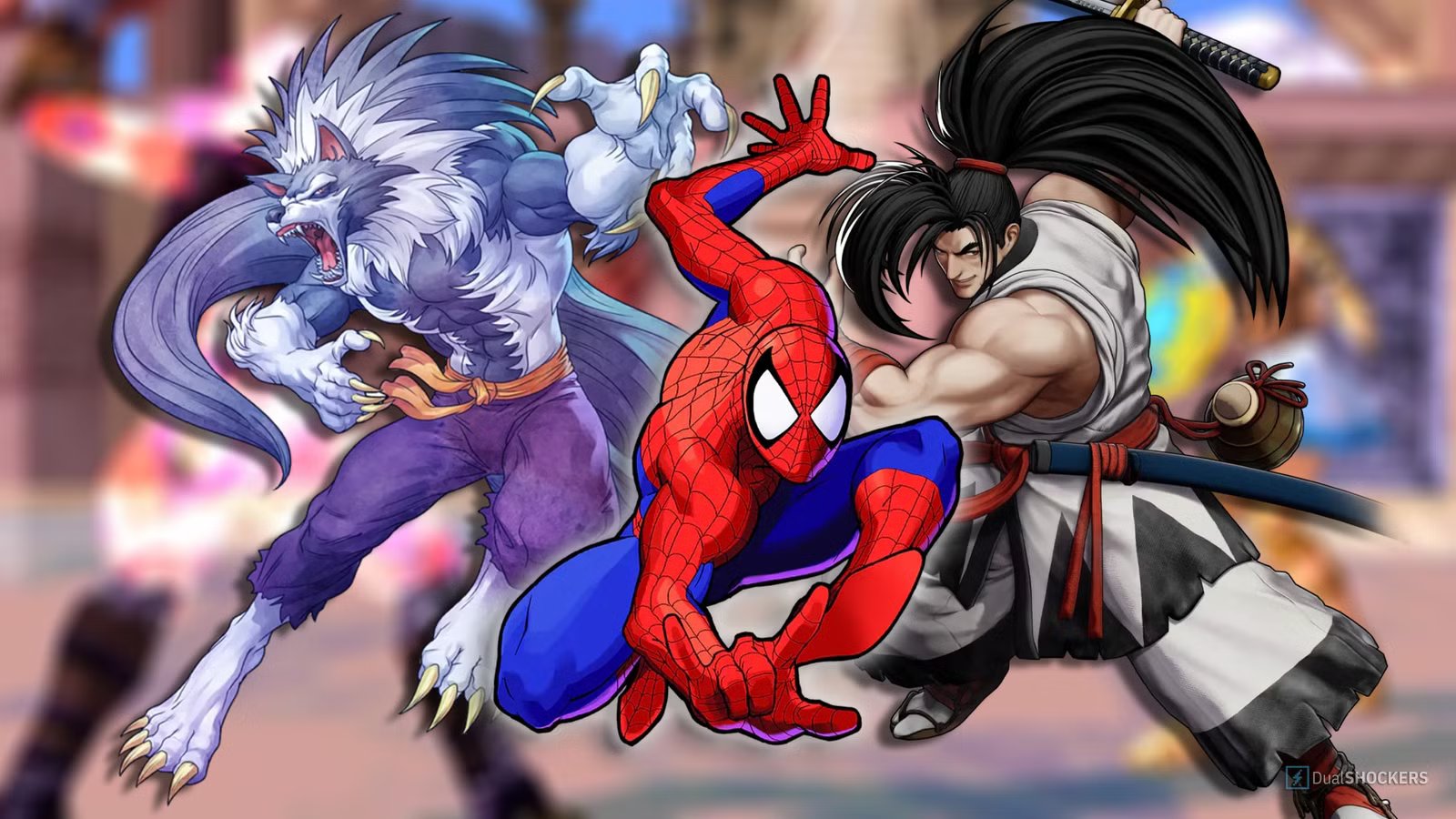
10 Fighting Games That Quietly Reinvented the Genre Without Getting Enough Credit
Possibly more than any other genre of game, fighting games are about building and improving upon what came before. It’s not just knowing your roots, important as that is, but understanding how different games’ disparate elements come together into new and interesting wholes. Because the genre has been around for so long and had so many games, not every fighting game that contributed a major ingredient to the proverbial stew gets full credit for it.
There are plenty of fighting games that, while well regarded in the overall annals of history, are only highlighted for being generally entertaining rather than for the specific contributions they made. That’s assuming the game in question even gets remembered, and doesn’t just get swept away by the tides of history. If you’re looking to learn more about fighting games in a broader scope, you should read up a little on these games and the ways they changed things up.
10
Karate Champ
Took a Couple of Tries

|
Developer |
Data East |
|---|---|
|
Platforms |
Arcade, NES, Apple II, Commodore 64 |
|
Release Date |
May 1984 |
Back in the 1980s, fighting games were… conceptually a thing? Like, there were games about fighting, but they didn’t really resemble the proper one-on-one fighting games we know and love today. One of the first games to start tipping the scales was 1984’s Karate Champ, albeit not exactly right away.
The original arcade-exclusive, Japan-exclusive release of Karate Champ was a strictly single-player affair, in which a player would take on a series of computer-controlled karateka, winning rounds by landing one of 24 different attacks. It wasn’t until a little later that same year that an updated version of Karate Champ was released that featured two-player head-to-head combat, aptly titled Karate Champ: Player vs. Player. It was this version that really put the game on the map, not just in Japanese arcades, but western arcades and game consoles as well, properly incepting the idea of a competitive fighting game into the collective consciousness of the gaming public.
9
Street Fighter II Turbo
Pick Up the Pace

Street Fighter II is a game that needs no introduction. Its characters and moves are all iconic, and it is largely considered the firing pistol that launched the arcade fighting game scene in earnest. However, what you might not know if you never actually played the original game is that it was very, very slow. It was still fun, but nowhere near as thrilling or mind game-y as modern day fighting games. It was the release of Street Fighter II Turbo in 1992 that really started pumping the gas.
Turbo is the second revamped version of Street Fighter II, following the additional characters and rebalanced mechanics introduced in Street Fighter II: Champion Edition earlier in 1992. The game added a few more tweaks and new super moves for most of the roster, but the major change was the pace of the game. The speed was cranked up noticeably compared to the original version, which not only improved the overall pacing of getting into and playing matches, it also helped to refine the game’s skill-centric aspects. You had to make your special inputs faster, react to incoming attacks faster, and so on. Turbo was the game that really got gamers’ neurons firing at double time, and it set the standard of speed for the genre going forward.
8
Art of Fighting
Needs More Meters

One of the reasons older fighting games aren’t as flashy as newer ones, besides lesser graphical capabilities, is that earlier fighting games didn’t have any meters besides the health meter. You can’t very well pull off wacky screen-clearing super moves if you don’t have a hyper meter to power it all. Surprisingly, the first game to shirk this norm wasn’t a Capcom game, but rather one of SNK’s seminal fighting series, 1992’s Art of Fighting.
In addition to the usual health meter, Art of the Fighting was the first fighting game to add a super meter into the mix, which filled up as you both landed and received damage. This meter could be expended to perform powerful super moves, which would become weaker if your meter was running dry. The game also introduced desperation supers, even more powerful techniques you could only perform at critical health. Supers have become inexorably linked with the fighting game identity, not to mention one of the genre’s most fun and flashy elements, and we have Art of Fighting to thank for that.
7
Samurai Shodown
Let Your Blades do the Talking

The majority of fighting games, both currently and in the past, have focused on hand-to-hand combat, supernaturally-enhanced or otherwise. Having fighters just pummeling each other rather than using bladed implements probably helps to skirt violence concerns, and you don’t need to justify just knocking out opponents rather than killing them. That doesn’t mean all fighting games follow these rules, though; just look at 1993’s Samurai Shodown.
Another classic gem from SNK, Samurai Shodown revolves around a roster of medieval-era combatants fighting specifically with weaponry, usually bladed stuff like katanas, rapiers, sickles, and so on. Because the fighters are using bladed implements, you can’t really justify them merely knocking each other out, so… they don’t! Rather than whittling down your opponent’s health with long combos, the point was to land one or two decisive blows with your weapon, which would do the thing a sword normally does when it slashes someone and kill them instantly. It was a very different kind of fighting game, but it was very popular thanks to its fast pace and brutal stylings, and it also helped to get the weapon-based fighter sub-genre off the ground.
6
Killer Instinct
C-C-C-Combos

The concept of combos in fighting games dates back to Street Fighter II where, legend has it, a development error allowed the devs to chain attacks into each other without waiting for recovery frames. Combos have proven to be one of the most vital elements of the broader fighting game meta, with nearly every game focusing on them to some extent and encouraging players to come up with their own unique chains. Arguably, the game that made building combos the biggest part of its identity was 1994’s Killer Instinct.
Killer Instinct featured several novel combo-centric mechanics on top of its general affinity for lengthy, impressive combo strings. For example, it was the first game to introduce the concept of auto combos, wherein performing a certain input would have your character launch a canned combo string without necessitating further input. More interesting than that was the introduction of the Combo Breaker, which allows a player currently trapped in a combo to perform a special maneuver during the combo’s transitional phases and immediately shut it down. Killer Instinct also had Ultra Combos, which allowed you to pin a massive combo string onto the end of a finishing move, though this was mostly just for bragging rights.
5
Darkstalkers: The Night Warriors
Refined the Formula Further

Street Fighter was undoubtedly the face of Capcom’s fighting game-centric pursuits for many years, and remains as such to this day. However, it’s not the only fighting franchise Capcom has under its belt, and during the mid-90s, there was actually another Capcom fighting game that arguably had a bigger presence in Japanese arcades. That game was 1994’s Darkstalkers: The Night Warriors.
Thematically, Darkstalkers was a pretty big departure from Street Fighter, featuring a cast of monsters and cryptids battling with overt magical and supernatural abilities rather than Street Fighter’s various martial artists. In addition to its thematic differences, though, Darkstalkers also introduced a variety of mechanical tweaks to Capcom’s fighting game soup that Street Fighter would pick up in subsequent entries. These tweaks included the ability to block attacks in the air, move along the ground while crouching, and a new kind of combo, chain combos, which let you automatically chain weaker moves into stronger moves. It was more or less a straight upgrade over the versions of Street Fighter II available at the time, and was quite popular for an age.
4
The King of Fighters ‘94
Take it in Teams

By the mid-90s, SNK had managed to put together a pretty respectable stable of fighting game franchises, including series like Fatal Fury and Art of Fighting. With all of these fighters at its disposal, SNK decided to do something new and interesting with the lot of them while creating a new kind of team battle system in the process. This yielded the very first entry in the King of Fighters series.
The King of Fighters ‘94 was one of the first 2D fighting games to use a team system, though it was a little different than the tag-based systems we would later see from games like X-Men vs. Street Fighter. King of Fighters used a canned team system consisting of three members apiece, which you’d select as a single unit before a match alongside the order your members would fight in. When a member of your team is KO’d, the next member in the lineup would take their place in the subsequent round, while your opponent’s character would carry over with only a portion of their health restored. It was a big departure from the traditional round-based structure, and added an entire new layer of meta to fighting games, which were already getting pretty complex.
3
Battle Arena Toshinden
Sidestepping Danger

3D fighting games began in earnest with the release of the original Virtua Fighter in 1993. However, the thing with Virtua Fighter was that, while its characters were rendered in 3D polygons, you couldn’t move them in a 3D space, only left to right, so it wasn’t really a “true” 3D game. Rather than Virtua Fighter, the game that would push a little more earnestly into the realm of 3D was 1995’s Battle Arena Toshinden.
This Tamsoft-developed, Takara-published fighting game also rendered its characters with 3D polygons, and also doubled as something of a successor to Samurai Shodown in that most of them used weapons instead of their fists, albeit not in quite the same fast-paced, fatal fashion. Where Toshinden broke the mold was in the introduction of the small, yet critical sidestepping mechanic, wherein tapping shoulder buttons let you nudge your character to the side in three dimensions in addition to moving left and right. It was a little detail, but it allowed you to avoid enemy attacks completely by simply stepping out of the way, a mechanic that would become standard in 3D fighters going forward.
2
Soul Edge
More Emphasis on Weapons

Speaking of 3D fighting games, and Samurai Shodown for that matter, while fists continued to remain the dominant fighting format for the genre, some games continued to dabble in new and interesting ways to add weapons to the mix. Hot on the heels of Toshinden, Namco released its own take on the 3D weapon-fighter concept in the form of 1995’s Soul Edge (AKA Soul Blade), the progenitor of the modern-day SoulCalibur series.
While Soul Edge wasn’t quite as swift and bloody as Samurai Shodown, it still put the focus on weaponry in a big way. Guard Impacts were used to deflect incoming weapon attacks, and a rock-paper-scissors-esque system was used in the event two attacks met at the same moment and a victor needed to be chosen. Most interesting was the Weapon Gauge located under the health meter, which depletes whenever you block an attack. If it drains completely, your weapon shatters, and you have to fight unarmed, which is obviously less-than-ideal. Not all of these mechanics carried over into SoulCalibur, but if nothing else, Soul Edge showed there was still room to grow in the weapon fighter sub-genre.
1
Marvel Super Heroes vs. Street Fighter
The Power of Variable Assist

In the late 90s, Capcom was once again on a hot streak, this time thanks to acquiring the rights to Marvel’s stable of superheroes and supervillains, using them for games like Marvel Super Heroes and X-Men vs. Street Fighter. The latter of those specifically opted for a genre-first tag-team system, where you could swap between your two chosen characters on the fly. While that was a big deal, though, the next game in this series, 1997’s Marvel Super Heroes vs. Street Fighter, took it even further.
In addition to the tag-team system, Marvel Super Heroes vs. Street Fighter was the game that introduced the Variable Assist system, which would become a series staple. With Variable Assist, you could bring in your second playable character to perform a special move without actually tagging them in. This meant you could get a combo going with your current character, have your second drop in to add their two cents, then keep the combo going without missing a beat. This was a whole new ball game for combo development and team selection, and only got more interesting with the introduction of multiple assist types in Marvel vs. Capcom 2.