16 Of The Coolest BMW Designs Of All Time
The blue and white badge that has represented BMW for over a century has been one of the most recognizable in the industry for almost as long. From making some of the most luxurious pre-War European cars to its most recent successes, BMW has continued to establish itself as one of the best examples of putting the driving experience first.
Choosing the very best of all BMWs ever made is an incredibly hard task, but if we’re basing it primarily on looks, there are some nameplates that stand head and shoulders above the rest. The German brand has managed to experiment with quite a few different design philosophies over the years, with some prioritizing uninterrupted curves and others going all out on functional aerodynamics. Still, the following 16 models all perfect their individual styles, all while fitting perfectly with BMW’s image. Here’s a closer look at some of the coolest BMW cars ever designed.
BMW M1
While the car officially broke cover in 1978, the foundations for the BMW M1’s design were set in 1972 with the Turbo Concept. For the production car, though, BMW hired Italian designer Giorgetto Giugiaro to ensure the car was just as effective on the race track as it was stunning to look at. As a homologation car intended for the Group 4 series, Giugiaro put aerodynamics at the forefront of the car’s philosophy. The defining element of the M1 is the super low-slung, wedged front end with sharp angles and tiny kidney grilles to remind you that it’s still a BMW at its core.
Moving down the side and to the rear, the sleek, minimal panels echo what was already seen in prior BMWs, but the continuation of the wedge design makes for what’s still one of the most unique rear ends. The 277-horsepower 3.5L six-cylinder sits under Italian-esque slats between the pillars, rounding off what might be the most Italian-looking BMW ever built (for all the right reasons).
BMW 1 Series M Coupe
Since the M1 was released in the ’70s, BMW’s performance division has come quite a long way. Cars like the M3 and M4 cemented the manufacturer’s place at the top of the industry, eventually adding cars like the 1 Series M Coupe to the lineup. The idea behind the relatively limited car was to create a compact version of the larger M-division performance cars to allow raw driving dynamics to take center stage.
The result was not only one of the most beloved driver’s machines of the 2010s, but the most eye-pleasing M-division cars of the decade by quite some margin. BMW heavily pushed how different the M Coupe was to any of the other 1 Series trims at the time, and you only have to look at it to see why. At the front, the grille is the only aspect that really looks similar, with the ultra-aggressive triple intake and carefully positioned openings in the bodywork on either side used to maximize aero efficiency as well as cooling. Wider archers can be found at both ends of the car, being one of the ways BMW used the M Coupe to honor the E30 M3.
BMW 507 Roadster
In the 1950s, buyers had no shortage of elegant cars in the market to choose from, with so many of the major names in the industry opting for simple, timeless designs that let natural, swooping curves throughout the body do all the work. The era-defining Ferraris and Mercedes-Benz, like the 250 GT and the Gullwing, tend to get the attention, at least until the BMW entered the two-seat grand touring segment with the 507 Roadster. Today, it’s still one of the most stunning European cars ever built.
At first glance, it’s easy to see the design elements typical of the ’50s. For the 507, Albrecht Graf Görtz used front fenders that stretched from the headlines down to the side of the car, creating the classic drop down to the sleek hood. However, compared to other European tourers of the time, the 507 really exaggerates the curves to create one of the smoothest, most elegant silhouettes from this era. Thanks to being a roadster, a similar effect is created with the rear fenders flanking the compact truck, which also has a curved design of its own. Only 259 examples were ever built.
BMW E9 3.0 CSL
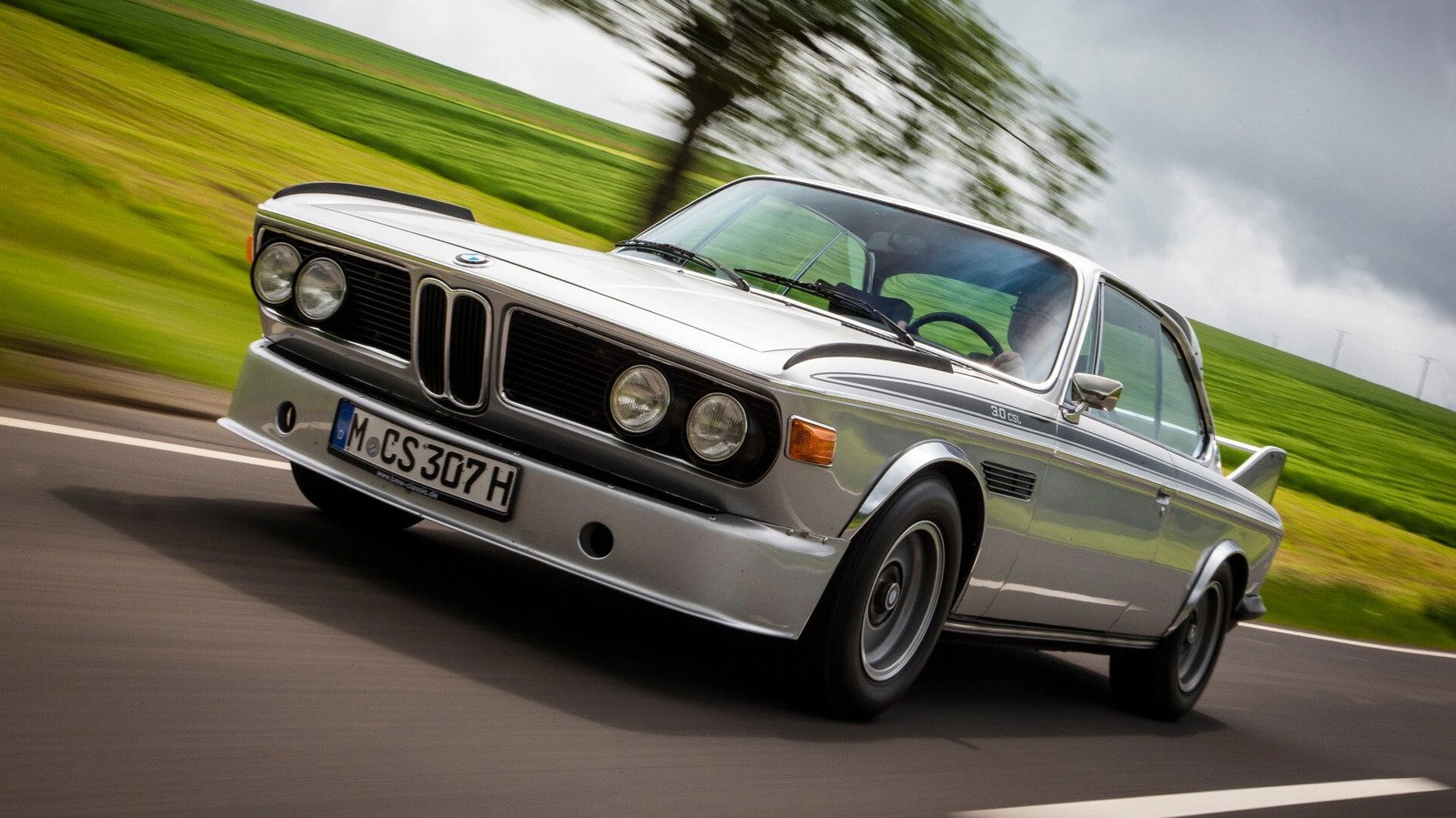
Back to the 1970s, the M1 wasn’t the only car from the decade that spearheaded the direction BMW would go down in the following decades. In 1968, the E9 was released as the newest iteration of the two-door luxury grand touring philosophy introduced by the 503. It fell much more in line with BMW’s staple boxy style that the New Class models used earlier in the decade, but this time with a low-slung, aggressive stance.
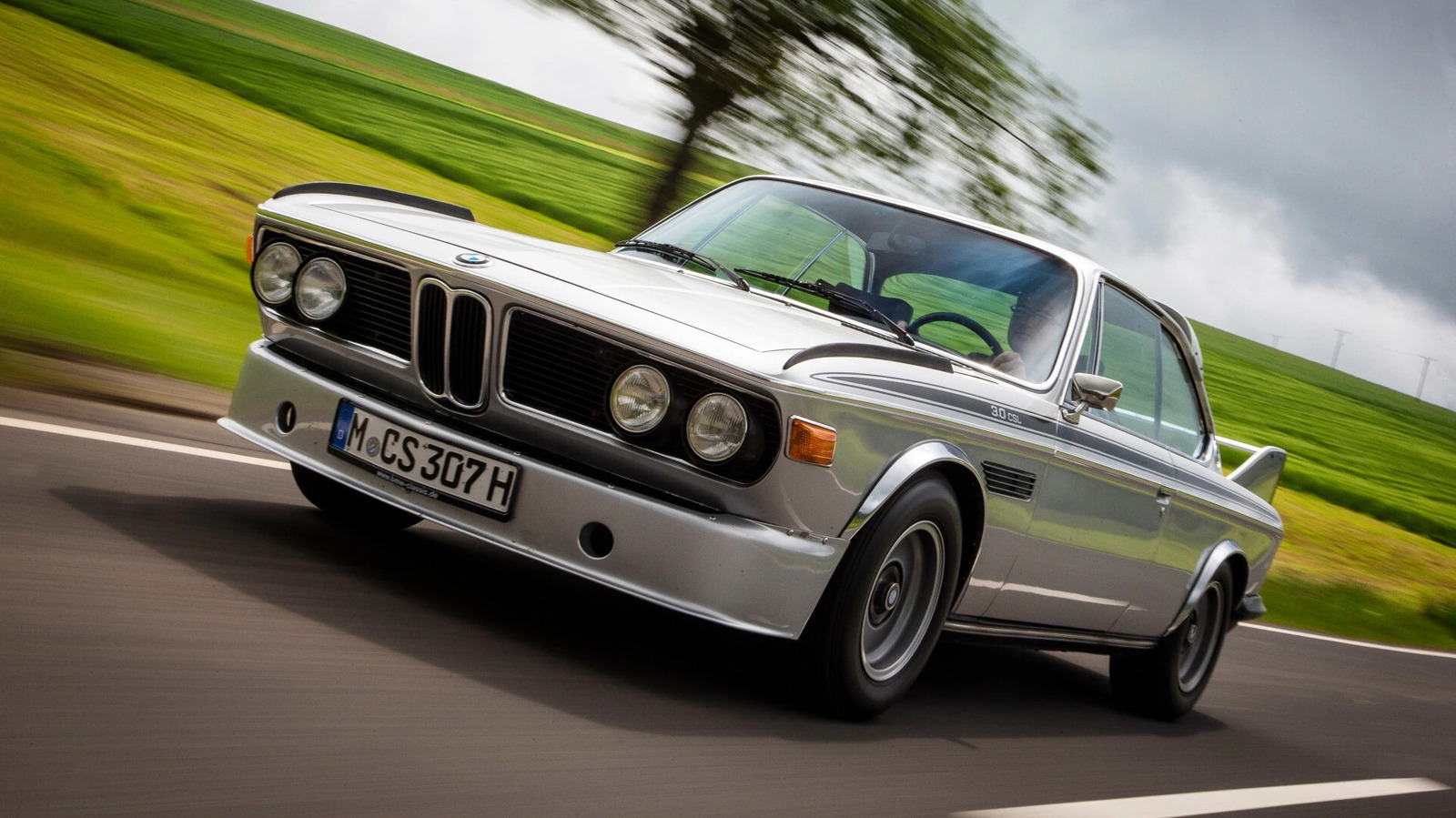
While a great-looking car in its own right, the base model isn’t what we’re focusing on here. Over the following few years, BMW released different variants of the E9, with the last iteration aptly nicknamed the “batmobile”. Alongside getting a power boost to 206 horsepower, this particular homologation spec got the distinct aero kit comprising of small fins on the hood, a solid air dam under the shark nose front end, a roof spoiler, and the distinctive main wing at the rear. The race cars take the philosophy to the extreme, but even the road-going car’s aggression is incredibly hard to match.
BMW E31 8 Series
The 8 Series may now have been completely discontinued, but the largest of the two-door BMWs was a staple part of the manufacturer’s lineup throughout the late 20th century and into the 21st. Its roots can be traced back to 1989 with the first-gen E31 models, and it is still, without a doubt, one of the best-looking entries into BMW’s grand touring lineup ever.
BMW once again put aerodynamics at the forefront of the first 8 Series to make sure it performed as well or better than its key rivals at the time, subsequently giving it close relations to the M1. It features a wedge design with the same flat grille and small kidney grilles as the M1, but using interrupted lines stretching from the front all the way to the raised rear end. You’ll definitely prefer this take on the wedge front if you’re looking for something more understated. The E31 doesn’t do anything flashy, but that’s what makes it so special.
BMW M3 E30
The car that started it all for the iconic M3 nameplate. So much E9 DNA can be found in the top-spec E30’s design, but BMW made sure to still give it its own raw personality. Another homologation car from the Munich Manufacturer, the 1985 M3 doesn’t pay much attention to the grand touring elegance of its predecessor, earning its spot on this list for its all-out aggression instead.
Gone is the shark nose front fascia, replaced by a completely squared front end. In fact, pretty much every section a swooping curve should be is instead closed off by sharp angles, with the widebody-type arches being the main way the E30 M3 gets some shape. But it’s the simplicity of the first M3 that makes it so easy to love, with its design being proven effective time and time again as one of the most ground-breaking race cars of the 1980s.
BMW M2 CS
Given the overwhelming demand for the 1 Series M Coupe, it wasn’t much of a surprise to see BMW bring the two-door coupe design back on a more permanent basis. The base 2016 model could easily feature on this list by itself, essentially being a curvier, more compact version of the M3 of the time. Only a few years later, though, the 2020 M2 CS took the coupe even further than the Competition trim.
Visually, the CS model looks very similar to the first-gen Competition, but it adds a few pieces, like the larger splitter and central air vent on the hood, to evoke some more aggression. At the rear, the carbon fiber ducktail spoiler is another small addition that actually makes a massive difference to the back-end profile, once again making the car look more visceral without disrupting the perfectly proportioned curves and edges that complete the wide stance. While the all-new M2 CS is stunning, it’s also the perfect example of how blending aggression with the sleekness of the first iteration makes for a great looking vehicle from every angle.
BMW E52 Z8 Roadster
Almost 50 years after the 507 took BMW into new territory, the manufacturer decided to honor the car with what was essentially a modern iteration of the grand tourer in 1999. The Z3 helped to keep the philosophy alive, but the short-lived E52 Z8 Roadster blended performance with luxury on the same level as the 507. Like the ’50s roadster, the Z8 had a noticeably long hood to house the engine, in this case a 400-horsepower V8. Further forward, the double grille design makes a return, but in the sleeker manner that you’d expect with a late ’90s GT car.
The arches of the Z8 still bulge up slightly, but not as much as the 507, resulting in what’s almost one continuous curve covering the entire front end. The sides are also a touch flatter, but the side vents that featured on the 507 perfectly complement the minimalistic approach. The rear of the car also swoops down, but the more muscular, defined bumper helps the Z8 to achieve its modern take on the classic design style.
BMW M3 Touring
There may not be a lot of choice, but we want to include a wagon on this list. Considering how few of these cars BMW has built compared to sedans over the segments, there aren’t actually that many to choose from. But in recent years, the manufacturer has started to expand its presence in the segment, with the likes of the M5 Touring. However, the best-looking of the touring models has unfortunately been left out Stateside.
The M3 Touring is essentially the same car as the sedan M3. The once-controversial vertical kidney grille design introduced in 2020 does look great on the sedan, but the much larger dimensions of the Touring complement the larger openings up front perfectly. Hard lines and edges throughout the rest of the car also stem from the centerpiece grille, allowing them to flow uninterrupted from start to finish.
BMW M8 Competition
The first iteration of the M8 is one of the best-looking BMWs ever built, and the same can be said for the latest. Particularly in its Competition form, the most recent G15 model manages to retain some of the core design aspects of the original, all while implementing the modern BMW philosophy in all the right places, whether it’s the coupé or convertible model.
The main element that calls back to the E31 is using a wedge-style design, which, while not quite as aggressive as the original, gives the M8 Competition an imposing stance that’s missing elsewhere in the recent lineup. By using the wedge design, the M8 can keep the traditional kidney grille, retaining the minimalism that other new BMWs didn’t quite manage to replicate. Looking over the roof and to the back, the flow of the M8 Competition is never broken, achieving an ideal balance between performance and luxury.
BMW E36 Z3 Coupe
At the complete opposite end of the 8 Series stood once the Z3. In more recent times, we’re more familiar with the Z4 representing BMW within the two-door sports car segment, but in the late ’90s and early 2000s, the Z3 was the ultimate compact car from the brand. The first and only E36 generation didn’t just offer the standard roadster model, but a highly unique and spectacular ‘coupé’ model that uses a wagon-style shooting brake design.
While essentially a hatchback, the dimensions and proportions were unlike anything else you could buy at the time. As it’s still a two-door sports car beneath the new roofline, the front-end stays super low-slung. The “clown shoe” nickname may be accurate, but that somehow isn’t a bad thing. The new shooting brake rear combined with the long front end actually worked perfectly as far as proportions go, adding plenty of muscle without anything feeling out of place.
BMW E24 6 Series
Directly after the E9 led the grand touring segment, BMW replaced it with the first-ever 6 Series: the E24. When parking both side by side, the two do share quite a few similarities, but the latter puts much more of a focus on the luxury side of the GT, building what’s still one of the sleekest executive cars from the 1970s. This was one of the first BMWs to use hard lines and angular corners, similar to what’s still used today, deviating slightly from the emphasis on flowing curves that the E9 used.
Similarities between the two include the return of the shark nose, which might actually look more at home on the E24 due to the sharp angles and flatness. The protruding bumper adds some visual interest, almost creating symmetry from a side view with the roofline and long rear deck. The small ducktail spoiler is also spot on for rounding off the sporty yet functional design style.
BMW 2000 CS
We’ve briefly mentioned the New Class BMWs (Neue Klasse in German) that led the company through the mid 1960s and early 1970s. The Neue Klasse name is attached to very different cars today, but at the very end of the original New Class run came the 2000 CS, which helped establish the design approach that so many other cars on this list would subsequently follow. While nowhere near as imposing as some of the later models, the 2000 CS was still the top-spec performance model, but it opted for a much simpler, classy design to ensure it appealed to those wanting luxury.
The 2000 CS is another older BMW to utilize the shark nose, but it’s not as aggressive as the likes of the E9 or E24 6 Series. The drop-off from the hood is still noticeable, but the front fascia has much more of a gentle curve to match the rest of the car’s proportions. To divide the top and bottom halves, a single silver strip runs from the rear bumpers and around the top of the headlights, which is a subtle yet hugely important aspect adding some needed contrast.
BMW E46 M3 Coupe
A very nostalgic car for anyone born in the 1990s and the early 2000s, the 2000 E46 M3 was one of the defining performance cars for a generation. Like so many others, it wasn’t trying to be bold or flashy, rather reliable on a smooth, understated appearance that has aged better than so many of its rivals of the time. Particularly in its Coupe form, the E46 easily has one of the most recognizable silhouettes from the blend, essentially being a mixture of so many M division cars that came before it.
While it has a very distinct, aggressive stance that makes it look like a powerhouse before you even look at the renowned S54 engine, the E46 does a great job of softening its edges without deviating too far from the classic boxy proportions. BMW purposefully made the windshields steeper to make it look more tight-knit. To subtly break things up, though, BMW includes subtle lines and dividers, most notably with the “powerdome” hood, to help push the aggressive image further.
BMW M4 GTS
For quite a while now, the M3 and M4 have been mechanically identical, while also sharing plenty of visual traits as well. In 2016, though, the M4 got a special track-focused, street legal trim named GTS that the M3 never got. The coupé body style definitely made it the easy option, and the result is the best-looking version of the first-gen models.
As soon as the standard M4 was released in 2014, the coupe body style couldn’t have fitted better with the F82 philosophy. This is another BMW that uses curvature around its relatively simple, raked shell to create one of the sleekest-looking cars in the segment, but the GTS model uses a pretty extreme aero kit for the standards of BMW, allowing it to tackle any circuit with ease. The prominent front splitter and rear wing are the selling points here, contrasting the flowing lines with harsh carbon fiber at both ends.
BMW 2002 Turbo
In the 1960s, BMW offered more compact versions of its New Class models, with one of the most prominent being the 02 sedan. Given its body shape, the 02 was much closer to a sedan rather than a coupé, being more functional but inherently sportier thanks to its smaller size and coupé-esque design. Then, in 1973, BMW took the industry by storm with the legendary 2002 Turbo.
The core foundations of the 02 model can still be seen in the 2002 Turbo, but BMW took every opportunity to make it look as fast and capable as possible. The shark nose was less prominent here compared to the likes of the E9, but the new, giant air dam creates one of the most distinct, angular front fascias BMW has ever come up with. Better yet, the splitter connects to the bolt-on arches. It didn’t get much more rugged than that in the early ’70s. At the rear, the ducktail spoiler is also one of the most prominent in any BMW, stretching from the wraparound chrome trim and deeper into the rear deck.