1976 – 2026: Celebrating 50 Years of NASA’s Viking Missions
When Viking 1 safely touched down on Mars on July 20, 1976—exactly seven years after Apollo 11 landed on the Moon—it became the first U.S. mission to successfully land on Mars and return data from the surface. The landing site along the western slopes of Chryse Planitia (22.483° N., 47.94° W.), which translates to “Golden Plain” in Greek, seems appropriate for the golden anniversary. Viking 2 followed with a second successful landing on September 3, 1976, in the flat, rocky plain of Utopia Planitia (47.968° N, 225.71° W) roughly 6,460 km (4,000 mi) away. Together, the twin spacecraft heralded a new era of robotic exploration and reshaped humanity’s understanding of the Red Planet as a dynamic, complex world worthy of long‑term scientific investigation.
First panoramic image taken from the surface of Mars by the Viking 1 lander at Chryse Planitia, July 20, 1976. The 300° panoramic sweep revealed a relatively flat, desert-like landscape featuring angular rocks of various sizes and fine-grained material reminiscent of sand dunes. In the right foreground are the lander’s high gain dish antenna, camera calibration charts, and a mirror for the Viking magnetic properties experiment. Seen in the left foreground is the lander’s low gain antenna used for the receipt of commands from Earth.
First color image taken by the Viking 2 lander at Utopia Planitia, nearly 6,460 km (4,000 mi) away from the Viking 1 landing site. The rusty reddish surface of Mars is attributed to the weathering of iron-rich volcanic rocks.
The Viking Project consisted of two identical spacecraft, each made up of an orbiter-lander combo, that were launched from Cape Canaveral, Florida, on August 20 (Viking 1) and September 9 (Viking 2),1975. The mission’s primary objective was simple but profoundly ambitious: to search for evidence of life on Mars, while also studying the planet’s geology, surface chemistry, meteorology, and atmospheric structure. The design of the Viking orbiters was derived from previous Mariner spacecraft, albeit with more “muscle” in the form of larger propellant tanks and enhanced brainpower via its instrumentation package. The orbiters were engineered to provide safe passage to Mars, serve as a communications relay system, perform landing site reconnaissance, and conduct high-resolution mapping or imaging of the Martian surface.
Together, the Viking orbiters carried an advanced suite of scientific instruments, including visible‑wavelength imaging systems, ultraviolet spectrometers, radio science experiments, and the Infrared Thermal Mapper (IRTM). The IRTM was especially important because it measured albedo and thermal inertia, revealing how the Martian surface or atmosphere heats up and cools down. Collectively, these data helped scientists distinguish between rock, dust, and sand, guided the selection of safe landing sites, and provided early insights into surface composition and atmospheric behavior. Once in orbit, each orbiter deployed its lander, which descended through the Martian atmosphere using a combination of parachutes and retrorockets.
The Viking Project consisted of two twin spacecraft, each consisting of an orbiter (top) and lander (bottom). Instrumentation packages aboard the orbiters were tailored for aerial reconnaissance, mapping, imaging, and communication relays. The landers were outfitted with a unique set of scientific tools that collected data about the geology, geochemistry, biology, and meteorology from the Martian surface.
Immediately after separating from its companion orbiter, the Viking lander entered a fully automated entry–descent–landing sequence, necessitated by the communications delay between Earth and Mars. During its nearly year-long journey of more than 805 million kilometers (500 million miles), the increasing distance stretched one-way signal transmission to roughly 20 minutes—far too long for real-time control. As a result, sophisticated autonomy was embedded in the lander’s “brain,” formally known as the guidance control and sequencing computer. Instructions stored in its memory enabled the spacecraft to operate independently without human intervention for its first 22 days on the Martian surface.
Equipped with a wide array of external instruments—including a sampling arm, cameras, a meteorology boom, pressure sensors, a seismometer, and a spectrometer—the Viking landers owed a significant technological debt to the earlier uncrewed Surveyor missions to the Moon. Two 360-degree cylindrical scanning cameras, known as facsimile cameras, captured sweeping panoramas and detailed views of a rocky, windswept landscape, profoundly reshaping scientific and public perceptions of Mars. As the lander’s “eyes,” these cameras were extensively tested in the deserts of Colorado and California prior to launch; one panoramic image even includes the NASA imaging team in an early form of a selfie.
On January 7, 1981, the Viking 1 lander was formally renamed the Thomas A. Mutch Memorial Station in honor of Thomas “Tim” Mutch, leader of the camera team. The engineering model of the Viking lander on display at the Smithsonian National Air and Space Museum once included an 8-by-10-inch stainless steel plaque and accompanying letter commemorating the designation of the memorial station. As a memorial to Mutch and a challenge for future exploration, the plaque is intended to be flown to Mars on a future mission and affixed to the side of the Viking 1 lander. In July 2001, the Viking 2 lander was renamed the Gerald Soffen Memorial Station after Gerald Soffen, the NASA project scientist of the Viking Program. Collectively, the Viking landing site memorials are part of a long tradition in which NASA celebrates scientists and other icons related to planetary exploration.
The Viking imaging team “selfie,” captured by one of the lander’s sweeping facsimile cameras during camera testing As the camera slowly panned to collect the panoramic image, several members of the team had a little fun and repositioned themselves to appear multiple times.
The search for life on Mars was central to the overall mission of the Viking Project but presented several major obstacles with respect to planetary protection protocols and engineering design. To minimize contamination by terrestrial microorganisms, the spacecraft were assembled in ultra-clean rooms and rigorously sterilized, including being baked in large ovens for approximately 20 hours at 112°C (233°F). The lander’s descent engines incorporated an innovative system of 18 nozzles that dispersed exhaust gases into a wide, gentle fan, preventing the Martian soil from being excessively heated, scoured, or contaminated by rocket exhaust. These precautions were intended to preserve the landing site and protect any potential indigenous life forms.
The interior of the landers featured three biology experiments that searched for signs of microbial metabolism by exposing Martian soil to nutrients and monitoring for chemical responses: the Labeled Release (LR), Gas Exchange (GEx), and Pyrolytic Release (PR) experiments. These were complemented by a gas chromatograph–mass spectrometer (GCMS), which searched for organic molecules in the soil. While the biological experiment results proved intriguing and controversial, the absence of detected organics complicated their interpretation—a scientific debate that continues to this day. Although we may not know for sure (yet) whether life existed on the Red Planet in the past or may even be there now, we do know that life, in the form of humans from Earth, will visit Mars one day.
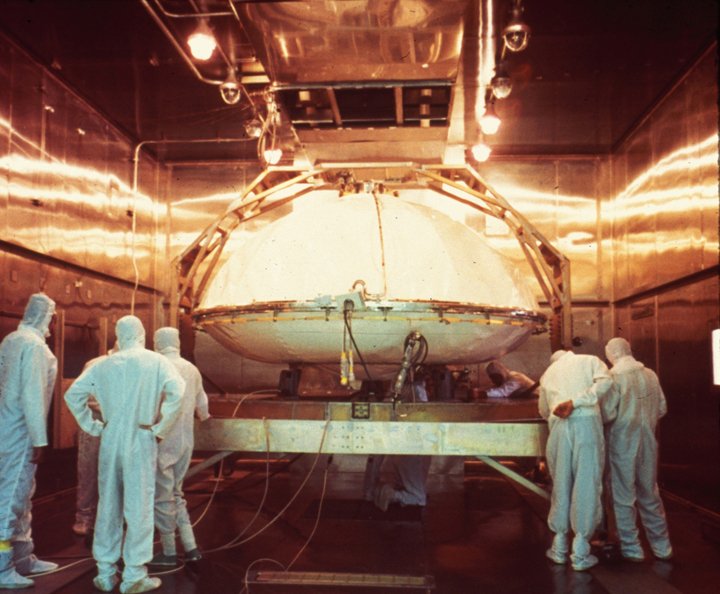
Viking’s tantalizing task of finding life on Mars required several planetary protection protocols to reduce terrestrial contamination and error. One of the landers, seen here in its protective bioshield, is being prepared for dry heat sterilization in a large oven.
Major Scientific Outcomes of the Viking Program
- Viking marks the first successful, long-duration landing mission on Mars. Although the Soviet lander Mars 3 touched down on the Red Planet in December 1971, it failed less than two minutes after landing. The Viking missions were originally planned to last only 90 days after landing, but both the landers and orbiters operated far beyond their design lifetime. The overall mission came to an end on May 21, 1983, roughly seven years after the historic landing of Viking 1.
- Completed high-resolution global mapping and imaging of the Red Planet. In total, the two Viking orbiters mapped about 97% of the Martian surface at 150 to 300 m resolution, with selected regions captured at 8 m resolution. Collectively, both orbiters completed 2,195 orbits around Mars and captured a total of 52,663 images of the planet and its two satellites, Phobos and Deimos.
- Discovered early evidence of ancient liquid water. Images of the Martian surface returned by the Viking orbiters far surpassed expectations in quality and quantity, revealing a planet adorned with craters, canyons, volcanoes, polar ice caps, and dust storms. However, orbital images depicting valleys, channels, and outflow features built upon previous evidence collected by Mariner 9 and supported the idea that liquid water once flowed across the surface of Mars.
- Detailed characterization of the Martian atmosphere. Immediately following separation from their companion orbiters, the Viking landers collected atmospheric data during their descent stage and continued to obtain information long after touchdown. The gas chromatograph/mass spectrometer instruments provided a precise and definitive analysis of Mars’ atmospheric composition, demonstrating the planet has a thin, CO₂‑dominated atmosphere with very low concentrations of water vapor, previously undetected trace elements (e.g., N2, Ar, O, O2, and CO), and strong seasonal pressure changes associated with polar ice sublimation. Detailed atmospheric data collected during the Viking missions has been utilized to confirm the origin of Martian meteorites yielding similar gas compositions.
- First direct weather measurements on Mars. The weather instrument package aboard the landers recorded temperatures, atmospheric pressures, and wind conditions over multiple Martian seasons. These instruments revealed significant temperature swings ranging from -123° F (-86° C) before dawn to -27° F (-33° C) in the afternoon. Atmospheric pressures recorded by the Viking landers were extremely low—roughly 1% of Earth’s surface pressure—with considerable seasonal variations due to the sublimation of CO2 at the polar caps. Each landing site was impacted by numerous dust storms, with maximum wind gusts measured at nearly 120 kph (74 mph).
- Physical and geochemical analyses of Martian regolith. Each Viking lander featured a combined suite of cameras, spectrometers, and a magnetic sampling arm that allowed scientists to investigate the surface of the Red Planet like never before. One of the first images captured by the Viking 1 lander was a high-resolution image facing straight downward at the Martian surface; the historic image of the rocky, dust-covered plain provided initial insights into the grain size, clast size, and angularity of rocks at Chryse Planitia. The X-ray fluorescence spectrometers aboard the landers discovered the regolith of Mars to be rich in iron (Fe), silicon (Si), sulfur (S), and magnesium (Mg), indicating oxidized, volcanic materials and explaining the rusty, reddish color of Mars.
The first image of the Martian surface taken by the Viking 1 lander shortly after touchdown, July 20, 1976. Images and panoramas of the landing site at Chryse Planitia revealed a rocky, windswept landscape adorned with angular clasts of various sizes. For scale, the lander’s circular footpad to the right of the image is 30.5 cm (1 ft) in diameter.
- Identification of a highly oxidizing regolith environment. The Viking landers detected unexpected regolith reactivity, later attributed to iron-rich clay containing a highly oxidizing substance (e.g., perchlorate‑like chemistry), which complicate the preservation of organic compounds on the surface. The oxidizing nature of the regolith, combined with significant solar radiation exposure and dryness conditions, had led many scientists to conclude that the surface of Mars is self-sterilizing.
- First direct search for extraterrestrial life on another planet. The Viking landers’ Life Detection Package included three biology experiments that produced ambiguous results; some showed reactive responses, but none conclusively demonstrated life. According to these experiments, Mars contains no organic molecules detectable at the parts-per-billion level. Although these outcomes helped reshape astrobiology and experimental design, there is still considerable debate regarding the results of these tests as we celebrate the mission’s 50th anniversary.
- Establishment that modern Mars is cold, dry, and biologically hostile. Viking demonstrated that modern Mars is extremely cold, dry, and exposed to significant amounts of solar radiation, guiding future missions to search for life in ancient terrains, subsurface environments, or volcanic regions instead of the exposed, desert-like plains of Chryse Planitia or Utopia Planitia.
- Setting a foundational legacy for future missions. The Viking “twins” proved to be valuable workhorses of discovery, returning a trove of data on Mars and its satellites; many of its achievements were built upon previous mission designs including Mariner and Surveyor. Data from the Viking Program continues to help define landing systems, environmental expectations, planetary protection methodologies, and life‑detection strategies used by subsequent robotic missions to Mars, including Pathfinder, Phoenix, Spirit, Opportunity, Curiosity, and Perseverance.