$4 million investment to fuel quantum, microbial research at ASU
Two Arizona State University researchers have earned prestigious National Institutes of Health awards, bringing nearly $4 million in federal investment to Arizona to advance quantum sensing and microbial research.
The work has the potential to improve human health and create new quantum technologies.
Known as the Maximizing Investigators’ Research Award, or MIRA, it is among the most competitive distinctions a biomedical researcher can achieve. The award provides millions of dollars over five years to support each scientist’s entire research program.
Unlike most awards, which fund a single project, MIRA gives researchers the flexibility and stability to explore new ideas and spend more time making discoveries with potential national impact.
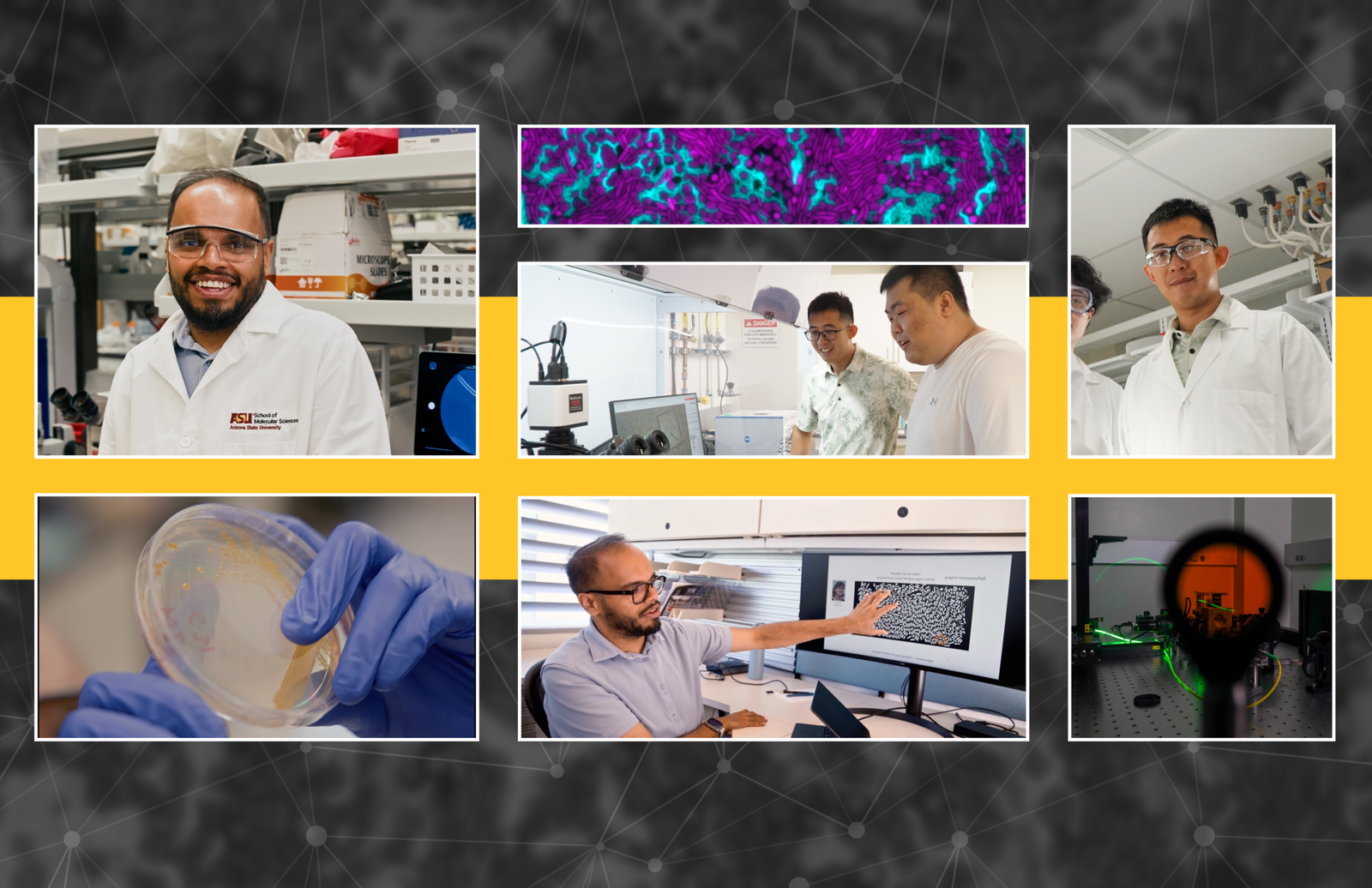
The recipients are Mouzhe Xie and Glen D’Souza, assistant professors in ASU’s School of Molecular Sciences. While their research explores different scientific questions, both are working to better understand the fundamental processes that could lead to healthier lives, new biomedical technologies and scientific discoveries.
“Receiving a prestigious NIH MIRA award is a tremendous accomplishment for both Professor Xie and Professor D’Souza,” said Ian Gould, President’s Professor and interim director of the School of Molecular Sciences.
“A MIRA award is fundamentally different from a traditional research grant. Rather than funding a single, predefined project, it reflects the NIH’s confidence in an investigator’s creativity, judgment and scientific vision, giving exceptional researchers the flexibility to pursue the most promising opportunities as new discoveries unfold.
“In essence, a MIRA award is an investment not in a specific research proposal, but in Professor Xie and Professor D’Souza themselves as scientists. This recognition speaks to their outstanding track records, the significance of their contributions to their respective fields, and the confidence that the NIH has in their future discoveries.”
Developing quantum sensors
Xie received approximately $2 million to develop quantum sensors that could help scientists study what happens inside individual living cells. His lab develops ultrasensitive quantum sensors built from tiny defects in diamonds that can detect faint magnetic signals at distances conventional instruments cannot reach.
By measuring biological activity one cell at a time, Xie’s research could help scientists better understand how diseases develop and progress, opening the door to more precise diagnostic tools and future biomedical advances.
“Quantum sensing is poised to make transformative impacts in biomedical research over the coming decades,” Xie said. “This research brings together expertise from multiple disciplines to advance quantum sensors for single-cell analysis, paving the way for future disease diagnosis beyond current methods.”
Understanding microbial communities
D’Souza received approximately $2 million to study how microbial communities form, compete and evolve. His lab combines advanced imaging and single-cell analysis to observe bacteria interacting in real time, helping answer fundamental questions about how microbial ecosystems form, function and evolve.
Those discoveries could ultimately improve scientists’ ability to engineer beneficial microbial communities for applications in human health, agriculture and biotechnology, including new approaches to fighting infectious disease.
Last year, D’Souza and collaborators published research in Science showing that some bacteria use microscopic molecular weapons to kill and eat neighboring cells when nutrients become scarce. The new NIH award will allow his lab to expand that work while recruiting postdoctoral researchers and research staff.
“Microbial communities underpin ecosystems, agriculture, biotechnology and human health, yet we still know remarkably little about the rules that govern how microbes interact with one another,” said D’Souza, who is also a core faculty member at the Biodesign Center for Fundamental and Applied Microbiomics. “This award gives our lab the freedom to pursue those fundamental questions while developing new technologies that allow us to observe microbial interactions one cell at a time.”