5G IoT Market Size & Share
5G IoT Market Size
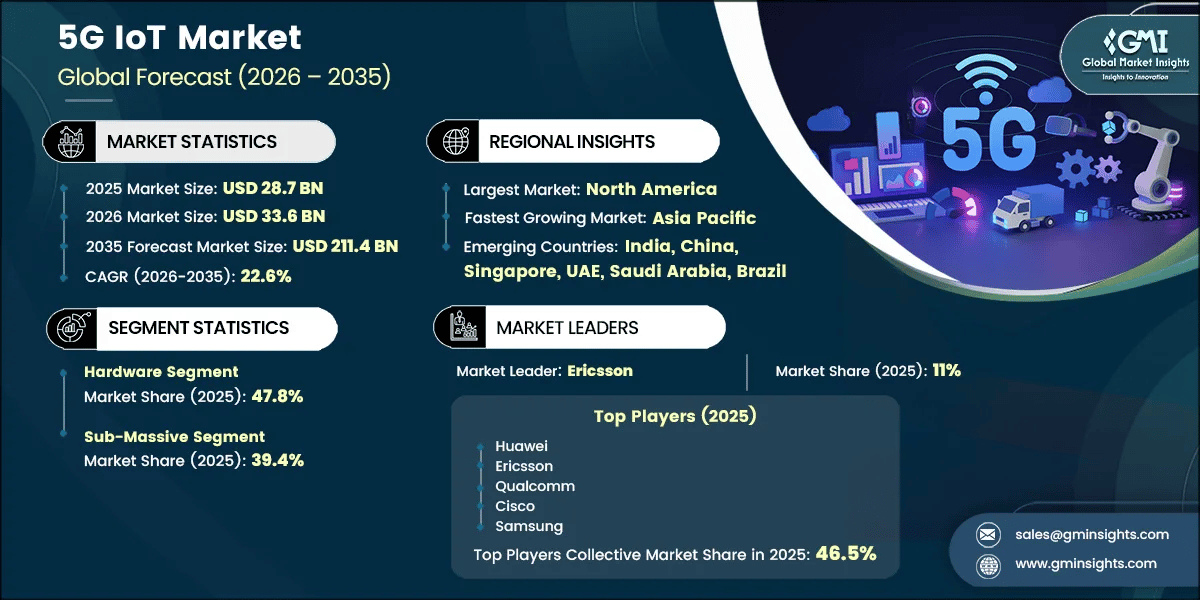
The global 5G IoT market was valued at USD 28.7 billion in 2025. The market is expected to grow from USD 33.6 billion in 2026 to USD 211.4 billion by 2035, at a CAGR of 22.6% during the forecast period, according to the latest report published by Global Market Insights Inc.
5G IoT Market Key Takeaways
2025 Market Size
$ 28.7 Billion
2026 Market Size
$ 33.6 Billion
2035 Forecast Market Size
$ 211.4 Billion
Regional Dominance
Largest Market
North America
Fastest Growing Region
Asia Pacific
Key Players
-
Market Leader: Ericsson led with over 11% market share in 2025.
-
Leading Players: Top 5 players in this market include Huawei, Ericsson, Qualcomm, Cisco, Samsung, which collectively held a market share of 46.5% in 2025.
Key Market Drivers
- Growth of private 5G networks
- Adoption of 5G RedCap technology
- Integration of AI and edge computing
Opportunity
- Expansion of private 5G deployments
- Growth of smart manufacturing
- Development of edge AI applications
Challenges
- High deployment costs
- Security and interoperability concerns
Get Market Insights & Growth Opportunities
Download Free PDF
Increasing adoption of connected devices and industrial automation is driving demand for 5G IoT solutions in manufacturing, healthcare, automotive, and logistics. Cable and Fixed Wireless broadband connections had reached approximately 2.6 billion by the end of 2025, up from around 1.4 billion at the end of 2021 according to Ericsson, due to growing far more enterprise connectivity demands. Similar to IoT broadband connections had reached just over two billion in Q3, driven heavily by critical IoT systems.[1]
5G IoT guarantees ultra-reliable, low latency and massive device connectivity for mission critical applications. GSMA states that global IoT connections to smart infrastructure, industrial automation and connected assets is likely driven more than 30 billion by 2030.[2]
According to GSA, more enterprises are replacing their conventional network elements for private 5G networks to attain the operational efficiency, security acceleration and real time data processing. More than 1,600 organizations around the world had deployed or planned private mobile networks by 2025, with manufacturing representing a primary adoption sector.[3]
The 5G IoT ecosystem is being fortified by developments in edge computing, artificial intelligence and 5G standalone networks. Ericsson said that global 5G subscriptions went over the 2 billion mark by 2025 and opened up viable IoT apps needing advanced connectivity performance.
Escalate Industry 4.0 initiatives drive wider adoption of connected robots, autonomous vehicles and smart factory solutions. According to International Data Corporation, global spending on IoT solutions is rising as enterprises concentrate on automation, predictive maintenance and operational visibility.[4]
To get key market trends
Download Free PDF
5G IoT Market Trends
RedCap technology in 5G is another trend that helps create cheap 5G IoT devices that can be used for industrial sensors, wearables, and other enterprises. Ericsson says that RedCap becomes increasingly popular with the introduction of commercial deployments by operators to cover the gap between LTE IoT and 5G applications.
The use of private 5G networks increases in enterprises that need their own connectivity for automation and mission-critical services. According to GSA, more than 1,600 private mobile networks have been announced globally, and manufacturing and industrial segments have become key consumers of such solutions.
Integrating edge computing improves performance of 5G IoT devices because of local data processing and the decrease of latency. Enterprises install edge computing platforms to run such applications as autonomous robots, predictive maintenance, and real-time monitoring within industrial environments.[5]
Integration of AI into 5G IoT platforms changes the connected operations thanks to automation and data analysis. IDC says that global spending on artificial intelligence and IoT technologies is constantly increasing.
5G IoT Market Analysis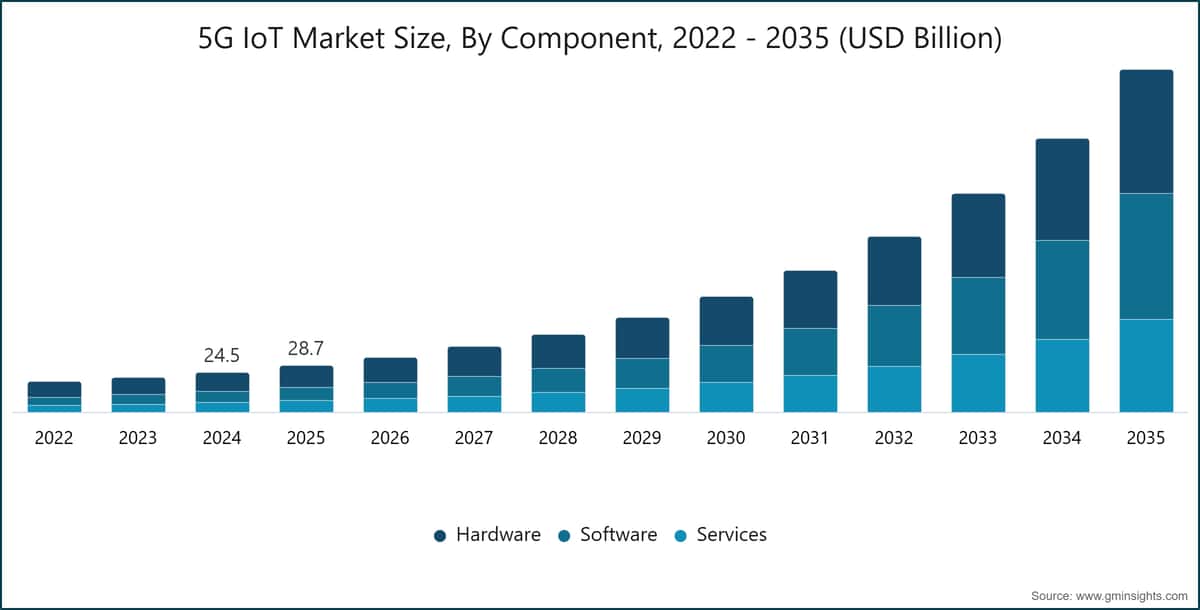
Based on component, the market is segmented into hardware, software and services. The hardware segment dominates the market with the highest revenue share of 47.8% in 2025.
- Hardware is seeing more demand, owing to the rising adoption of 5G enabled devices in smart manufacturing, vehicles, and industrial automation. Per Ericsson, there were around 2.6 billion Broadband and Critical IoT connections by the close of 2025, and that’s basically fueling demand for hardware that has advanced connectivity abilities.
- The 5G IoT modules and chipsets are getting a noticeable boost in adoption, mainly because there are stronger needs for steady communications and low latency, like in real time use cases. Companies such as Qualcomm, Huawei, and Quectel are widening their portfolios with products that are designed for industrial, plus automotive connectivity requirements.
- The software market keeps growing because more teams are adopting IoT platforms, device management software, analytics platforms and cybersecurity software applications. In general, enterprises are taking on these software solutions so they can handle connected devices, make sense of data, and improve day to day operations.
- IoT software platforms offer features like device management, predictive upkeep, and even decision support in multiple industries. IDC notes that spending on IoT offerings is still trending upward worldwide, as organizations stay on their digital transformation path.
- System Integration services are also becoming more important, given the need for interoperability among networks, devices, and enterprise applications. Enterprises are teaming up with service providers for quicker rollout of private 5G and industrial IoT solutions, without too much delay in alignment.
Learn more about the key segments shaping this market
Download Free PDF
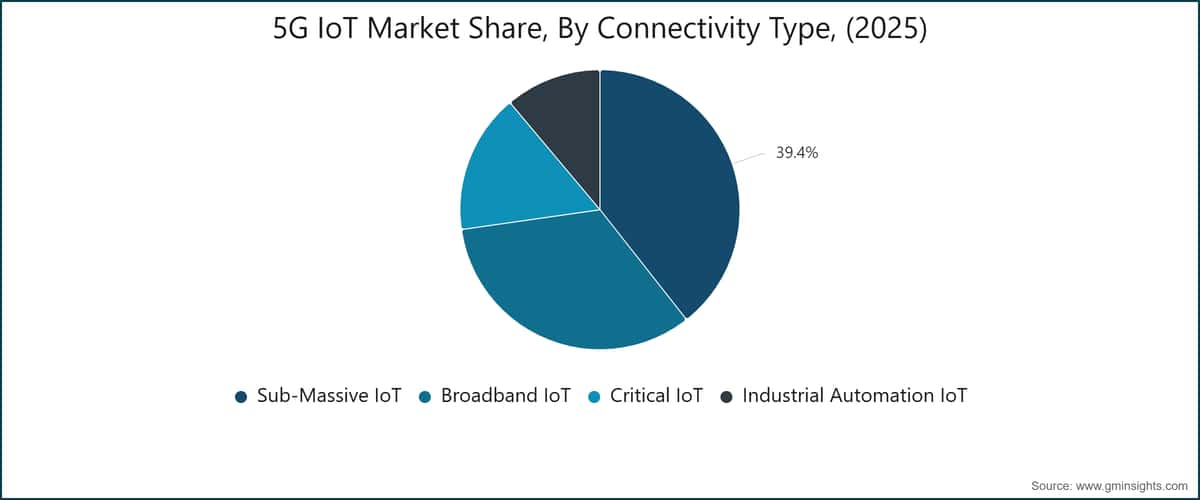
Based on connectivity type, the market is segmented into sub-massive, broadband, critical and industrial automation. The sub-massive segment dominates the market with the share of 39.4% in 2025 and is expected to maintain its leadership position during the forecast period.
- The sub massive category includes smart meters, environmental sensors, asset tracking applications and agriculture monitoring. For all of these applications, long battery life, broad coverage and cost-efficient connectivity are essential.
- Subcategory benefits from rising popularity of connected infrastructure and smart city solutions. According to GSMA estimates, the total number of IoT connections will grow past 30 billion in 2030.
- Connected vehicles and industrial monitoring are some of the drivers of the Broadband IoT market. Connectedness is crucial for real-time data exchange and operation monitoring of these applications.
- Critical IoT usage is growing because of the need for real-time control and automation. Such IoT applications are used in cases when any network malfunction can be dangerous, or cause problems with productivity or efficiency.
- Critical IoT implementation is facilitated by 5G standalone networks due to their high reliability and performance. As stated by Ericsson, 5G standalone network deployments are becoming more common around the world.
- Industrial Automation IoT implementation is driven by the rising popularity of Industry 4.0 initiatives and solutions for smart manufacturing. It includes such applications as connected machinery, robotics, automated production systems, and machine vision.
Based on deployment mode, the market is segmented into public 5g network, private 5g network and hybrid 5g network. The public 5g network segment dominates the market with the largest share in 2025 and is expected to maintain its leadership throughout the forecast period.
- Public networks provide scalable connectivity for enterprises deploying IoT solutions without investing in dedicated network infrastructure. Telecom operators are expanding enterprise 5G services to support connected devices and industrial applications.
- Public 5G networks remain suitable for applications requiring broad geographic coverage. Connected vehicles, logistics tracking, and smart city applications commonly rely on public network connectivity.
- Private 5G networks are gaining strong adaption among enterprises requiring secure, dedicated, and reliable connectivity. These networks enable organizations to control performance, security, and data management within their operational environments.
- Manufacturing, energy, and logistics industries are major adopters of private 5G networks. According to GSA, more than 1,600 organizations globally had deployed or planned private mobile networks by 2025.
- Hybrid 5G networks combine public and private network capabilities to provide flexible connectivity solutions. Enterprises use hybrid deployments to balance coverage, security, and operational requirements.
- The segment is gaining adoption among organizations operating across multiple locations. Hybrid networks allow enterprises to maintain private connectivity in critical areas while using public networks for wider coverage.
Based on organization size, the market is segmented into large enterprises and small & medium enterprises. The Large Enterprises segment dominates the market with the highest share in 2025 and is expected to maintain its leading position throughout the forecast period.
- Large Enterprises represent the primary adopters of 5G IoT solutions due to their complex financial operations, high volume of employee expenses, extensive business travel activities, and stringent compliance requirements. These organizations utilize 5G IoT platforms to automate expense reporting, reimbursement processing, corporate card management, travel expense tracking, and accounts payable workflows across multiple departments and geographic locations.
- The increasing emphasis on financial transparency, cost optimization, and operational efficiency is driving large enterprises to invest in advanced 5G IoT systems integrated with enterprise resource planning (ERP), accounting, and human resource management platforms. Leading organizations are increasingly leveraging artificial intelligence (AI), machine learning, and analytics capabilities to gain real-time visibility into spending patterns and improve decision-making.
- Growth is driven by increasing digitalization among SMEs, rising awareness of expense automation benefits, and the growing availability of affordable cloud-based subscription models. SMEs are adopting 5G IoT solutions to eliminate manual processes, streamline employee reimbursements, improve budgeting accuracy, and gain better control over operating expenses. The ability of modern platforms to provide enterprise-grade capabilities without substantial upfront investments is accelerating adoption across small and medium-sized businesses globally.
Based on end-use industry, the market is segmented into manufacturing, healthcare, energy & utilities, automotive & transportation, supply chain & logistics, government & public safety, agriculture and other. The manufacturing segment dominates the market with the largest share in 2025 and is expected to maintain its leadership position throughout the forecast period.
- BFSI (Banking, Financial Services, and Insurance) represents the largest end-user segment for 5G IoT solutions due to the industry’s high transaction volumes, strict regulatory requirements, extensive business travel activities, and focus on financial transparency. 5G IoT platforms help BFSI organizations automate expense reporting, policy compliance, reimbursement processing, corporate card management, and audit tracking while reducing operational costs and minimizing the risk of fraud. Financial institutions increasingly leverage artificial intelligence (AI), automation, and advanced analytics to gain greater visibility into employee spending and ensure compliance with evolving regulatory standards.
- IT & Telecom is the fastest-growing segment and is expected to register a strong CAGR during the forecast period. Growth is driven by the expanding remote workforce, increasing employee mobility, and significant spending on travel, cloud services, software subscriptions, and telecommunications infrastructure. IT and telecom companies are adopting advanced 5G IoT solutions to streamline reimbursement processes, manage distributed workforces, optimize operating costs, and improve spend visibility. The increasing adoption of cloud-based platforms and digital finance tools further supports market expansion within this segment.
- Healthcare & Life Sciences is witnessing significant adoption of 5G IoT solutions as healthcare providers, pharmaceutical companies, and life sciences organizations seek to improve financial efficiency and regulatory compliance. These solutions help automate travel expenses, procurement-related costs, employee reimbursements, and operational spending while maintaining accurate audit trails. Growing investments in healthcare digitalization and increasing operational complexity are driving demand for automated 5G IoT platforms across the sector.
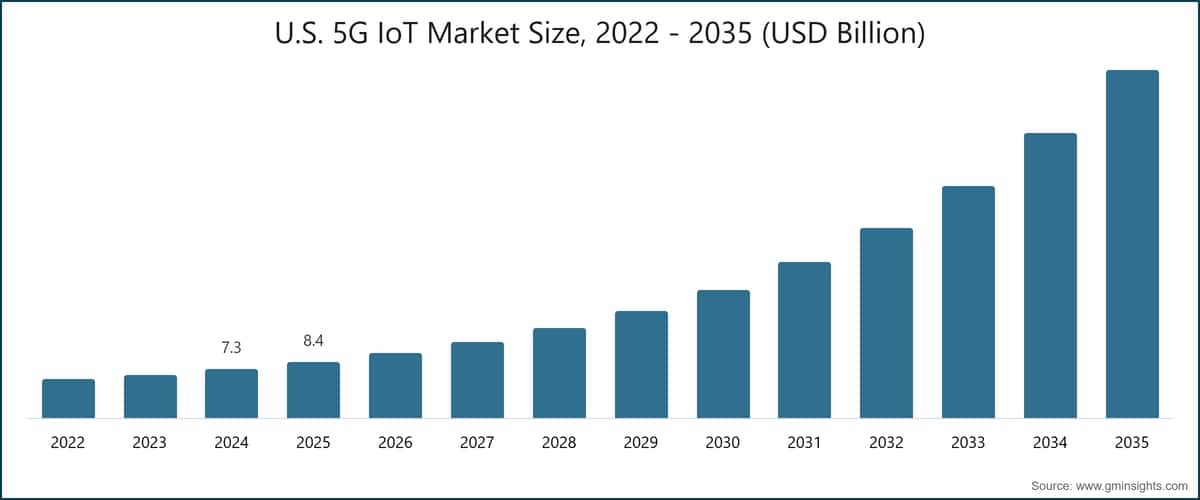
U.S. dominated the 5G IoT market in North America with around 88.3% share and generated USD 8.4 billion in 2025.
- North America is a leading region in the 5G IoT industry due to early adoption of 5G infrastructure, private networks, and enterprise digital transformation initiatives. The region has strong demand from manufacturing, automotive, healthcare, and logistics sectors requiring advanced connectivity solutions.
- The United States represents the largest market in the region due to extensive 5G network deployment and strong investment in industrial automation. According to GSMA, North America is among the leading regions in 5G adoption, supported by high enterprise connectivity demand.
- Private 5G networks are gaining traction among manufacturing facilities, ports, warehouses, and utilities companies. Organizations are deploying 5G IoT solutions to improve automation, asset monitoring, and operational efficiency.
- The presence of major technology companies such as Qualcomm, Cisco, and Verizon supports regional market growth. Increasing investments in edge computing, artificial intelligence, and connected infrastructure are expected to drive future adoption.
The Germany 5G IoT market in Europe is expected to experience significant and promising growth from 2026 to 2035.
- Europe is a significant market for 5G IoT due to strong industrial automation initiatives, regulatory support, and increasing deployment of private wireless networks. Countries including Germany, the United Kingdom, and France are leading adoption across industrial sectors.
- Manufacturing remains a major application area due to Industry 4.0 initiatives and demand for smart factory solutions. According to the European Commission, digital transformation of industries remains a key priority across European economies.
- Private 5G networks are expanding across automotive plants, logistics hubs, and energy facilities. Companies are using 5G IoT solutions for robotics, predictive maintenance, and real time operational monitoring.
- The presence of leading telecom companies such as Ericsson, Nokia, and Deutsche Telekom strengthens the regional ecosystem. Increasing focus on connected mobility, industrial automation, and sustainable infrastructure will support market growth.
The 5G IoT market in China is expected to experience significant growth from 2026-2035 with a CAGR of 23.8%.
- Asia Pacific dominates the 5G IoT industry due to large scale manufacturing activity, rapid 5G deployment, and increasing adoption of smart infrastructure solutions. China, Japan, South Korea, and India are major contributors to regional growth.
- China represents the largest market due to extensive industrial automation investments and strong domestic 5G infrastructure development. According to GSMA, Asia Pacific is expected to account for a significant share of global 5G connections due to rapid network expansion.
- Manufacturing, automotive, and electronics industries are adopting 5G IoT for smart factories, connected equipment, and automated production systems. Government initiatives supporting digital infrastructure are accelerating enterprise adoption.
- The region benefits from the presence of major technology providers including Huawei, ZTE, Samsung Electronics, and Qualcomm. Increasing private network deployments and smart city projects will continue driving regional market expansion.
The 5G IoT market in Brazil is expected to experience significant and promising growth from 2026 to 2035.
- Latin America is an emerging market for 5G IoT due to increasing telecom investments, digital transformation initiatives, and growing demand for connected solutions. Brazil, Mexico, and Chile are leading regional adoption of enterprise IoT applications.
- The automotive, agriculture, logistics, and energy sectors are adopting 5G IoT solutions to improve monitoring, automation, and operational efficiency. Growing demand for connected infrastructure is creating opportunities for telecom operators and technology providers.
- 5G network expansion across major economies is supporting enterprise adoption. According to GSMA, Latin America continues to experience growth in mobile broadband adoption, creating a foundation for advanced IoT connectivity.
- Challenges such as infrastructure gaps, deployment costs, and limited enterprise awareness affect adoption rates. However, increasing investments in smart cities, industrial modernization, and digital services are expected to support future growth.
The 5G IoT market in UAE is growing significantly from 2026-2035 with the CAGR of 22.1%.
- Middle East and Africa represent an emerging region in the 5G IoT industry due to increasing investments in smart cities, industrial automation, and digital infrastructure. Countries such as Saudi Arabia, UAE, and South Africa are leading regional adoption.
- The Middle East is witnessing strong demand for 5G IoT solutions in smart cities, energy management, transportation, and public safety applications. Large scale initiatives such as smart infrastructure development are accelerating technology adoption.
- Africa is gradually adopting 5G IoT solutions across agriculture, healthcare, logistics, and connectivity applications. Telecom operators are expanding network infrastructure to support digital transformation across developing economies.
- The region benefits from government-leading technology programs and investments in advanced communication networks. Increasing adoption of private networks, connected infrastructure, and industrial IoT solutions will create growth opportunities during the forecast period.
5G IoT Market Share
The top 7 companies in the 5G IoT industry are Huawei, Ericsson, Nokia, Qualcomm, Cisco Systems, Samsung Electronics and ZTE contributed around 54% of the market in 2025.
- Huawei is a leading player in the 5G IoT industry, offering end to end solutions including 5G infrastructure, IoT platforms, communication modules, and industrial connectivity solutions. The company supports applications across manufacturing, transportation, energy, and smart city sectors.
- Ericsson is a major 5G IoT infrastructure provider offering private networks, cellular connectivity solutions, IoT platforms, and enterprise networking technologies. The company supports industrial, automotive, healthcare, and logistics applications across global markets. Ericsson benefits from its strong telecom operator relationships and extensive 5G network deployment experience. The company provides solutions supporting Broadband IoT, Critical IoT, and industrial automation applications.
- Nokia participates in the 5G IoT industry through private wireless networks, industrial connectivity solutions, and enterprise networking platforms. The company focuses on manufacturing, energy, transportation, and public sector applications. Nokia’s private 5G solutions enable enterprises to deploy secure and reliable networks for automation and connected operations. The company supports industrial customers through its industrial-grade networking technologies and IoT ecosystem partnerships.
- Qualcomm is a key semiconductor provider supporting 5G IoT adoption through advanced chipsets, modems, and connectivity platforms. The company provides solutions for industrial devices, automotive systems, smart cameras, and connected equipment. Qualcomm’s Snapdragon platforms and 5G modem technologies enable low power, high performance connectivity for IoT applications. The company focuses on expanding 5G adoption across automotive, industrial, and enterprise markets.
- Cisco Systems provides networking, security, and edge computing solutions supporting enterprise 5G IoT deployments. The company enables secure communication between connected devices, enterprise networks, and cloud platforms. Cisco’s IoT portfolio supports industries including manufacturing, transportation, healthcare, and energy. The company combines networking infrastructure with cybersecurity capabilities to address enterprise connectivity requirements.
- Samsung Electronics participates in the 5G IoT ecosystem through network infrastructure, semiconductor technologies, and connected device solutions. The company supports enterprise connectivity, industrial automation, and smart infrastructure applications. Samsung provides 5G network equipment, processors, and IoT components that enable connected device ecosystems. Its integrated hardware capabilities support applications across manufacturing, automotive, healthcare, and consumer electronics.
- ZTE is a major telecommunications equipment provider offering 5G infrastructure, IoT platforms, and enterprise connectivity solutions. The company supports applications across smart manufacturing, transportation, energy, and public infrastructure. ZTE focuses on developing integrated 5G IoT solutions combining network equipment, cloud platforms, and industrial applications. The company has strong market presence in China and expanding operations across international markets.
5G IoT Market Companies
Major players operating in the 5G IoT industry are:
- Ericsson
- Nokia
- Huawei
- Cisco
- Qualcomm
- Quectel
- Verizon Business
- Vodafone IoT
- Deutsche Telekom
- Accenture
- The 5G IoT market is highly competitive, with leading companies focusing on network innovation, private 5G deployments, edge computing, artificial intelligence integration, strategic partnerships, acquisitions, and global expansion to strengthen their market position. Major players, including Huawei Technologies, Ericsson, Nokia, Qualcomm, Cisco Systems, Samsung Electronics, and ZTE Corporation, compete through comprehensive 5G infrastructure, IoT platforms, semiconductor solutions, private wireless networks, and enterprise connectivity offerings. Vendors are increasingly integrating artificial intelligence, edge computing, cloud platforms, network automation, and cybersecurity capabilities to improve real time data processing, network performance, device management, and industrial automation. Their strong presence across Asia Pacific, North America, and Europe, combined with extensive telecom partnerships and enterprise customer bases, provides a significant competitive advantage.
- Companies operating in the market are under increasing pressure to continuously innovate as enterprises seek secure, reliable, and scalable 5G IoT solutions for digital transformation. Leading vendors are investing in private 5G networks, RedCap technology, network slicing, edge intelligence, industrial automation, and cloud native connectivity platforms to enhance operational efficiency. Strategic acquisitions, technology collaborations, and partnerships with telecom operators, cloud providers, and system integrators remain key growth strategies for expanding capabilities and market reach. Additionally, companies are developing industry specific solutions for manufacturing, healthcare, automotive, energy and utilities, logistics, agriculture, and public safety while strengthening cybersecurity, interoperability, and regulatory compliance to address evolving enterprise connectivity requirements.
5G IoT Market Report Attributes
| Key Takeaway | Details |
|---|---|
| Market Size & Growth | |
| Base Year | 2025 |
| Market Size in 2025 | USD 28.7 Billion |
| Market Size in 2026 | USD 33.6 Billion |
| Forecast Period 2026-2035 CAGR | 22.6% |
| Market Size in 2035 | USD 211.4 Billion |
| Key Market Trends | |
| Drivers | Impact |
| Growth of private 5G networks | Private networks enable secure, reliable connectivity for industrial automation and enterprise applications. |
| Adoption of 5G RedCap technology | RedCap reduces device complexity and cost, expanding 5G IoT adoption across mid tier applications. |
| Integration of AI and edge computing | AI powered edge analytics improve real time decision making and operational efficiency. |
| Expansion of industrial IoT applications | Manufacturing, logistics, and automotive sectors are increasing deployment of connected systems. |
| Pitfalls & Challenges | Impact |
| High deployment costs | Infrastructure investment and device costs slow adoption among small enterprises. |
| Security and interoperability concerns | Complex IoT ecosystems increase cybersecurity risks and integration challenges. |
| Opportunities: | Impact |
| Expansion of private 5G deployments | Growing enterprise demand creates opportunities for network providers and solution vendors. |
| Growth of smart manufacturing | Industry 4.0 adoption increases demand for connected machines and automation solutions. |
| Development of edge AI applications | Real time processing requirements accelerate adoption of edge enabled 5G IoT platforms. |
| Increasing connected vehicle adoption | Automotive connectivity creates opportunities for reliable low latency IoT solutions. |
| Market Leaders (2025) | |
| Market Leader |
11% market share |
| Top Players |
Collective Market Share in 2025 is 46.5% |
| Competitive Edge |
|
| Regional Insights | |
| Largest Market | North America |
| Fastest growing market | Asia Pacific |
| Emerging countries | India, China, Singapore, UAE, Saudi Arabia, Brazil |
| Future outlook |
|
What are the growth opportunities in this market?
Download Free PDF
5G IoT Industry News
- In February 2026, Cargill deploys private 5G networks across 50 manufacturing facilities globally in partnership with NTT DATA, with plans to expand to over 100 sites per year. The network supports AI-powered robots, including Boston Dynamics’ Spot for automated inspections, and delivers a 70% reduction in cabling and setup costs compared to Wi-Fi infrastructure.
- In November 2025, EMSTEEL and e& UAE launch a private 5G network at EMSTEEL’s industrial manufacturing campus, providing secure, high-speed connectivity for the steel manufacturer’s complex industrial environments. The deployment supports IoT sensors, asset tracking, and the company’s Asset Insight platform.
- In September 2025, NTT Data installs a managed private 5G network from Celona at two Celanese manufacturing plants in Texas (Clear Lake and Bishop), supporting worker safety, automation applications, and digital transformation initiatives across the chemical company’s facilities.
- In September 2025, GlobalLogic and Ericsson deploy a private 5G network at Hitachi Rail’s advanced digital factory in Hagerstown, Maryland, enabling advanced automation, worker safety monitoring, and scalable industrial IoT solutions across the 307,000 sq ft manufacturing facility.
- In September 2025, GSA confirms that 34 operators across 24 countries are investing in 5G RedCap, with commercial launches by T-Mobile US, China Mobile, China Telecom, China Unicom, STC Kuwait, and Dito Philippines. The emergence of eRedCap is expected to drive commercial adoption from 2026 onward.
- In July 2025, AT&T achieves nationwide 5G RedCap coverage across the United States, serving over 200 million points of presence. The milestone expands 5G IoT connectivity to mid-tier use cases including healthcare monitoring, industrial sensors, asset tracking, and fleet management.
- In July 2025, LG Uplus partners with South Korea’s RAPA, Qualcomm, and Ericsson to commercialize 5G RedCap technology for SME industrial IoT applications, enabling local device manufacturers to test and validate RedCap-based solutions in near-commercial conditions.
- In June 2025, Verizon Business and Nokia win a contract to deploy multiple private 5G networks across Thames Freeport’s port logistics and manufacturing sites in the UK, including the Port of Tilbury, London Gateway, and Ford’s Dagenham plant, covering over 1,700 acres with AI-enabled IoT and automation infrastructure. [NOKIA.COM]
- In June 2025, Vodacom Business deploys a Mobile Private Network at Sasol’s Secunda synthetic fuel facility in South Africa, replacing Wi-Fi to deliver reliable, low-latency connectivity for 3,000 employees and enabling IoT, asset management, and future autonomous operations.
- In April 2025, Ericsson’s Mobility Report confirms that total cellular IoT connections reached approximately 4.5 billion at the end of 2025, with 5G RedCap having been launched by 14 service providers globally. The report highlights 5G’s growing role in enterprise IoT connectivity as operators expand 5G SA coverage.
The 5G IoT market research report includes in-depth coverage of the industry with estimates & forecasts in terms of revenue ($Bn) and volume (Units) from 2022 to 2035, for the following segments:
Market, By Component
- Hardware
- IoT Modules & Chipsets
- Gateways & Routers
- 5G SIM Cards & eSIMs
- Edge Compute Nodes & Customer Premises Equipment
- Software
- Device Management Platforms
- Data Analytics & AI/ML Platforms
- IoT Orchestration & Middleware
- Digital Twin Platforms
- Services
- Professional Services
- Managed Services
Market, By Connectivity Type
- Sub-Massive IoT
- Broadband IoT
- Critical IoT
- Industrial Automation IoT
Market, By Deployment Mode
- Public 5G Network
- Private 5G Network
- Hybrid 5G Network
Market, By Organization Size
- Large Enterprises
- Small & Medium Enterprises (SMEs)
Market, By End-Use Industry
- Manufacturing
- Healthcare
- Energy & Utilities
- Automotive & Transportation
- Supply Chain & Logistics
- Government & Public Safety
- Agriculture
- Others
The above information is provided for the following regions and countries:
- North America
- Europe
- Germany
- UK
- France
- Italy
- Spain
- Russia
- Belgium
- Netherlands
- Asia Pacific
- China
- India
- Japan
- Australia
- South Korea
- New Zealand
- Latin America
- MEA
- South Africa
- Saudi Arabia
- UAE