800 Million Years Ago, a Catastrophic Asteroid Breakup Rained Fire on the Inner Solar System
On Earth, it’s hard to track events that reshape its surface, as the surface itself is being reshaped constantly by weather and tectonic or volcanic upheavals. However, the Moon is much more static, and scientists have been slowly unraveling a pattern that is noticeable in its craters – that something dramatic happened around 800 million years ago. A new paper by researchers at the Southwest Research Institute (SwRI), led by Dr. William F. Bottke, and accepted for publication in the Planetary Science Journal, suggests they might have found a culprit – the parent body of a family of asteroids now known as Eulalia.
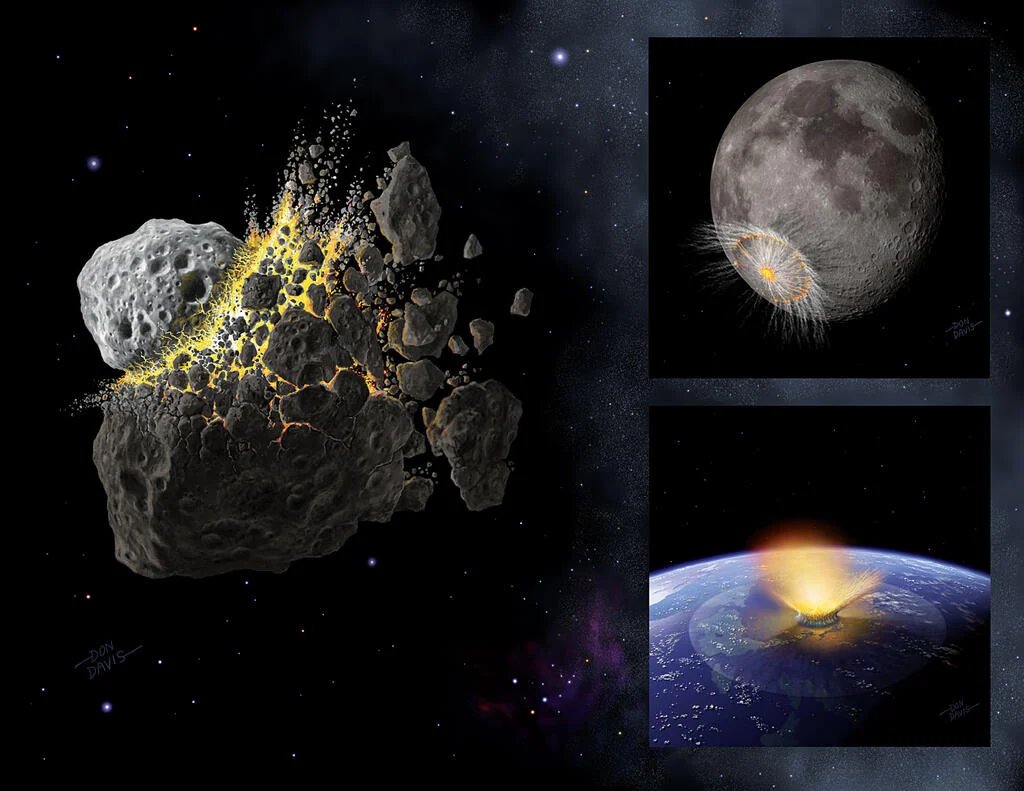
So what exactly is Eulalia? Now, it’s a “family” of asteroids with similar geological makeups that asteroid researchers believe were originally part of a single, much larger asteroid. Estimated to be around 100 km in diameter, this asteroid suffered a catastrophic collision around 800 million years ago that broke it into thousands of much smaller pieces. That happens all the time throughout the solar system, but what made this one more impactful was where it happened.
Eulalia’s parent body was believed to be very near the 3:1 mean motion resonance with Jupiter, meaning it would rotate three times around the Sun for every single orbit of Jupiter. This orbital position, more commonly called J3:1, critically serves as a gravitational escape hatch for the asteroid belt, flinging objects that cross its path into planet-crossing regions throughout the solar system.
Fraser talks about asteroids striking the Moon.
According to the paper, when the catastrophic collision happened 800 million years ago, some of those fragments were immediately sent into the J3:1 point, and then distributed throughout the inner solar system. And over the next 150 million years or so, other fragments from the collision were slowly pushed into that position through a non-gravitational thermal acceleration force known as the Yarkovsky effect.
The end effect of these asteroid fragments being flung into that resonance point is the inner solar system seems to have suffered a pretty heavy asteroidal bombardment around this time. Many of the Near-Earth asteroids currently orbiting near our home planet appear to be remnants from this collision, as samples from Ryugu and Bennu have shown. But the most critical evidence comes from the Moon.
According to crater surveys on our nearest neighbor, there was a massive uptick in crater formation around 800 million years ago. Notably, the 93 km wide Copernicus crater was created in this time frame, but samples collected by the Apollo astronauts show it wasn’t the only one – tiny glass beads formed by the intense heat of impacts show a clustering of radiometric ages around 800 million years ago.
Fraser talks about how we might destroy an asteroid.
But if this inner solar system bombardment did happen, it wasn’t just the Moon that was affected. In fact, a general rule of thumb means that for every impact on the Moon, there should be 20 of a similar size on Earth due to its higher gravity level. 800 million years ago, Earth’s climate underwent a dramatic change known as the Bitter Springs Anomaly, which was marked by huge disruptions to Earth’s carbon cycle. The paper posits this as a speculative connection intended to inspire future research, suggesting that the increased amount of asteroid dust in the atmosphere could have contributed to an atmospheric cooling event that drove some evolutionary diversification of marine life just before the “Snowball Earth” glaciation period.
Mars would have been hit too, with the authors pointing out that there was a peak in the formation of massive volcanic calderas right around 800 million years ago. The impact shocks from repeated pummeling by asteroids could have destabilized Martian magma reservoirs, triggering a planetary surge in volcanic eruptions.
Venus, on the other hand, had something even more dramatic happen approximately 650 million years ago. The authors calculate the average surface age of Venus is right around that mark, and present the speculative hypothesis that the barrage of asteroid remnants from the Eulalia breakup could have sparked a catastrophic, planet-wide volcanic resurfacing event.
That is definitely a leap, though admittedly a logical, and (critically) a testable one. The authors already used some collisional and dynamical models to reverse-engineer the Eulalia family’s history, so there’s already a level of rigorous orbital dynamics proven in part of the paper. But tying such massive biological and geological changes such as Earth’s Snowball Period or Venus’ entire surface restructuring requires extraordinary evidence. This undoubtedly won’t be the last we hear of this theory, but it might be some time before enough additional evidence is gathered to be able to disprove it. Until then, the theory drives home just how critical asteroids can be in the development of a planet – and how critical it is that we find any capable of doing that to our own, modern home.
Learn More:
SwRI – SwRI-led research connects asteroid collision to impact showers 800 million years ago
W.F. Bottke et al – An 800-Million-Year-Old Impact Shower on the Terrestrial Planets from the Breakup of the Eulalia Parent Body
UT – Researchers Narrow Down the Type of Meteorite that Killed the Dinosaurs