800x Golden Dog, “Card Drawing” Rescues NFT Trading
Last month, we detailed the narrative of on-chain TCG card games, describing how “card pulling” has become the second most potent crypto-native “money printer” after Hyperliquid and pump.fun:
“CARDS Surged 5x in 2 Months: Is On-Chain TCG the Next Big Narrative After HYPE?”
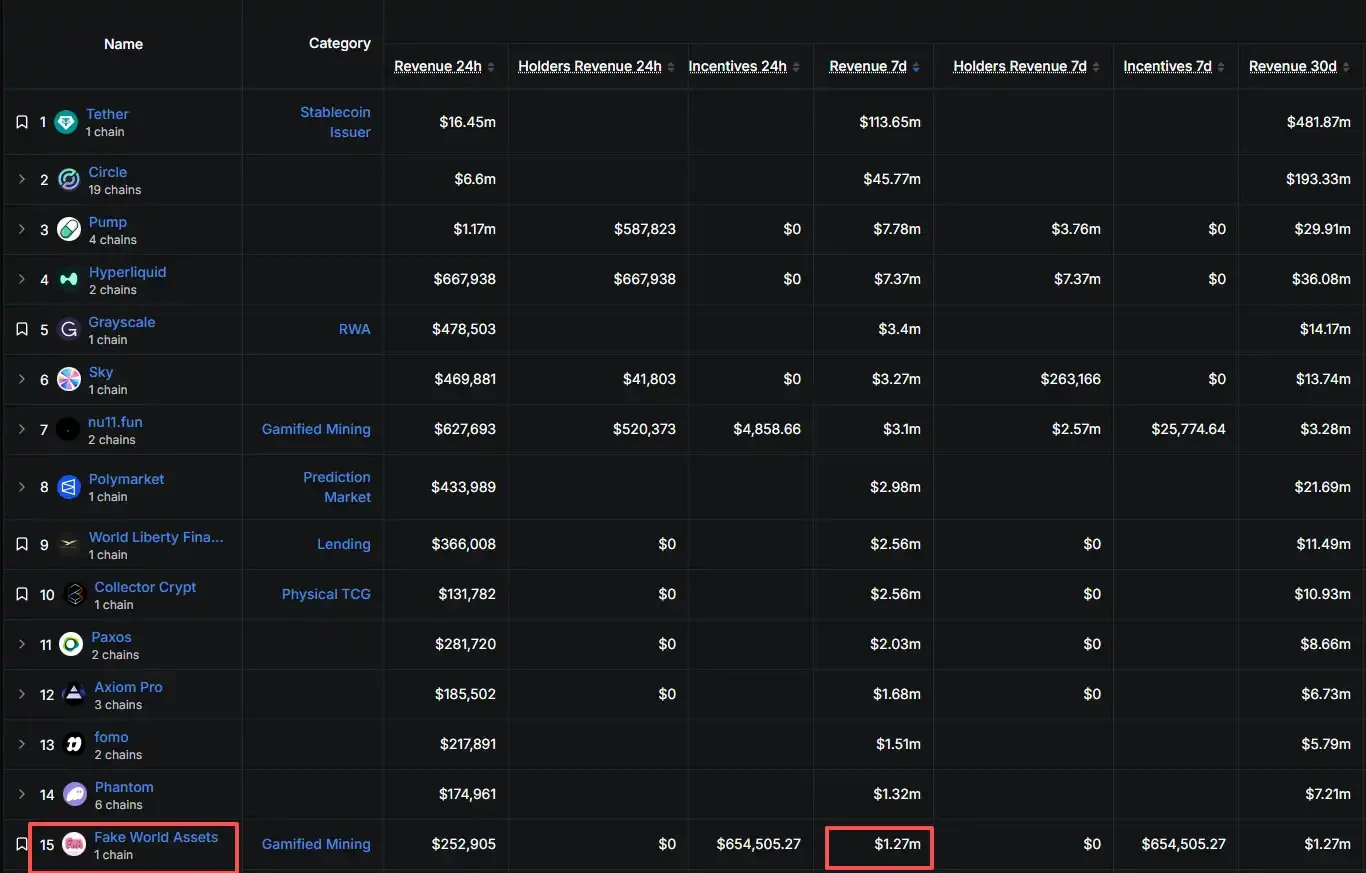
Last week, the “card pulling” trend finally arrived on the Ethereum mainnet. A new protocol named Fake World Assets generated approximately $1.3 million in revenue within just over a week of launch, ranking 15th among crypto applications by revenue over the past seven days:
Meanwhile, the protocol’s token, $FWA, surged from an initial market cap of around $47,550 to a peak of approximately $38.8 million—an 800x golden gem. In contrast, Collector Cards, while still maintaining strong revenue momentum, saw its token $CARDS plummet from a high of nearly $90 million about a month ago to a market cap of just around $28.87 million.
Why?
How FWA Works
Many of you may already be familiar with the team behind FWA, TokenWorks. Their previous hit project was “PunkStrategy,” which reached a peak market cap of $300 million within a month.
However, TokenWorks doesn’t always launch a winner. Their previous project, TTT (Ten Thousand Tokens), was released during the mid-to-late phase of the Uniswap v4 hook hype. It was essentially a launchpad where users needed an NFT to launch tokens. With a total supply of 10,000 NFTs, only 10,000 tokens could be launched on this platform. Fees were distributed among token creators, all NFT holders, and the protocol itself.
Since no popular projects emerged from it, the NFT prices collapsed shortly after the platform launched.
I initially missed out on FWA, thinking it was just a simple “NFT card-pulling” game. But it cleverly designed a token flywheel, allowing $FWA to form a Ponzi-like structure.
The $FWA token cannot be bought directly on the open market. To acquire it, you must participate in “card pulling.”
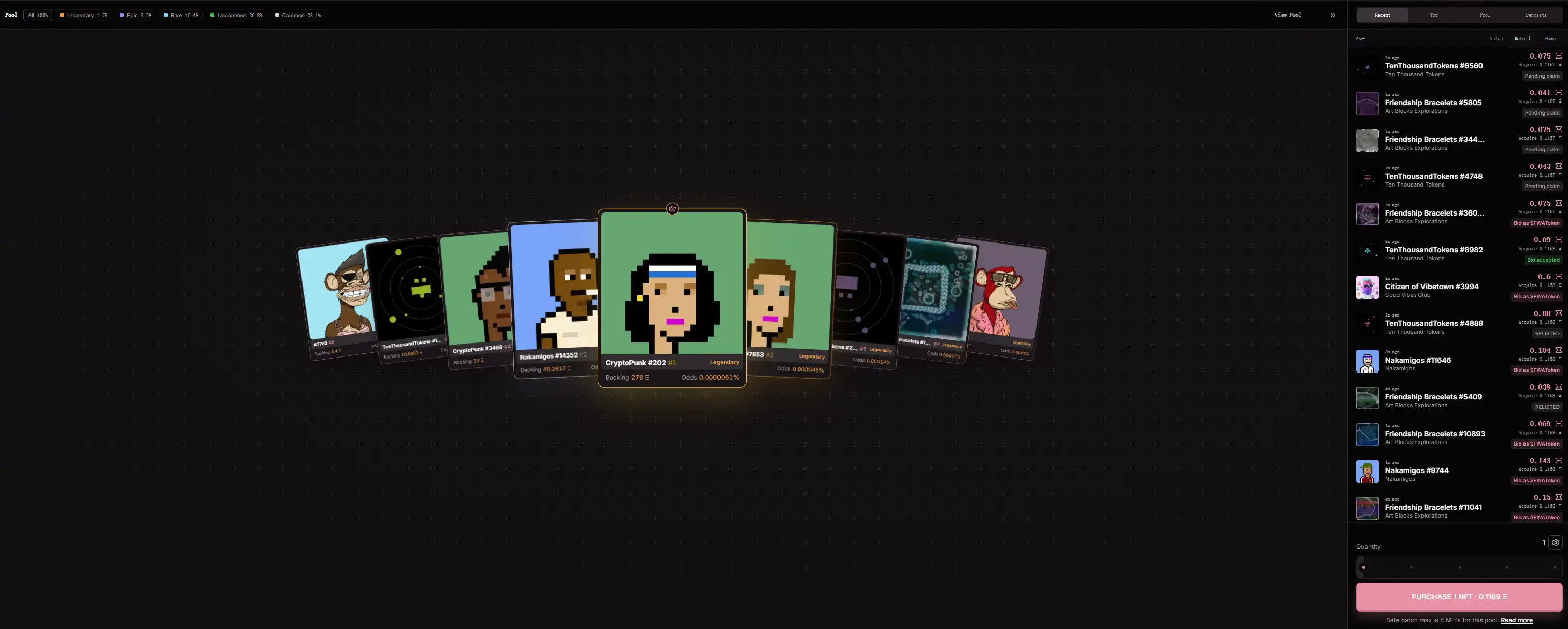
The NFTs in this pool are deposited voluntarily by players. When depositing an NFT, players must also deposit ETH as bilateral liquidity. In other words, each player depositing assets essentially opens their own pool.
The more ETH deposited, the lower the probability of that corresponding NFT being drawn. Take the CryptoPunks below as an example: paired with 276 ETH, the probability of it being drawn is only 0.0000061%, meaning it would require over 10 million draws to potentially win it. Since the protocol launched on July 3rd, only 73,884 draws have occurred in total, averaging just over 3,000 per day.
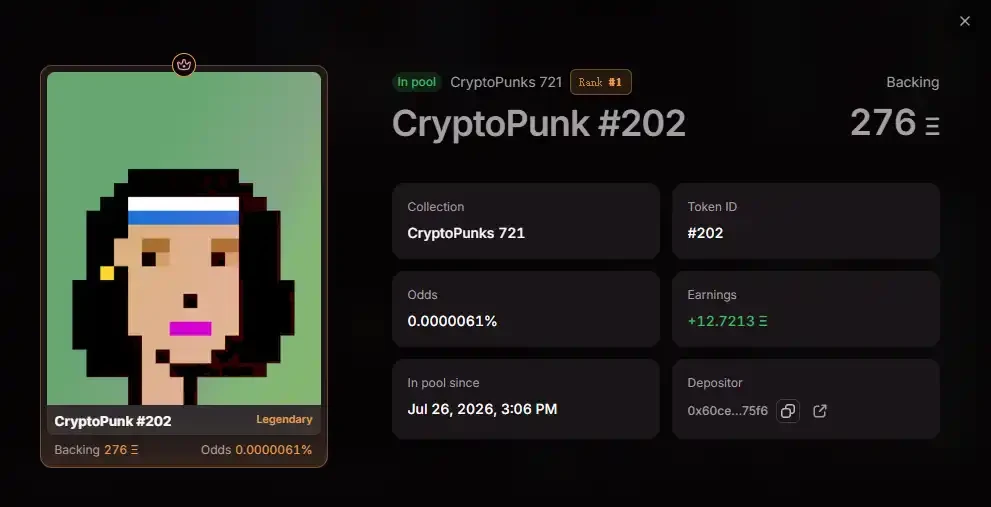
Note that the depositor of this CryptoPunks has already earned 12.7213 ETH in revenue over a little more than a day. This revenue comes from:
– A fixed 1% fee is charged for each draw.
– If a player wins a desirable NFT and chooses to keep it, 1% of the revenue generated by that NFT’s depositor is deducted.
– Most players draw common NFTs and immediately sell them back to the corresponding depositor at an 85% discount. This price difference constitutes the depositor’s revenue.
The share of profits each player receives for depositing NFTs and ETH depends not on the size of their deposited assets, but on how long their deposited NFT survives in the pool. In other words, as long as the deposited NFT is never drawn, it continues to share in the profits. Once it is drawn, the profit-sharing ends, and a new NFT needs to be deposited.
To ensure their NFT survives longer in the pool, users need to deposit more ETH, which incentivizes the pool to grow larger.
In summary, this system is essentially an NFT AMM layered with a card-pulling mechanism.
FWA’s Flywheel
The most interesting aspect of the $FWA protocol token is that it cannot be bought directly from outside. To acquire this token, you must genuinely play the NFT gacha machine.
50% of the total token supply was used to provide initial liquidity, 30% is allocated for emissions over the first half-month (distributing 1% daily to both asset depositors and card pullers), and the remaining 20% was for early snapshot airdrops.
The most common way to obtain $FWA is through card pulling. As mentioned earlier, when you draw an undesired NFT, you can sell it back to the depositor at an 85% discount. At this point, you can choose to receive either ETH or $FWA (the protocol automatically uses the returned ETH to buy $FWA).
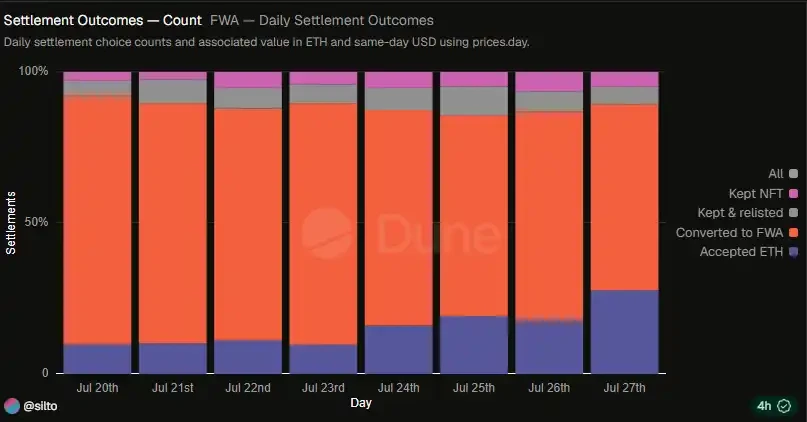
Most players opt to receive $FWA when selling back undesired NFTs. Data shows that over the past seven days, up to 82.3% of operations involved immediately selling back the draw for $FWA, especially in the early days before the token price had taken off. In recent days, as the $FWA price has risen to highs and entered a correction, the proportion of users choosing ETH upon immediate sell-back has gradually increased. However, choosing $FWA still accounts for over 60% of daily operations.
If we directly calculate the acquisition cost of $FWA, we find that every draw has a negative expected value. The cost of acquiring $FWA through each draw is actually higher than the market price of $FWA on that day, representing a premium purchase.
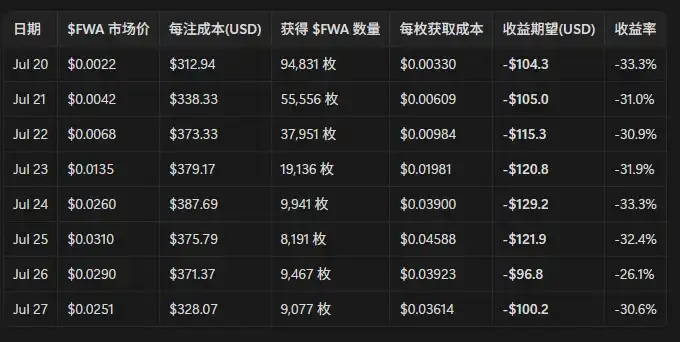
However, if players held onto their $FWA instead of selling immediately, each draw converting to $FWA between July 20th and 23rd became a money-printing machine. This is quite similar to enduring the wear-and-tear of Offer farming for Blur airdrops back in the day—both are bets on the token’s future appreciation, trading time for space. There is a difference, though: this game has a much shorter cycle and primarily revolves around attention. If this mechanism is quickly discovered and becomes a focal point of attention, any influx of new card pullers will generate significant buy pressure for $FWA. Latecomers will continuously boost the portfolio value of those who acquired $FWA earlier.
This explains why FWA surpassed Collector Cards’ market cap in such a short time. Both protocols’ core gameplay revolves around card pulling, and their primary revenue comes from instant buyback discounts. In fact, Collector Cards’ content (Pokémon cards) arguably has broader appeal than NFTs and shows better profit margins. However, Collector Cards’ token utility has been widely criticized by the community. Apart from the project’s buybacks (which haven’t disclosed details due to the Clarity Act’s failure to pass), the token has almost zero utility.
Even pump.fun’s massive daily buybacks failed to gain market approval, let alone Collector Cards’ much weaker buyback efforts.
Conclusion
FWA’s flywheel is highly unlikely to be sustainable in the long term. When the token price is rising, everyone rushes in to pull cards, praising this great innovation that “saved NFTs.” But once the token price falls, and the losses from card pulling can no longer be covered or generate excess returns through continued $FWA appreciation, the protocol will gradually be forgotten, and the so-called “great revival” of NFTs will come to an abrupt halt.
However, the more valuable lesson we can learn here is that profitability is a narrative easily forgotten in the crypto market. If we understand the relationship between attention and buy-side conversion, we might better avoid getting stuck holding the bag at the top.