I couldn’t tell my weeds from my berries — a few Claude photos sorted the bed out
Last spring I planted blackberries, blueberries, raspberries, and strawberries along the back of the yard, with tomatoes at the open end. This year the bed got away from me early, and by the time I dealt with it everything had filled in and started setting fruit. That should have made things easier. It didn’t.
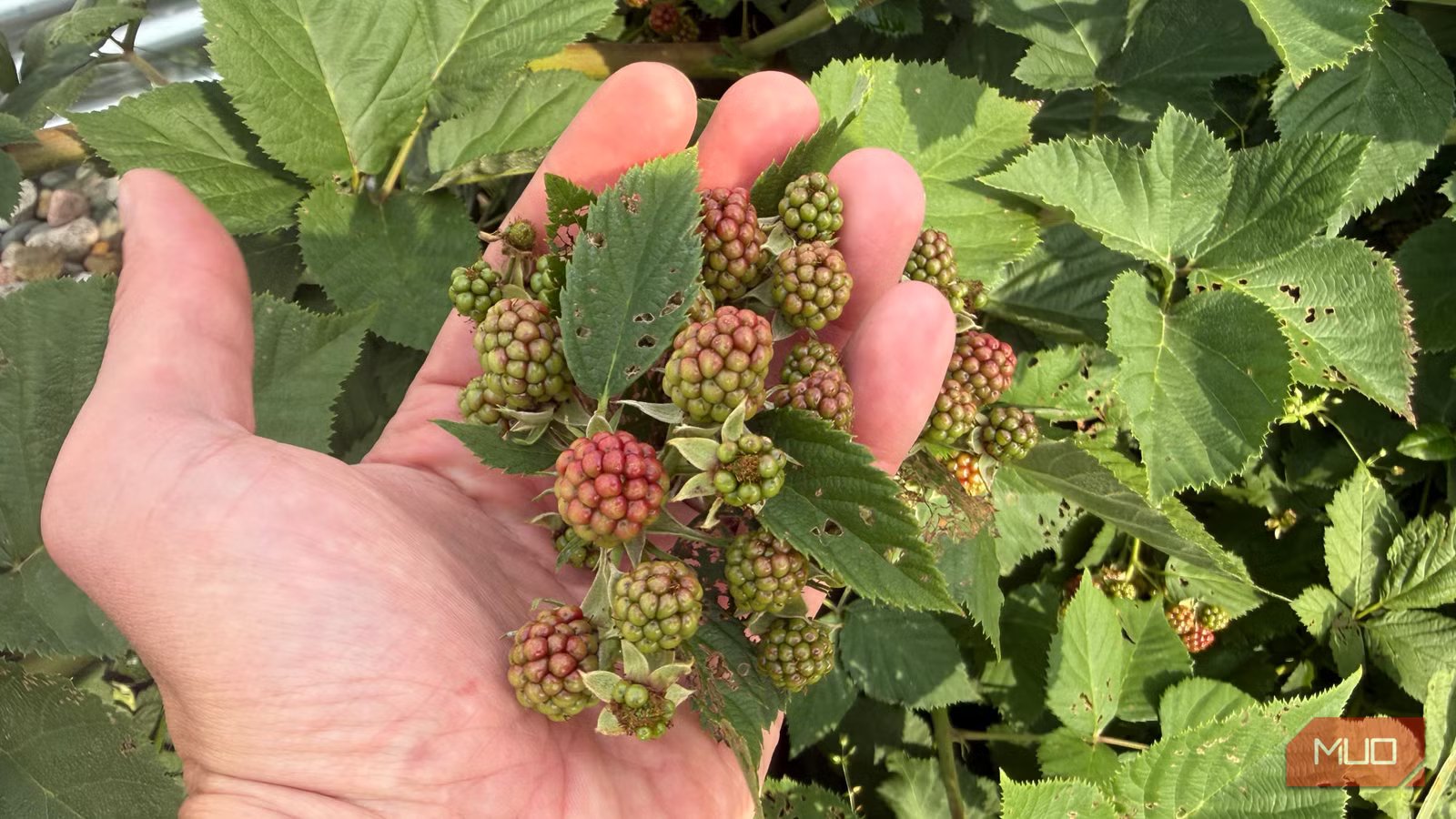
Brambles refuse to stay where you put them, wild ones look identical to the ones you paid for, and I had a cane fruiting in a gravel strip where I have never planted anything. So I photographed the plants one at a time and sent each shot to Claude with a note about what went in last year and where. I’d already had it clear a two-year photo backlog off my Mac, so pointing it at dirt wasn’t much of a leap.
Naming the plants was never the hard part
A berry bed that gets away from you stops being legible
Raspberries push horizontal roots out under the soil and send up suckers as far as four to six feet from the parent clump. Blackberries sucker too, and they tip-root on top of it: let a cane arch over until the end touches dirt and it will root there and start a new plant. So a cane standing by itself in open ground proves nothing at all. It might be mine. It might have walked.
The reverse is the trap that actually costs you. Wild brambles grow all over northern Indiana, and a volunteer that seeded in from a fence line looks exactly like the plant on the receipt.
Blueberry was the only thing out there I could name on my own. Everything else was a coin flip, and the coin flips are expensive. Pull a first-year cane and next summer’s fruit is gone before it existed. Leave a perennial weed sitting on a rhizome and you’ve handed it the row.
What came back wasn’t just a name
The field marks, the lookalike, and a test I could run without it
The blackberry answer shows the shape of them. It opened with the call and the reasoning behind it: aggregate fruit built from a cluster of small drupelets, compound leaves with sharply serrated edges, and thorny canes that arch. Fine so far. A dedicated app gets you that much.
Then it went past the name. The lookalike worth ruling out here, it said, is black raspberry, which turns up in northern Indiana as a wild volunteer. I hadn’t asked about black raspberry. I didn’t know to. It surfaced the confusion that applies where I actually garden instead of listing near relatives.
It also handed me two checks I could run myself. Black raspberry canes carry a whitish waxy bloom and blackberry canes don’t. Raspberry fruit pulls off hollow like a little cap, while a blackberry keeps its white core inside. Mine showed no obvious waxy coat, which pointed to blackberry, and it said plainly that the picked-fruit test at ripeness would settle it for good.
The closing line is the one I keep coming back to. If the plant volunteered on its own in that gravel bed, it told me, it was almost certainly a wild native, probably Allegheny blackberry. That’s conditional reasoning on something no camera can see. I mentioned the gravel. It used the gravel. This is the same principle that made a Claude workflow good enough for a client to ask me to hand it over: what comes out is only as good as the context you put in.
PictureThis and iNaturalist exist, and they’re good at this
They answer “what is this,” which wasn’t quite my question

I should be straight with you: I haven’t run this bed through a dedicated plant app. They’re on my list, and I’ll get there. They’re also the obvious tools for the job, and they earn their reputation.
PictureThis claims better than 98% accuracy across more than 400,000 species and ships a weed identification feature built for this exact scenario. It runs $29.99–$39.99 a year depending on the offer you land on, after a seven-day trial that renews on its own unless you cancel first. Seek, from iNaturalist, costs nothing and names things in the viewfinder before you press the shutter. PlantNet returns a ranked list with a probability beside each result, which is something Claude flatly does not do. Plenty of gardeners have used these apps for years, and I’m not going to sit here and pretend they don’t work.
The difference isn’t quality. It’s structural. They’re classifiers: one subject in, one name out. Seek is built around wild biodiversity rather than garden plants, which iNaturalist states openly and isn’t a flaw. And not one of them has a field where I can type that four canes went in along the fence in May 2025, and I’ve never planted a thing in that gravel.
One opinion, no score, and prose that reads sure either way

Claude gives you paragraphs, and paragraphs read the same whether the model is right, hedging, or wrong. Nothing tells you how much of your trust to spend. PlantNet’s probability rating does real work that confident prose can’t. There’s no community behind it either. Post to iNaturalist and human beings look at your photo, which takes time but gets you eyes that aren’t the model’s.
It also only worked because I had context to hand it. I knew what I bought, roughly where it went, and which patch of gravel I’d never touched. Take that away, and the edge goes with it. Standing in a yard you inherited, a dedicated app is the better call, and it’s faster, because you don’t have to write a paragraph first.
Anything headed for my mouth gets a second source regardless. Poison hemlock sits in the same family as carrots and shows up in gardens. A well-written paragraph is not a positive ID on something that can hurt you.
My garden bed is legible now, and it was never a botany problem
I know what’s growing out there, which I couldn’t have told you at the start of the season. The gravel-strip cane is a blackberry as far as anything short of the fruit test can tell me, and the fruit test comes when the berries go black.
None of this means Claude out-botanizes an app trained on 400,000 species. It doesn’t. It means I walked out there carrying information no plant app has a slot for. A classifier can’t take that input, so it can’t use it. Something that reads a photo next to a paragraph can, and that gap keeps turning up in places you wouldn’t expect. However, Claude could do much more, like driving FreeCAD to design 3D printed parts, which is a longer walk from sorting photos than a garden bed is.