Delray Beach, FL, July 21, 2026 (GLOBE NEWSWIRE) — The global Humanoid Robot Market is projected to grow from USD 5.41 billion in 2026 to USD 50.27 billion by 2035, at a CAGR of 28.1%, according to a new report by MarketsandMarkets™. Growth is being propelled by rising adoption of humanoid robots in personal assistance, caregiving, and healthcare applications, alongside increasing deployment in manufacturing, retail, and logistics for workforce augmentation. Rapid advancements in artificial intelligence, natural language processing, and human-robot interaction, combined with large-scale R&D investment and strong government initiatives across Asia Pacific, North America, and Europe, continue to accelerate robotics adoption across industries.
Humanoid robots are moving out of research labs and demo stages and into real commercial deployments — greeting customers in retail stores, assisting patients in hospitals, supporting elderly care at home, and working alongside people on factory floors. As labor shortages persist and populations age across major economies, the ability of a robot to operate in spaces built for humans, using human-like mobility and interaction, is becoming a genuinely practical solution rather than a novelty. That shift matters well beyond the robotics industry itself: healthcare systems, retailers, educators, and manufacturers are all beginning to treat humanoid robots as a workforce augmentation tool, meaning the market’s growth trajectory has direct implications for how care, service, and physical labor get delivered in the years ahead.
Market Overview
A humanoid robot is designed to resemble and imitate the human body structure and behavior — typically featuring a torso, head, two arms, and two legs — equipped with hardware, software, and advanced technologies to perform tasks across diverse environments, from deep-ocean exploration and scientific research to complex medical procedures and household chores. Their human-like form allows them to operate in environments designed for humans, making them well suited to tasks requiring interaction with people or navigation in human-centric spaces. The market is segmented by type (biped, wheel drive), offering (hardware, software, services), application (education & entertainment, research & space exploration, personal assistance & caregiving, search & rescue, public relations, manufacturing, and other applications), and region, with the report covering North America, Europe, Asia Pacific, and the Rest of the World across 14 countries.
Analyst Perspective
According to MarketsandMarkets™, advancements in artificial intelligence and machine learning are the primary force accelerating humanoid robot development, enabling enhanced perception, decision-making, and interaction capabilities that push these robots beyond basic service roles into more complex tasks across healthcare, retail, logistics, and education. Analysts see the rapidly growing elderly population worldwide as the market’s biggest opportunity, as humanoid robots equipped with monitoring, mobility support, and interactive communication capabilities can meaningfully reduce the burden on healthcare workers and caregivers. At the same time, the significant capital investment and extensive R&D expenditure required to develop humanoid robots remains a key restraint, limiting participation to well-funded companies and research institutions and creating entry barriers for smaller players. Safety concerns tied to operational risk and human interaction are also flagged as a challenge that must be addressed to build broader end-user trust.
By Type: Biped robots are expected to hold the largest market share and register the highest CAGR through 2030, driven by their ability to replicate human locomotion and navigate complex environments. Their superior dexterity, human-like interaction, and operational flexibility make them well-suited for healthcare, personal assistance, and industrial settings, with expanding roles in rehabilitation, elderly care, and workforce augmentation. Wheel drive robots are seeing steady adoption in retail assistance, customer service, and indoor logistics, where ease of navigation, cost efficiency, and stability are key advantages.
By Offering: Hardware is expected to hold the largest market share, supported by high demand for sensors, actuators, control systems, and mechanical components enabling mobility, dexterity, and human-like interaction. Software is projected to register the highest CAGR, driven by advancements in AI, natural language processing, and computer vision that enable enhanced human-robot interaction and autonomous decision-making, supported by rising demand for cloud-based analytics and real-time monitoring. Services continue to see steady growth through integration, maintenance, and training support.
By Application: Personal assistance & caregiving is expected to hold the largest market share and register the highest CAGR, driven by rising demand for elderly care, rehabilitation support, and assistance for individuals with disabilities. Education & entertainment, research & space exploration, manufacturing, public relations, and search & rescue continue to see strong and growing adoption as humanoid robots expand into broader commercial and institutional use cases.
Regional Analysis
Asia Pacific is projected to be the fastest-growing region in the global humanoid robot market, driven by rapid advancements in artificial intelligence, machine learning, and robotics research, along with expanding adoption across healthcare, education, and industrial automation. The region is home to leading innovators and an extensive ecosystem for components, AI development, and advanced manufacturing, positioning it as a central hub for production and commercialization, with China, Japan, and South Korea at the forefront of humanoid robot innovation. North America shows strong momentum, supported by extensive R&D and pilot deployments in healthcare and logistics, while Europe remains a key innovation hub backed by collaborative robotics initiatives and regulatory frameworks. The Rest of the World, comprising the Middle East, Africa, and South America, is witnessing gradual adoption in emerging applications. The report provides country-level analysis across 14 countries in total.
Key Industry Trends
Advancements in artificial intelligence and machine learning are enabling humanoid robots with enhanced perception, decision-making, and interaction capabilities.
Rising deployment of humanoid robots in retail stores, education, and hospitality is expanding commercial adoption beyond traditional industrial use cases.
Growing use of humanoid robots alongside humans in manufacturing environments is enhancing productivity and workplace safety.
Increasing adoption of humanoid robots in search and rescue operations is opening new opportunities in hazardous-environment applications.
Rising demand for humanoid robots from the logistics sector is driving growth in warehouse automation and last-mile delivery use cases.
Requirement for significant capital investment and extensive R&D expenditure remains a key restraint, limiting participation to well-funded companies.
Competitive Landscape
MarketsandMarkets™ identifies SoftBank Robotics Group as a Star in the Humanoid Robot Market Company Evaluation Matrix, leading with a strong global presence and a comprehensive portfolio of humanoid robots such as Pepper and NAO, widely deployed across retail, education, hospitality, and healthcare. Its advanced AI-driven interaction, multilingual communication, and scalable deployment models have positioned SoftBank Robotics as the dominant player in the market. Boston Dynamics is recognized as an Emerging Leader, leveraging its expertise in advanced mobility and robotics engineering to expand its footprint in the humanoid segment through innovations in dynamic locomotion and industrial applications.
Other key players profiled in the report include ROBOTIS Co., Ltd., Agility Robotics, UBTECH Robotics Corp Ltd., PAL Robotics, Kawada Robotics Corporation, Toyota Motor Corporation, Honda Motor Co., Ltd., Hanson Robotics Ltd., Samsung, and Tesla, along with additional players such as Engineered Arts Limited, Apptronik, Figure, 1X Technologies, and LimX Dynamics Inc. The broader market ecosystem spans research institutes including MIT, Carnegie Mellon University, and IIT; component providers such as Intel, Bosch, and NVIDIA; AI developers including OpenAI, Google AI, and DeepMind; and end users such as Disney, Universal, and Japan Airlines.
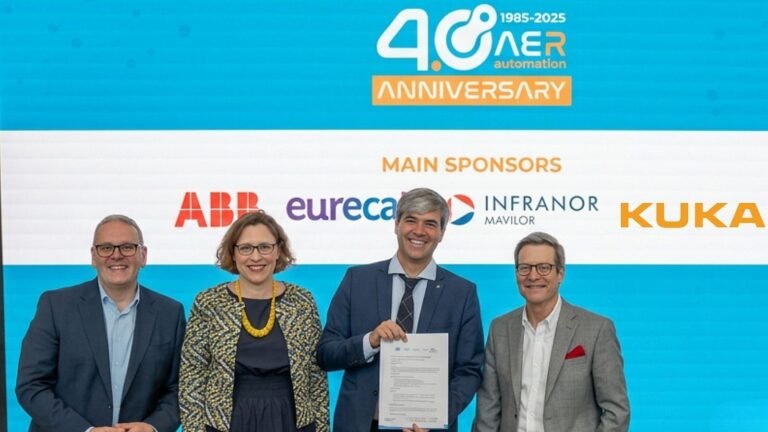
A3, The International Federation of Robotics (IFR), VDMA Robotics + Automation and Spanish AER Automation, formalize a long-term commitment to promote public policies that accelerate automation, industrial competitiveness and talent development. Four robotics and automation organizations have officially signed the Barcelona Declaration on Robotics and Automation 2026, an agreement that consolidates a global initiative to…
Asylon has secured a contract from the Warner Robins Air Logistics Complex to further develop and demonstrate an autonomous aircraft inspection system designed to support US Air Force maintenance operations. Known as Multi-modal Autonomous Robotics for Inspection of Aircraft (MARIA), the system combines aerial and ground robots to perform general visual inspections of…
You might be interested in Possible betrayal of Raphinha: his father would have swindled him out of a lot of money A white car approached me, under the summer rain of Shanghai. While holding the umbrella with one hand, with the other I took out my phone. “Unlock the taxi door,” a notification told me….
I let an AI startup film every inch of my apartment. That’s a privacy nightmare — and yes, I did suitably hide all my personal items before they arrived. But, as a 23-year-old living in New York on a journalist’s budget, I’m not exactly splurging on house cleaners. These were free, so long as I agreed…
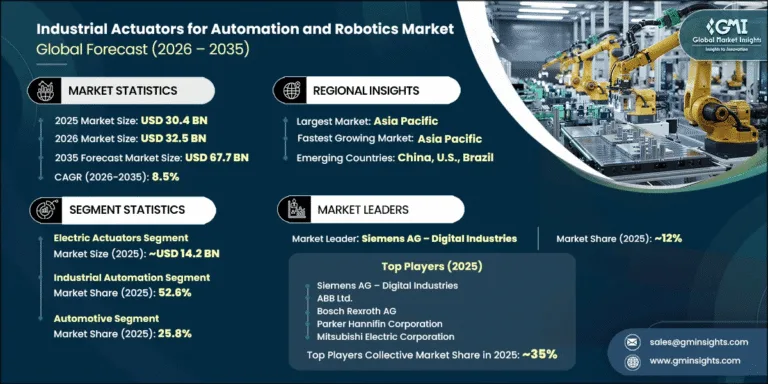
Industrial Actuators for Automation and Robotics Market Size The global industrial actuators for automation and robotics market was estimated at USD 30.4 billion in 2025. The market is expected to grow from USD 32.5 billion in 2026 to USD 67.7 billion in 2035, at a CAGR of 8.5% according to latest report published by Global…
By Anthony King What if training a robot to handle dirty, dangerous work on the factory floor was as simple as showing it how? Czech startup RoboTwin is doing exactly that, helping factory workers teach robots new skills by demonstration. Instead of writing complex code, workers perform the job once and RoboTwin’s technology turns those…