Lithium company to use provincial funding for mill byproduct research
The province has given Rock Tech Lithium over $262,000 to continue to study the use of crude tall oil from Thunder Bay Pulp and Paper’s operations in lithium processing.
THUNDER BAY — A company looking to build a lithium mine and refinery east of the city is partnering with Thunder Bay’s pulp mill for some novel research.
And that collaboration has received a financial boost from the province.
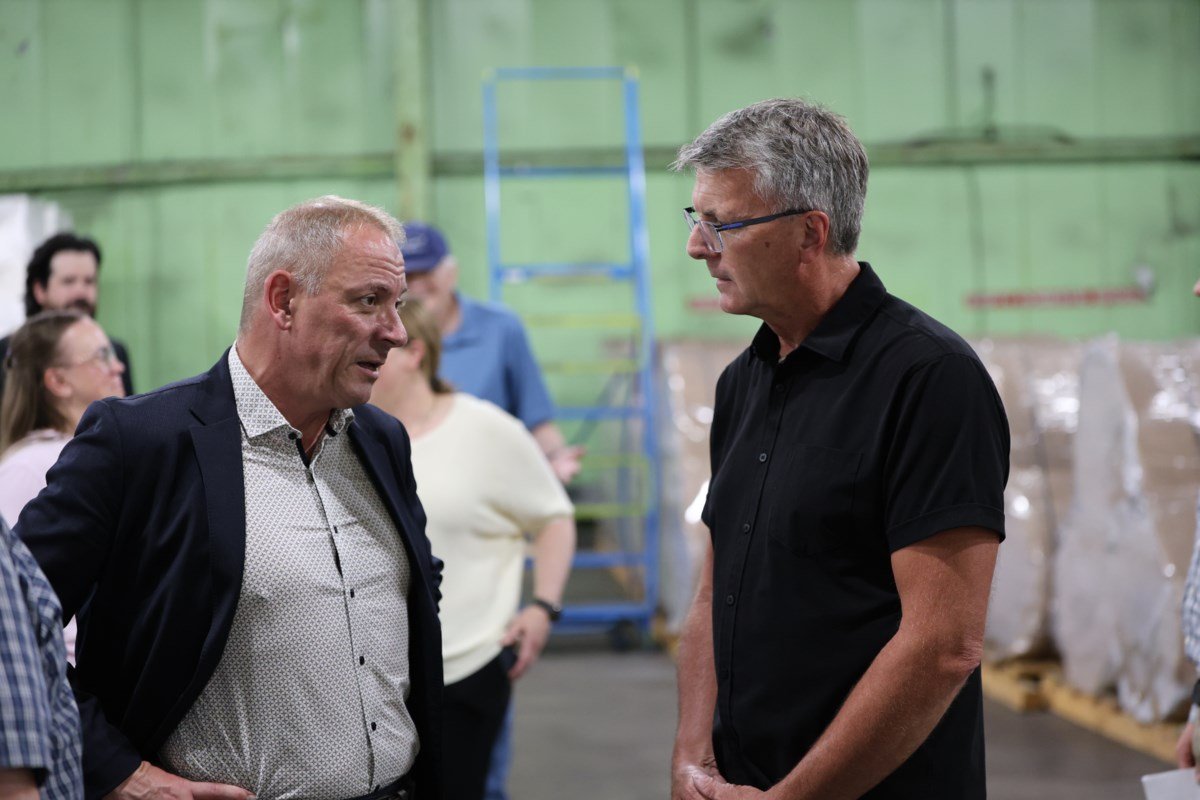
On Friday, representatives from Rock Tech Lithium and Thunder Bay Pulp and Paper joined Kevin Holland, Ontario’s Associate Minister of Forestry and Forest Products, to tout $262,500 from the province’s critical minerals innovation fund towards research Rock Tech is leading into the potential use of crude tall oil — a byproduct of the mill’s operations — for the minerals company’s lithium processing.
Effectively, that’s the separation of the lithium from the surrounding mined rock.
“We have figured out that there are synergies between the pulp and paper industry on the one hand and our lithium industry on the other hand, and to have the most efficient businesses, you try to create regional supply chains,” said Dirk Harbecke, the chair of the German-Canadian minerals company. “This is a huge opportunity for both parties.”
“We in lithium, we need these byproducts as reagents for our own lithium production, and this is what the Government of Ontario is currently supporting in our research program, to figure out how to get this … to be started here in Northwestern Ontario to be applied afterwards all over the country.”
If all goes well, Harbecke said the technology would also be deployed the across the Atlantic in its German operations. The two companies are also working with Queen’s University in Kingston, Ont.
The six-figure funding pot was originally made public as part of a June 10 provincial announcement about money for various projects the Ford government said would help secure the critical minerals supply chain.
“I’ve been advocating since being elected that there’s a lot of synergies between our two major natural resources sectors, being mining and forestry, and there’s a lot of synergies that I thought we could be capitalizing on,” Holland said. “This project is an example of some of that work that we can be doing.”
“It’s a win-win for Northwestern Ontario as we see mining move forward, and it’s really a win for the forestry sector.”
Thunder Bay Pulp and Paper already sells tall oil to other customers who typically use it in things like aviation fuel, said Brenden Thew, the mill’s vice president of operations. He said it’s important for the company to continue to look for ways to diversify.
The mill now solely makes kraft pulp after it closed its newsprint division earlier in 2026. It also generates renewable energy for sale to the Ontario power grid.
“Forestry used to be a dominant industry within northern Ontario in particular, and now there’s two or three mills left standing,” Thew said. “So we need to branch out outside of traditional forestry, work with our other heavy industry companies within the region and see if there’s ways that we can help each other out with all of our different products.”
“If successfully validated, the technology could help reduce processing costs and emissions while decreasing reliance on foreign or conventional processing materials,” a government press release said of what the Rock Tech-led research could mean.
“It could also create a new use for a product generated by Ontario’s forest sector.”
Harbecke, with Rock Tech, said he’s optimistic about their research’s prospects.
“We are very confident in this because there’s a chemistry around this byproduct,” he said. “The products that we would deploy otherwise are very similar, so I’m very confident that we will find ways to make this happen.”
Several months worth of research has already gone into the work in order to be able to approach the province for funding, Harbecke said, adding that he expects another three to six months before they can prove whether what they’re proposing can be used on the ground.
He said, if it works, it would be a less expensive solution to current methods.
“It will definitely be cheaper,” Harbecke said. “If it can be better, we have to figure (that) out — that’s one of the key elements at the moment of this research that we are conducting.”