Social Media Leads Product Discovery, Yet Few Buy There
Social media has quietly won the battle for product discovery, yet in some parts of the world, it keeps losing the war for the actual sale.
A new report from ESW, drawn from interviews with 23,000 shoppers across 18 markets, found that social platforms are now the top channel worldwide for finding new products. The problem is that many people discover on social, then leave to buy somewhere they trust.
The gap between influence and purchase is startling. ESW found that 62% of consumers say social platforms influence their buying decisions, yet only 6% actually prefer to check out there. That chasm captures the entire challenge, since attention and trust turn out to be very different things in online shopping.
Discovery numbers show just how dominant social has become. Around half of all consumers now discover new products on social media, and among Generation Z that figure climbs to three-quarters. By comparison, only 38% of global shoppers find new items through search engines, and just 36% through physical stores. So social is not merely competing, it is leading the discovery race outright.
The trust problem appears the moment money enters the picture. In the US, only about a quarter of consumers trust social commerce checkout experiences, so most retreat to familiar ground. Nearly a third prefer buying on brand or retailer websites, a preference that rises to 37% in the US and a striking 52% among baby boomers. There is a deeper credibility puzzle too, since eMarketer found 26% of consumers distrust influencer marketing, more than double the 11% who distrust regular ads, and yet 58% still say they have bought because of an influencer.
The most revealing part is that this trust gap is not universal. In China, social commerce conversion rates average around 34.7%, and Douyin’s live shopping alone generated over $85 billion in the first half of 2026. Indonesia tells a similar story, where 60% of online buyers already purchase through live sessions. Live shopping converts at up to 30% globally, against just 2% to 3% for traditional e-commerce, which shows the gap is a matter of trust and habit rather than technology.
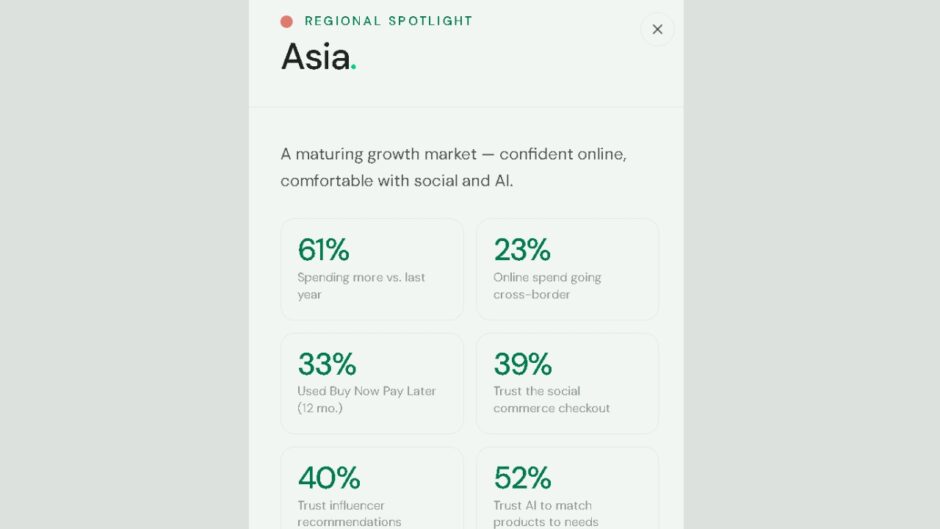
ESW chief executive Eric Eichmann summed up the Western pattern crisply:
“Nearly half are comfortable using AI for price comparison and 45% discover products through social media, but confidence drops sharply when those experiences move closer to checkout and payment,” he said. The willingness to explore simply does not survive the walk to the till.
The lesson for brands is to design for a journey that no longer runs in a straight line. A shopper might spot an item on Instagram, verify its price on an AI tool or review site, then finally buy from a trusted website. Any friction during those handoffs risks losing the sale, so clear pricing, familiar payment options, and a secure feel matter more than ever, especially in markets where live-shopping trust has not yet taken hold.