Climate change is slowly making our days longer, say scientists | story
The slowing stems from melting polar ice
⭐️HERE’S WHAT YOU NEED TO KNOW⭐️
- A new study reports that climate change is making Earth’s days longer.
- Melting ice at Earth’s poles redistributes water closer to the equator.
- This redistribution pulls water away from Earth’s axis, slowing it down.
- Scientists say this can cause issues for technology like satellites.
- Read on to find out why scientists find this mind-boggling. ⬇️⬇️⬇️
We know that the effects of climate change are far-reaching.
Scientists say human activity — through things like burning fossil fuels — is leading to more extreme weather, rising ocean levels and forest fires.
But did you know it’s also affecting our clocks?
In a new study published in the Journal of Geophysical Research: Solid Earth, scientists have found that melting ocean glaciers are slowing the rotation of the Earth, making our days longer by a fraction of a second each century.
Researchers say the time change, though slight, will grow larger as the years pass and poses threats to some technologies if not accounted for.
How climate change makes our days longer
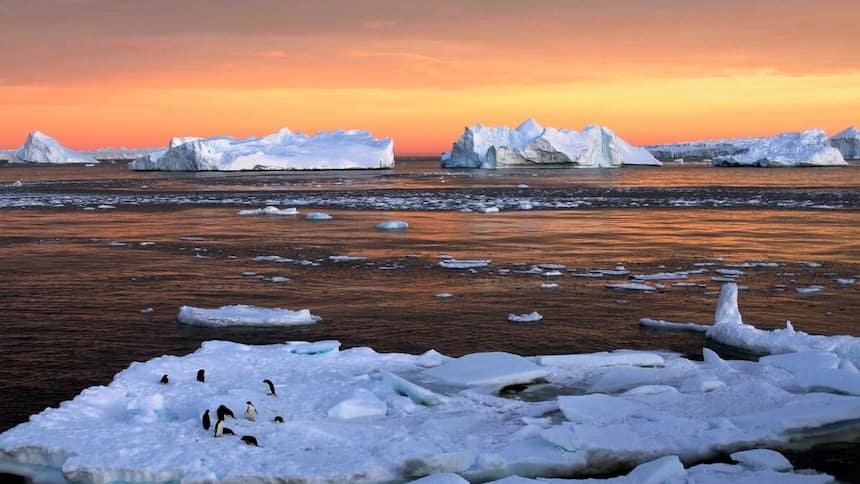
Scientists say Earth’s rotation is slowing because of the massive amounts of ice at Earth’s North and South Poles that are melting.
As it melts, the water from that ice gets closer to the equator, rather than staying frozen at the poles where Earth’s axis lies.

According to a new study, ice at Earth’s poles is melting due to climate change, redistributing water closer to the equator. (Image credit: James Balog/Extreme Ice Survey/Associated Press)
The farther this water gets from Earth’s axis, the more it has a dragging effect on Earth’s rotation, slowing it down.
“We see the same principle in figure skating,” said study author Benedikt Soja, a professor at the Swiss Federal Institute of Technology in Zurich, Switzerland,
“If skaters want to spin fast, they tuck their arms close to their body, toward their own axis of rotation. If they want to slow down, they reach their arms out,” he told CBC Kids News.
The Earth takes 24 hours to make one full rotation on its axis, so slowing Earth’s rotation down means our days get longer.
In total, researchers found that human-led climate change is lengthening our day by 1.33 milliseconds per century.
That’s the most rapid climate-driven increase in day length observed in the past 3.6 million years, according to Soja.
Outside of climate change, tidal effects from the moon are the biggest factor slowing down the Earth, at a rate of 2.4 milliseconds per century.
However, the study found that by the end of this century, climate change will surpass the moon’s effects and become the biggest factor in slowing Earth’s spin.
Why does this matter? It’s only milliseconds
A millisecond is one-thousandth of a second.
However, even one millisecond added to our daily clocks can have a huge impact on technology, said Soja.

Even millisecond changes to Earth’s rotation time can have effects on certain technologies like satellites, which require precise calibration with clocks. (Image credit: Surrey Satellite Technology Ltd.)
“Satellite navigation and deep-space spacecrafts, for example, require precise calibration in order to operate properly,” he said.
He said that without accounting for these milliseconds, things like the GPS on your phone would end up making errors.
“Precise calibration is also needed for spacecraft to land safely. That millisecond difference could lead a spacecraft to land hundreds of metres farther than intended,” he said.
Scientists, according to Soja, are constantly monitoring Earth’s rotation in order to account for these factors.
The scale of human impact
Compared to things like wildfire and more extreme weather, the slowing of Earth’s rotation doesn’t pose the same kind of immediate threat to humans.

Scientists say climate change will soon become the biggest factor in the slowing of Earth’s rotation. (Image credit: . David Goldman/Associated Press)
That said, scientists say it is an example of how human activity can cause big changes.
“I think it’s really strange to see that now climate change, induced by humans, has actually reached a level of the moon in terms of the dominating factor influencing Earth’s rotation,” said Soja.
David Holland, a professor of math and environmental science at New York University, said there are many factors over billions of years that have made Earth’s days shorter or longer.
That said, he said the new finding is surprising.
“It’s just mind-boggling to me that we started burning fossil fuels roughly 150 years ago and we’re now having effects like these on the Earth,” he told CBC Kids News.
Holland — who did his PhD in the 1990s on Arctic sea ice at McGill University in Montreal, Quebec — said the study’s findings are something he never could have predicted.
“Back then, no one on Earth thought the Arctic ice would go through this type of change,” he said.
“Now, half the Arctic melts during the summer, and in a few decades, it will be completely gone during the summer months”.
Have more questions? Want to tell us how we’re doing? Use the “send us feedback” link below. ⬇️⬇️⬇️
![How NASA’s Artemis III Lander Test Will Pave Way for Moon Landings [new NASA article with 2 new SpaceX renders of Artemis 3 Starship docked to Orion]](https://jobssz.com/wp-content/uploads/2026/07/R8nWmVoH_14TSiSL9tXSnV0CObQPnEosMzgM7Q1yRnw.jpeg)