Robots can now learn high-dexterity factory tasks from videos
Swiss physical AI company Mimic Robotics has unveiled FLUX-mimic, a next-generation Video-Action Model developed with Black Forest Labs that enables robots to learn complex, high-dexterity industrial tasks from video demonstrations.
The company said the system requires only a fraction of the demonstration data used by existing approaches, making robot training faster and more efficient for factory environments, including deployments at Audi.
FLUX-mimic combines mimic’s expertise in robot learning, dexterous manipulation, and industrial automation with Black Forest Labs’ FLUX 3 video model.
According to the team, it builds on mimic’s earlier Video-Action Model research with an architecture specifically designed for real-world physical AI applications.
Video models evolve
FLUX-mimic is marketed as a next-generation Video-Action Model developed in collaboration with Black Forest Labs that enables industrial robots to learn complex manipulation tasks from video demonstrations while requiring significantly less training data than existing approaches.
Unlike most robot learning systems that rely on Vision-Language-Action (VLA) models, FLUX-mimic is built on a generative video foundation model. Conventional VLA systems are typically pre-trained on static image-and-text datasets and must learn physical interactions almost entirely from costly robot demonstration data. FLUX-mimic instead leverages a video model that has already learned the dynamics of objects, motion, and physical interactions through large-scale video pre-training before being adapted for robotic control.
The system predicts robot actions by pairing the video model with an action decoder that converts visual predictions into executable robot movements. This architecture allows robots to learn physical skills more efficiently while reducing the amount of task-specific data needed for deployment.
According to Mimic Robotics, FLUX-mimic can be fine-tuned for certain manipulation tasks using as little as 30 minutes of robot demonstration data, compared with the 30 or more hours often required by conventional learning pipelines, depending on task complexity. The reduction in training data is expected to shorten deployment cycles from several months to a matter of weeks.
Factory AI accelerates
The technology builds on mimic robotics’ earlier Video-Action Model research, which extended pre-trained video generation models with the ability to predict robotic actions. FLUX-mimic advances that work with an architecture specifically designed for physical AI applications in industrial environments, enabling robots to better understand motion and object behavior before executing tasks.
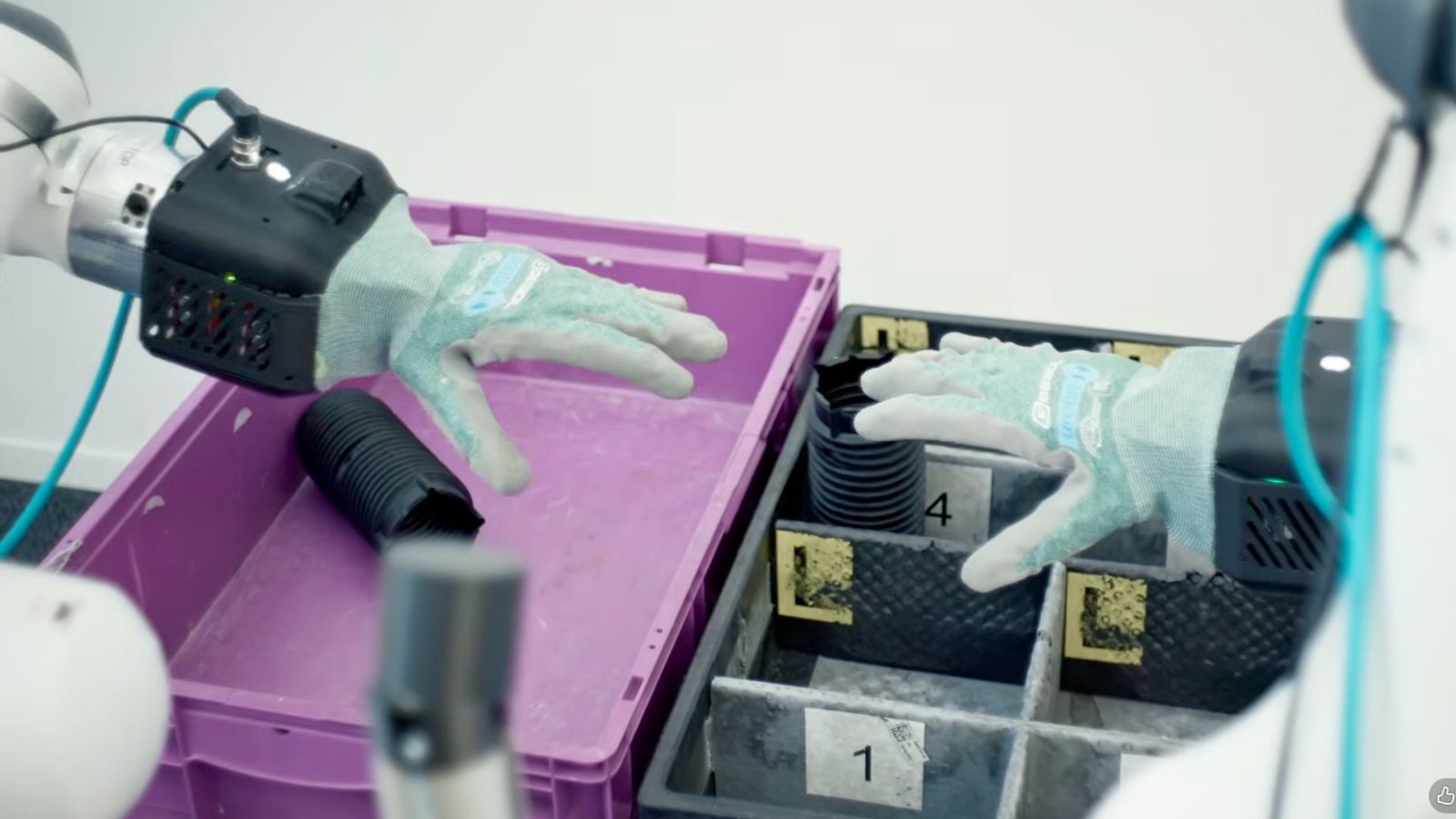
The company is deploying the technology with automotive manufacturer Audi to evaluate its performance in real-world factory settings. The collaboration focuses on automating high-dexterity tasks involving flexible materials and fine manipulation—applications that have traditionally remained difficult for conventional industrial robots because they require extensive programming and frequent re-engineering.
Audi‘s production facilities, which already use a high degree of automation, provide a testing environment for learning-based robotic systems capable of adapting to changing production requirements. The partners are exploring how Video-Action Models can reduce engineering effort, accelerate robot deployment, and expand automation across manufacturing and logistics operations.
The company claims that by combining large-scale video understanding with robot action prediction, FLUX-mimic represents a shift toward robots that learn new industrial skills from relatively small amounts of demonstration data rather than relying on manually programmed workflows. The approach aims to improve flexibility in manufacturing while making robotic automation more practical for complex, variable production environments.