New Images Reveal the Stunning Properties of the Black Hole at the Center of M87
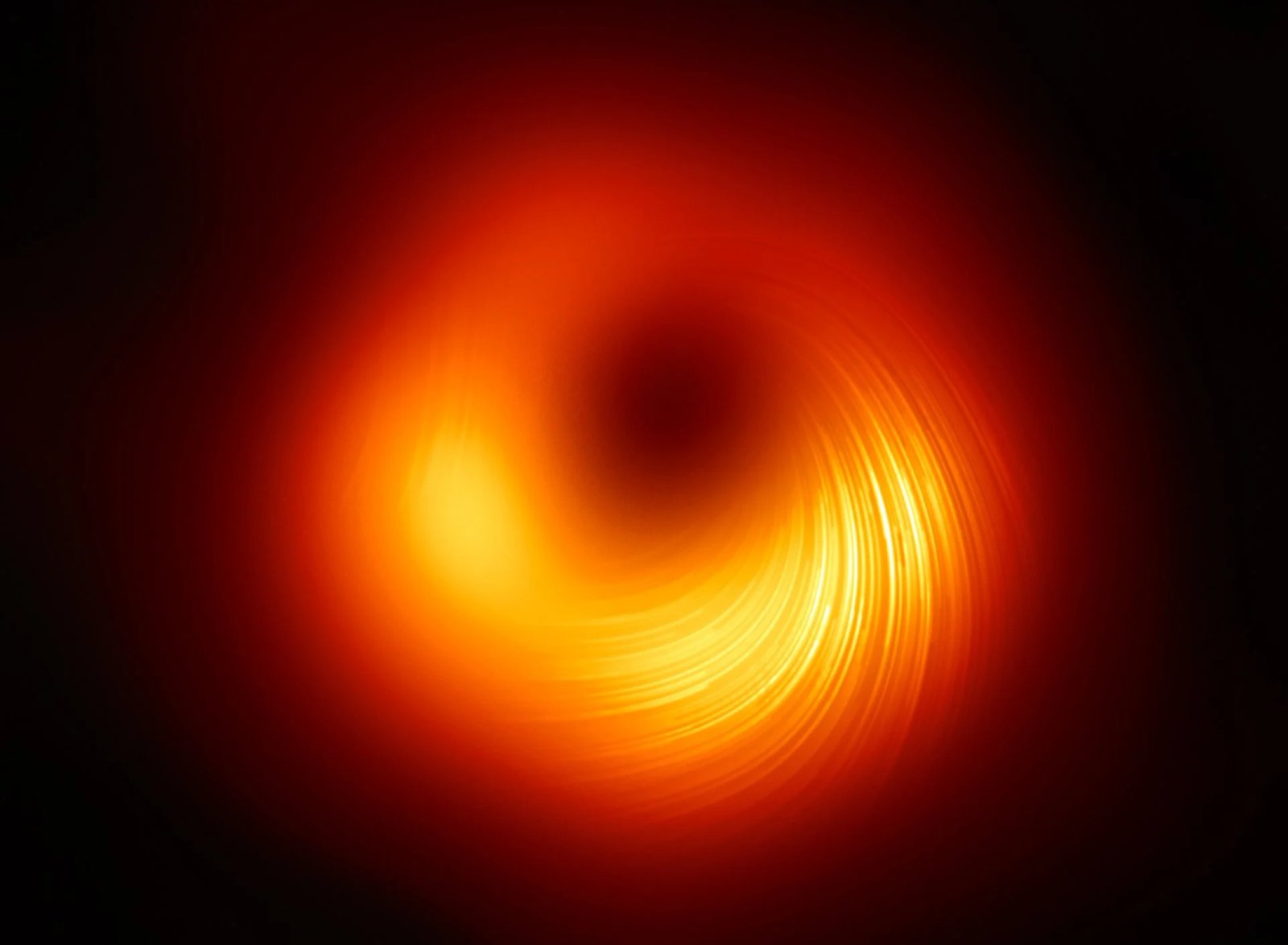
In 2019, scientists with the Event Horizon Telescope (EHT) released the first-ever image of a black hole. After years of gathering data from observatories worldwide, the world got a glimpse of the supermassive black hole (SMBH) at the center of the M87 galaxy, a super-giant elliptical galaxy about 53.5 million light-years from Earth in the constellation Virgo. Since then, follow-up observations have provided additional details and insight into the extreme physics of black holes.
Recently, an international team led by researchers from the Shanghai Astronomical Observatory (SAO) carried out the first spatially resolved dual-frequency spectral study of the M87 black hole. By combining horizon-scale images from multiple observatories, they produced the first spatially resolved map that reveals how the M87 black hole’s spectral signature changes with distance. This work goes beyond imaging the plasma structure beyond the event horizon and provides a new method for characterizing the extreme physics and conditions present.
The astronomers at the SAO were joined by researchers from the Chinese Academy of Sciences’ Key Laboratory of Radio Astronomy and Technology, the Center for Computational Sciences at the University of Tsukuba, Japan, the INAF Institute of Radio Astronomy, the CSIS Andalusian Institute of Astrophysics, and the Max Planck Institute for Radio Astronomy (MPIR). Their results are presented in a paper published yesterday (July 20th) in The Astrophysical Journal Letters.
The team’s survey was based on observations obtained in 2018 by the EHT and the Global Millimeter VLBI Array (GMVA). By combining horizon-scale images in the Extremely High Frequency (EHF) range of radio waves and the high-frequency edge of microwaves (1.3 and 3.5 mm). As noted, the spectral index that resulted shows that the radiation properties surrounding the black hole vary with distance from the black hole. In the innermost region, for example, the spectral index is positive and increases slightly depending on the radius.
This suggests that emissions in this region are significantly affected by synchrotron self-absorption, a process in which electrons moving through a magnetic field at nearly the speed of light reabsorb photons they previously emitted. Farther out, the spectral index decreases and becomes negative, indicating a transition toward a regime where the photons emitted escape freely without being absorbed, scattered, or re-emitted. This transition occurs at a distance of about 30 microarcseconds (μas) from the black hole, consistent with the ring-like structure observed with the GMVA.
This suggests that the ring-like structure revealed by the EHT in 2019 is closely connected to the physical state of plasma near the event horizon and not merely a morphological feature. These observations have therefore provided a new means of characterizing the extreme physical conditions surrounding black holes that goes beyond imaging the structure alone. The research was made possible by advances in millimeter very long baseline interferometry (VLBI), which have enabled imaging studies beyond a single frequency.
Said Dr. Shan-Shan Zhao, an assistant researcher at the SAO at the Chinese Academy of Sciences (CAS) and the first author of the paper:
By obtaining the first spatially resolved spectral-index distribution of [the] M87 black hole, we can quantitatively characterize how the radiation properties change across the region surrounding the black hole. This allows us to directly explore how the plasma properties vary on horizon scales and provides new clues for understanding accretion flows and jet formation.
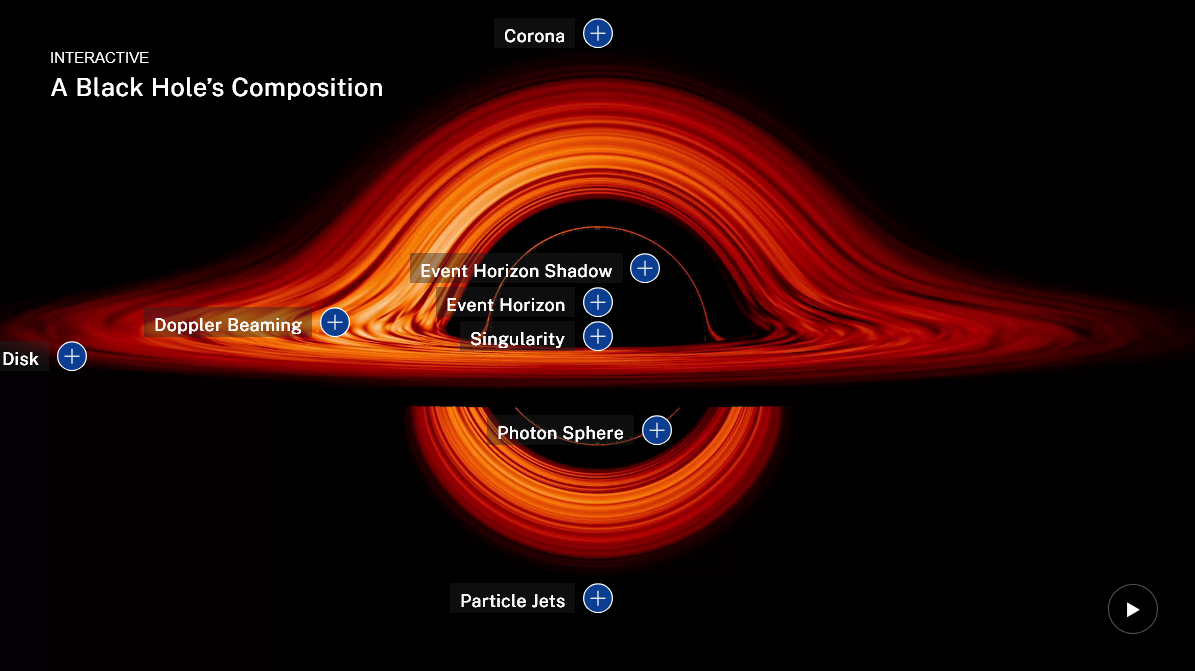 The anatomy of a black hole, emphasizing the accretion disk, event horizon, and other areas. Credit: NASA
With continued advances in millimeter VLBI, astronomers will be able to observe black holes at more frequencies, with higher sensitivity, and with greater time-resolved imaging capabilities. These will provide even greater information on phenomena ranging from black hole accretion and jet formation to radiation processes in strong gravitational fields. Such studies will further improve our understanding of the extreme plasma environments surrounding black holes. Said corresponding author and fellow SAO researcher Dr. Ru-Sen Lu:
Multi-frequency horizon-scale imaging will become a powerful tool for diagnosing the physical conditions of plasma near black holes. With improved observational capabilities, multi-frequency observations will help disentangle the effects of plasma physics from gravitational signatures in black hole images, enabling more precise studies of black hole accretion, jet formation, and strong-field gravity.
Further Reading: Shanghai Astronomical Observatory, The Astrophysical Journal Letters