World-first medical breakthrough as humanoid robots perform keyhole surgery
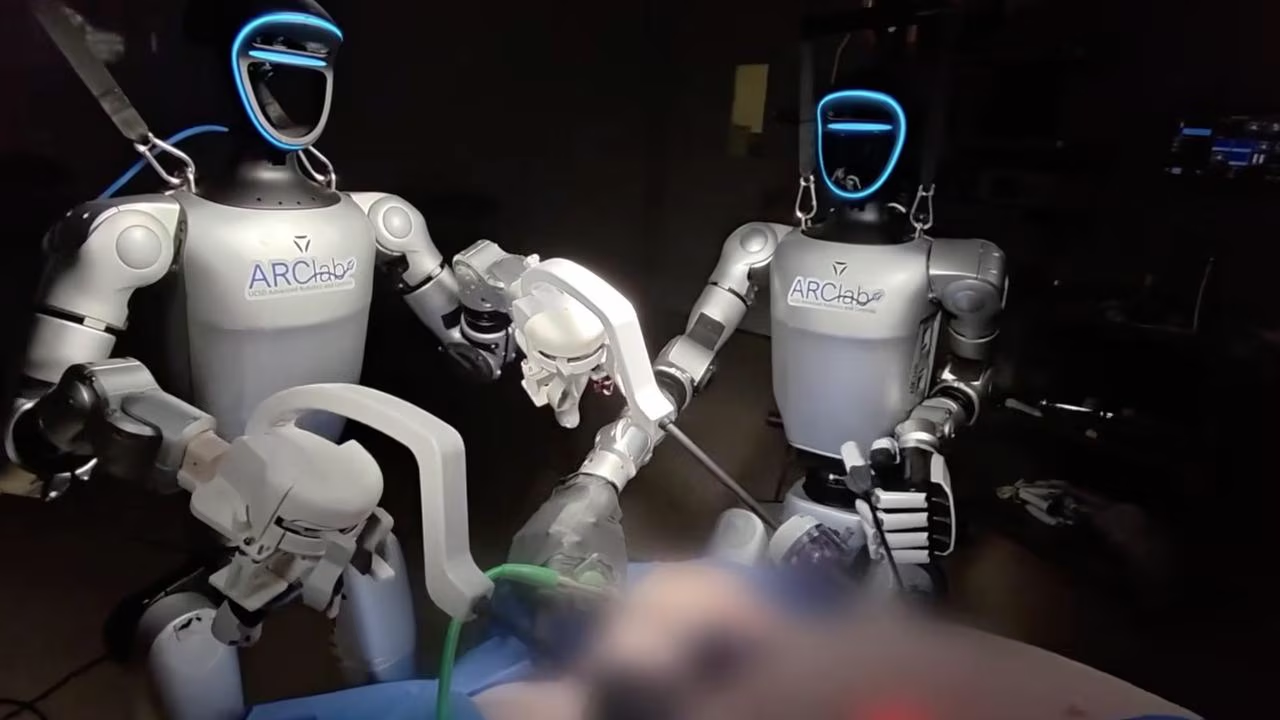
Humanoid robots have officially performed keyhole surgery on live patients for the very first time, marking a world-first medical breakthrough that could completely transform the future of operating theatres.
A team of engineers and surgeons from the University of California, San Diego (UCSD) teamed up to test just how useful these two-legged humanoid robots could be in a high-stakes clinical environment.
As part of the landmark preclinical trial, two humanoid robots carried out keyhole procedures on live, anaesthetised pigs while being remotely operated by human surgeons.
In one operation, a robot worked side-by-side with a human surgeon to successfully remove a pig’s gallbladder.
The first-of-its-kind operation also saw two of the humanoids working side-by-side as a team to complete the delicate task.
The Unitree G1 robots, dubbed ‘Surgie’, were equipped with specialised adaptors to hold standard surgical tools, but remained otherwise completely unchanged from their standard off-the-shelf build.
Researchers say Surgie offers precision and accuracy comparable to traditional surgical robots, but comes with a much cheaper price tag, simpler setup, and far easier operation.
With a growing global shortage of skilled medical professionals putting pressure on healthcare systems, researchers suggest these autonomous humanoids could eventually step in to perform operations on humans.
Senior author Professor Michael Yip, from UC San Diego, said the technology could completely revolutionise emergency medical care and expand access to lifesaving operations.
“You can imagine these robots being deployed in remote communities where staffing is challenging, or in austere environments like search and rescue scenarios,” Professor Yip said.
The research team began by evaluating the robots’ fine motor skills through basic tasks, having them handle inanimate objects and standard surgical tools.
Once they were satisfied, the team advanced the humanoids to conducting actual surgical procedures on live pigs.
A report published in the journal Nature confirmed that both operations were completed successfully.
While there was some minor bleeding during the initial stages of the procedure, the robots quickly brought it under control.
In fact, the research team admitted they were actually surprised by just how effectively the humanoids performed under pressure.
Surgeons noted that controlling a humanoid’s movements felt far more intuitive than operating the bulky arms of a traditional surgical system, especially for operators without specialised training.
“Remotely operated and autonomous humanoid robots have real potential for amplifying access to critical surgeries to which patients would otherwise not have access,” Professor Yip said.
Surgeons currently rely on massive robotic surgery systems equipped with three or four arms for complex operations.
However, these traditional setups can weigh up to 800kg, take up massive amounts of space, and require a huge team just to assemble in the operating theatre.
They’re also expensive to purchase and maintain, pricing out smaller regional hospitals and emergency response teams.
By comparison, Surgie stands at just 1.5 metres tall and weighs just 27kg, even when fully equipped with its specialised surgical adaptors.
Despite the historic milestone, the technology is still far from perfect and researchers warn several technical hurdles remain before it reaches human hospitals.
Surgie required multiple recalibrations during the procedures, which added significant time to the operation and dragged the timeline out past initial estimates.
Engineers are also working to drastically reduce latency — the split-second delay between the surgeon’s command and the robot’s physical movement — to make the system safer and more practical for high-stakes procedures.