NASA Unveils $2.1B Cost for Nuclear Mars Mission as Congressional Funding Falls Short
For the first time, NASA has put a specific dollar figure on its most ambitious near-term space mission: $2.1 billion for Space Reactor-1 Freedom, the nuclear-electric spacecraft it intends to launch toward Mars before the end of 2028. The number, confirmed this week in a document sent to Congress and reviewed by Politico, also reveals a year-by-year spending plan that collides almost immediately with a congressional appropriations process that has authorized a fraction of what the program needs.
The disclosure settles months of public uncertainty about the program’s scale. But rather than resolving questions about SR-1 Freedom’s viability, the revealed cost structure makes the program’s central risk impossible to avoid: NASA says it needs $890 million from congressional appropriations in fiscal year 2027 alone, and the House Appropriations Committee has so far recommended just $10 million specifically for SR-1 Freedom.
The gap between what NASA needs and what Congress has approved is not a rounding error. The $880 million difference between NASA’s $890 million FY27 ask and the $10 million the House has recommended represents a program-ending risk if it persists through the appropriations process. Associate Administrator Lori Glaze’s response at the National Academies meeting — “It is ambitious. It’s a challenge, but NASA is doing everything it can to rise to the occasion” — acknowledged the concern without resolving it.
Why the December 2028 Deadline Is Not Negotiable
Behind every design decision in SR-1 Freedom’s architecture is a fact that physics, not policy, controls: Mars launch windows open approximately every 26 months, governed by the Hohmann transfer orbit — the minimum-energy ellipse from Earth to Mars that requires both planets to be in precise alignment. The December 2028 window is the target. If SR-1 misses it, the next opportunity does not arrive until roughly 2030 — a two-year reset that would strain every other element of the program.
“The schedule must align with the next Mars launch window in December 2028,” NASA program executive Steve Sinacore has said. “Orbital mechanics won’t negotiate, so the project’s scope has to conform to that deadline.”
That deadline means the program’s front-loaded budget is not optional. The spending plan — $640 million in fiscal year 2026, $890 million in FY27, $415 million in FY28, and $180 million in FY29 — was shaped entirely by hardware that has to exist, tested, and ready for integration by late 2027, before final assembly and launch preparations begin.
NASA plans to draw the money from two sources: its exploration account and funds provided through the 2025 Working Families Tax Cut Act, which included $2.6 billion originally earmarked for the now-suspended Lunar Gateway orbital station. Associate Administrator Lori Glaze confirmed the funding approach at a June 2026 meeting of the National Academies’ Aeronautics and Space Engineering Board.
How SR-1 Freedom’s Nuclear Propulsion System Actually Works
SR-1 Freedom is not a traditional rocket. It is a nuclear-electric spacecraft — a class of vehicle that uses heat from a fission reactor to generate electricity, then uses that electricity to drive ion thrusters. The distinction matters for understanding both the mission’s promise and its limits.
At SR-1’s heart is a closed Brayton-cycle reactor fueled by high-assay low-enriched uranium (HALEU) — uranium enriched to between 5 and 20 percent U-235, more than the fuel in commercial power plants but far below weapons-grade material. In a closed Brayton cycle, the reactor heats a working fluid (in space applications, typically a helium-xenon mixture) that expands through a turbine to generate electricity, then is cooled by radiators and recompressed in a continuous loop. The target: more than 20 kilowatts of electrical power — equivalent to roughly what 15 American homes use simultaneously — generated reliably in deep space regardless of distance from the Sun.
That electricity drives a combined suite of seven Hall-effect thrusters. Four 6-kilowatt Busek-built BHT-6000 thrusters and three 12-kilowatt Advanced Electric Propulsion System (AEPS) thrusters built by L3Harris (Aerojet Rocketdyne) provide the primary propulsion, as confirmed by NASA’s Glenn Research Center. Hall-effect thrusters use magnetic and electric fields to ionize xenon propellant into a plasma and accelerate ions to exhaust velocities between 10 and 80 kilometers per second (6 to 50 miles per second) — compared to the 4 kilometers per second (2.5 miles per second) achievable with the best chemical rockets. The result is extraordinary fuel efficiency: specific impulse values of 1,200 to 1,800 seconds, compared to 450 seconds for hydrogen-oxygen rocket engines.
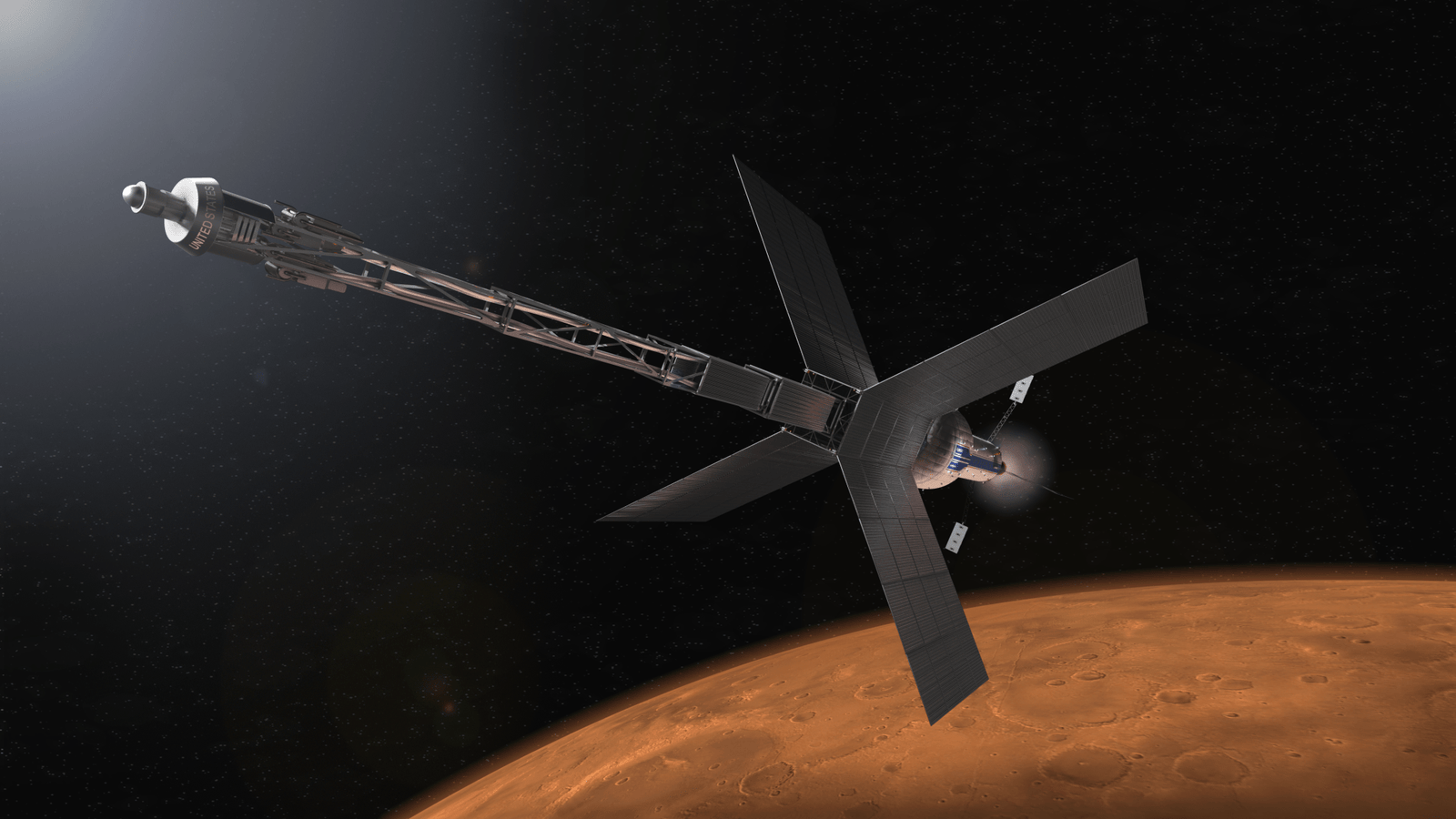
The spacecraft’s physical architecture is determined by one engineering imperative: the reactor must be kept as far from the electronics as possible. SR-1 Freedom uses a long structural truss with the fission reactor at one end, the PPE electronics and thruster cluster at the other, and heat-rejection radiators occupying the space between. Within 48 hours of escaping Earth’s gravity, the fission reactor will be activated — before that, supplementary solar arrays handle early-phase power.
A critical nuance: at 20 kilowatts, SR-1 Freedom will not dramatically shorten the Mars transit compared to previous spacecraft. The mission’s value is fuel efficiency, endurance, and the infrastructure and regulatory precedent it establishes — not raw speed. America’s only previous fission reactor in space, the SNAP-10A, flew for 43 days in 1965 before a voltage regulator failure ended its mission. SR-1 Freedom would be the first U.S. fission system to operate beyond Earth orbit.
Gateway’s Conversion: From Lunar Station to Mars Probe
The design choice that made the December 2028 deadline credible was not engineering genius — it was reuse. In March 2026, when NASA Administrator Jared Isaacman announced the suspension of work on the Lunar Gateway orbital station, one piece of hardware that had already been under construction became suddenly available: the Power and Propulsion Element, a sophisticated spacecraft bus built by Lanteris Space Systems in Palo Alto, California, under a $375 million firm-fixed-price contract.
The PPE — with a launch mass of approximately 5,000 kilograms (about 11,000 pounds) — was originally designed to serve as Gateway’s power and propulsion hub, equipped with Hall-effect ion thrusters capable of handling up to 60 kilowatts of solar electric power. For SR-1 Freedom, engineers are swapping the solar power source for the fission reactor while keeping the rest of the propulsion architecture intact. The AEPS thrusters already delivered to NASA Glenn Research Center and confirmed installed are the same hardware originally built for Gateway.
“PPE gives us a huge leg up,” Sinacore said earlier this year. “That’s the only thing that makes this achievable.”
Isaacman has been explicit about why the reuse approach was non-negotiable. “Our SR-1 nuclear program isn’t about going out and lobbying for billions to fund an entirely new mission,” he said at the March Ignition event. “Frankly, after roughly $20 billion in failed programs over time, we haven’t earned the right to do that. That’s why we’re leveraging hardware we already have.”
SkyFall and the Science Budget Trap
The $2.1 billion figure covers SR-1 Freedom’s propulsion system and spacecraft bus — and notably excludes SkyFall, the payload of three next-generation Mars helicopters the spacecraft will carry.
SkyFall, managed by NASA’s Jet Propulsion Laboratory and co-designed with AeroVironment — the Arlington, Virginia-based aerospace firm that co-designed Ingenuity, the helicopter that completed 72 flights on Mars between 2021 and 2024 — represents a genuinely ambitious science mission in its own right. Firefly Aerospace won a $13 million subcontract to build the entry aeroshell that will protect the three helicopters during Mars atmospheric entry. After landing, the helicopters will carry cameras and ground-penetrating radar to map subsurface water ice and scout potential crewed-mission landing sites — without needing a rover for communications relay, unlike Ingenuity’s dependence on Perseverance.
But SkyFall’s costs, wherever they eventually land, will flow through NASA’s Mars Exploration Program budget — and planetary scientists are alarmed. In a June 2026 memo, the Mars Exploration Program Analysis Group (MEPAG) warned that the science directorate had been directed to absorb SkyFall’s costs within its existing budget, within the Mars Future Missions line. That line contains approximately $110 million. “The chances are quite high that more than one currently operating mission at Mars will be terminated and their funds redirected to supporting Skyfall,” the MEPAG memo stated.
Phil Christensen, a planetary scientist at Arizona State University, captured the dilemma facing the Mars research community. “We’re in this tough spot of, when someone offers you something, it’s hard to say, ‘No thank you, I don’t want it,'” he told Scientific American. “You say, ‘Sure, we can do great science with that.'”
What Critics Say the Clock Cannot Hide
The timeline skepticism runs deeper than the budget. At the June 2026 National Academies meeting, a board member noted that a two-year development schedule is “more typical of a cubesat than a nuclear interplanetary spacecraft.” Scientists have noted that missions like SR-1 Freedom typically take three to five years to design, build, and test. Andrew Higgins of McGill University has criticized the design’s “LEGO-like approach of cobbling together disparate components.”
One risk the article’s budget documents do not address: HALEU fuel. The reactor that will power SR-1 Freedom runs on high-assay low-enriched uranium — a fuel type for which the domestic U.S. supply chain barely exists at commercial scale. Before a 2024 import ban, Russia’s Rosatom was effectively the only commercial HALEU supplier globally. The Department of Energy has committed more than $2.7 billion to building domestic HALEU production capacity, and Centrus Energy’s facility in Piketon, Ohio, has produced approximately 920 kilograms as of mid-2025. But Centrus’s $900 million DOE task order in January 2026 calls for a full-scale cascade to be operational within approximately 42 months — a timeline that would not mature until roughly mid-2029, after SR-1’s planned launch. The program will likely depend on fuel from DOE national laboratories rather than commercial production.
The Bigger Picture: From SR-1 to a Space Nuclear Industrial Base
SR-1 Freedom does not exist in isolation. The mission is the flagship element of the National Initiative for American Space Nuclear Power, formalized in April 2026 through the White House’s National Science and Technology Memorandum 3 (NSTM-3), which directed NASA to develop a mid-power space reactor of at least 100 kilowatts-electric ready for launch in the 2030s — explicitly using SR-1 Freedom as the foundation.
SR-1’s paired sibling, Lunar Reactor-1, is planned for a 2030 lunar surface landing to provide continuous electrical power for NASA’s future Moon base during extended lunar nights. Together, the two missions are intended to establish flight heritage, regulatory precedent, and supply chain capability for fission systems in space.
Congressional support is cautiously positive but not yet aligned with the funding reality. Sen. Jerry Moran, who chairs the Senate appropriations subcommittee that funds NASA, has stated support for nuclear propulsion funding and has said he would seek to fund the agency at FY2026 levels. But the gap between expressed support and appropriated dollars remains the program’s most immediate non-technical risk.
SpaceDaily put it directly in April 2026: “If SR-1 Freedom slips — as every previous program’s first milestone has — the entire downstream timeline for lunar surface reactors and Pentagon systems collapses with it.”
Whether NASA can deliver the world’s first fission-powered interplanetary spacecraft, within budget, on schedule, with a fuel supply chain that does not yet operate at commercial scale, while simultaneously funding SkyFall and managing a broader portfolio that includes Moon base development, will be one of the most closely watched management challenges in American space history over the next 30 months. Orbital mechanics has already decided when the answer is due.
Frequently Asked Questions
How does nuclear electric propulsion work on SR-1 Freedom, and is it faster than a normal rocket?
SR-1 Freedom uses a fission reactor — fueled by high-assay low-enriched uranium (HALEU) — to generate electricity via a closed Brayton cycle. That electricity powers Hall-effect ion thrusters that accelerate xenon ions to speeds far beyond what chemical rockets can achieve, giving the spacecraft extraordinary fuel efficiency. However, at SR-1’s 20-kilowatt output, the spacecraft will not travel significantly faster than conventional Mars probes; the trip will still take months. The mission’s value is demonstrating that fission power works reliably in deep space, establishing regulatory precedent, and building the supply chain — not shaving time off the transit.
What is the $880 million funding gap, and what happens if Congress does not fill it?
NASA’s spending plan calls for $890 million from congressional appropriations in fiscal year 2027 — the single largest yearly outlay of the program. The House Appropriations Committee has so far recommended only $10 million specifically for SR-1 Freedom in FY27. The remaining $880 million would need to come from reconciliation funds originally earmarked for the now-suspended Lunar Gateway, subject to congressional approval. If that gap is not filled, NASA cannot complete hardware integration in time to meet the December 2028 Mars launch window. Missing that window means a mandatory two-year wait for the next opportunity in 2030.
What is HALEU, and why is the fuel supply a risk for this mission?
HALEU — high-assay low-enriched uranium — is uranium enriched to between 5 and 20 percent U-235, significantly more concentrated than fuel used in conventional nuclear power plants. It allows for smaller, lighter reactor designs suited for space applications. Until the U.S. banned Russian uranium imports in 2024, Russia’s Rosatom was effectively the world’s only commercial HALEU supplier. The U.S. is building domestic production capacity with $2.7 billion in DOE investment, but the main production facility’s full-scale cascade is not expected to be operational until approximately 2029 — after SR-1’s planned launch. The program will depend on DOE national laboratory fuel production, which has not been publicly confirmed as sufficient for SR-1’s needs.
Will SkyFall’s Mars helicopters harm other ongoing Mars science missions?
Possibly yes. The Mars Exploration Program Analysis Group — the independent scientific body that advises NASA on Mars science — warned in a June 2026 memo that SkyFall’s costs are expected to exceed the $110 million available in NASA’s Mars Future Missions budget line. Without a budget augmentation in FY27, MEPAG warned, “the chances are quite high that more than one currently operating mission at Mars will be terminated and their funds redirected to supporting Skyfall.” NASA has not released a cost estimate for SkyFall separately from SR-1 Freedom’s $2.1 billion price tag.