Scientists long thought that when RNA kick-started life on Earth 4 billion years ago, it could form only small, simple structures. But new research shows that naturally occurring RNA molecules can also adopt large, sophisticated geometries, like filaments and cages. Now, scientists wonder whether the structures were present at life’s beginning.
According to an idea known as the RNA world hypothesis, RNA-based life-forms preceded modern ones that use DNA and protein. RNA, a molecular cousin of DNA, still plays roles in modern cells but does not serve as the primary genetic material. By comparison, primordial species used RNA to store genetic information and to catalyze reactions as stand-in enzymes.
Proteins eventually dominated as enzymes, perhaps because they can fold into more diverse figures than RNA can. That’s because proteins are composed of 20 types of subunits, called amino acids, each with a unique structure, whereas RNA is composed of only four subunits, called nucleotides, that all adopt similar shapes.
Latest Videos From
Scientists originally thought that only proteins were varied enough to assemble into large structures, but a new paper has demonstrated that RNA — though more limited in its variety — also has the capacity to form these large configurations. The research was posted to the preprint server bioRxiv July 1 and has not been peer-reviewed yet.
“We show RNA can do things which we have never seen before,” said study co-author Lin Huang, an RNA biologist at Sun Yat-Sen University in China. “It suggests that at the origin of life RNA could assemble into all kinds of shapes,” he told Live Science.
Huang and his colleagues had hypothesized that RNA molecules could link together if they possessed sequences that fold into “kissing stem loops.” This occurs when an RNA strand folds over on itself, forming a structure that resembles a loop in a shoelace. If loops from different RNAs bond together, or “kiss,” the molecules could link up and form larger complexes, the researchers proposed.
After sifting through a bevy of RNA sequences, the researchers found a family of RNA molecules encoded by bacteriophages — viruses that infect bacteria — that form these loops. They purified several of these RNA molecules in the lab, allowed them to assemble in a dish, and then captured their structures using cryo-electron microscopy.
Get the world’s most fascinating discoveries delivered straight to your inbox.
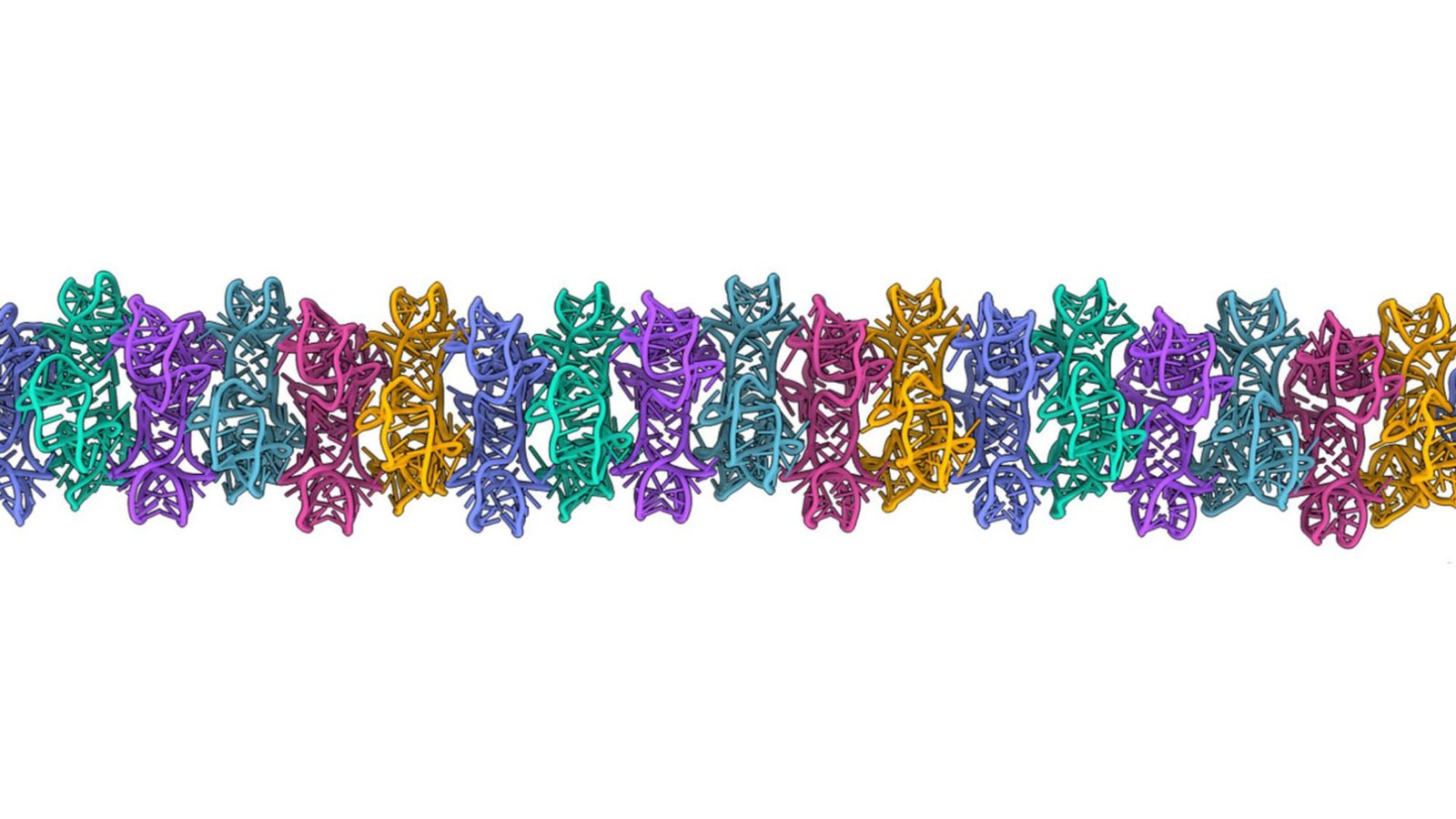
They discovered that some of the RNA molecules formed long filaments. These resembled protein-based filaments such as the cellular cytoskeleton, a scaffold that participates in many functions, including shaping and moving the cell.
Other RNA molecules assembled into cages as large as common viruses. Some of these took the form of an icosahedron — a 3D shape that is built from 20 equilateral triangles and resembles a soccer ball. Many viruses, including herpesviruses, package their genome into protein-based icosahedra called capsids. This raises a question: Could RNA-based capsids have packaged genomes in the RNA world?
RNA structures assemble into icosahedra as large as protein-based virus capsids.
(Image credit: Lin Huang)
This work demonstrates that RNA had the capacity to assemble into these elaborate structures during the RNA world, Huang said, but that doesn’t prove it actually happened.
“I definitely think that environmental parameters are a question,” Anna Medvegy, an evolutionary biologist at Eötvös Loránd University in Hungary, told Live Science in an email. “Can these structures form in the environment in which the hypothetical RNA World existed?” said Medvegy, who was not involved in the new work.
If scientists could recreate these environmental conditions at the dawn of life, such as high temperatures and low pH, and still observe that these structures take shape, that would strengthen the theory that they could have been present in the RNA world, she said.
Although the RNA cages and filaments were large, Huang’s team generated them using only short RNA strands, each no longer than 200 subunits. Medvegy said long RNAs are susceptible to breaking, so if short strands can assemble into these structures, that provides more promise that these multi-tiered molecules could have formed in the RNA world.
Another question is whether these elaborate RNA complexes currently assemble inside the bacteriophage-infected bacteria from which they were derived. So far, Huang’s team has only seen these structures form in a lab dish, so they need to determine if factors inside bacteria, such as proteins, would either disrupt or enable their formation inside cells.
Beyond providing insight into life’s beginnings, these RNA cages could have potential applications in biotechnology, Huang thinks. Efforts are underway to use DNA folded into “DNA origami” to deliver drugs into cells, and Huang thinks DNA’s older cousin, RNA, could one day play a similar role in medicine.
Ren, Y., Zhang, Z., Chen, K., Li, M., Xie, Y., Bai, T., Huang, B., Xiao, B., Westhof, E., Lilley, D.M.J., Wang, J., Miao, Z., Wei, X., & Huang, L. (2026). Structural assemblies for an RNA world. bioRxiv. https://doi.org/10.64898/2026.07.01.735769
Researchers are trying to make human sperm (shown here in a colourized electron microscope image) from stem cells in the lab.Credit: Juergen Berger/Science Photo Library It sounds like science fiction: collecting a person’s blood cells, engineering them so they eventually transform into immature sperm, and then incubating them in a tiny pouch grown on a…
There may be an easier way to describe how black holes “leak” energy than the theory Stephen Hawking proposed — and the newly suggested process is similar to how we describe a boiling pot of water. This simple (well, relatively simple) description could be used to model black holes in many situations such as during…
LTR Pharma (ASX: LTP) has signed a definitive telehealth distribution agreement with Shed Holdings for the planned US commercialisation of its rapid-onset intranasal erectile dysfunction (ED) treatment ROXUS under a partnership intended to provide a scalable route to patients. The agreement converts the parties’ previously announced binding term sheet into a long-form framework covering commercialisation,…
A once-anonymous Maya scientist now has a name. Sak Tahn Waax, or “White-Chested Fox,” is credited as the author of a calendrical formula painted in Maya glyphs on the wall of a ruin in Guatemala, researchers report July 14 in Antiquity. The table of dates and calculations, recorded more than 1,200 years ago, lays out…
Mink numbers in Kent could be cut by 90% within two years under a new project aimed at protecting wildlife. The Waterlife Recovery Trust (WRT) has received a £20,000 grant from the BASC Wildlife Fund to expand trapping and monitoring across Kent, which once had one of Britain’s highest densities of invasive American mink. Conservationists…