
[Sci-Tech NOW] DGIST hosts Glocal Lab plaque ceremony and workshop, secures 279 billion won research base
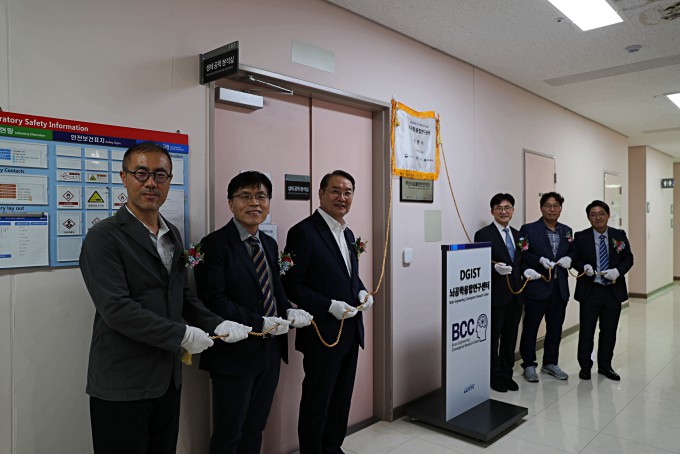
The Brain Engineering Convergence Research Center at Daegu Gyeongbuk Institute of Science and Technology (DGIST) holds a plaque ceremony to commemorate its selection as a ‘Glocal Lab’. Provided by DGIST
■ Daegu Gyeongbuk Institute of Science and Technology (DGIST) announced on the 23rd that its Brain Engineering Convergence Research Center and the Robotics and Mechatronics Engineering Research Institute held a joint plaque unveiling ceremony and workshop on the 22nd at DGIST’s Consilience Hall and other venues to commemorate their selection for the ‘2025 Science and Engineering Academic Research Support Program Glocal Lab’. Around 120 researchers, students, and officials from related institutions attended the event, where they shared the latest research trends in brain engineering and robotics and discussed ways to identify convergence research projects and disseminate research outcomes. The Brain Engineering Convergence Research Center will develop neural circuit digital twin technology based on ‘Neuro-Replica’, which implements the structure and operating principles of actual brain neural circuits in a digital environment. The Robotics and Mechatronics Engineering Research Institute will promote the development of ‘TransHuman Robotics’ that extend human motor, sensory, and cognitive functions, as well as human–robot integration platforms. By linking brain engineering technologies with robotics technologies, the two organizations plan to expand research outcomes into rehabilitation, healthcare, smart manufacturing, and space and marine applications. Through the Glocal Lab program, DGIST has secured a research infrastructure worth a total of 27.9 billion won, including 27 billion won in government funding over nine years and 900 million won in support from Daegu Metropolitan City.
■ Ulsan National Institute of Science and Technology (UNIST) announced on the 23rd that a joint research team led by Professor Bongsoo Kim in the Department of Chemistry at UNIST and Professor Junhoak Oh at Seoul National University has developed a high-performance near-infrared circularly polarized light detector by applying a chiral organic semiconductor thin-film material to a vertical transistor structure. The research results were published online on June 28 in the international journal ‘Advanced Science’. A circularly polarized light detector is an optical sensor that distinguishes whether light is left-handed circularly polarized, rotating to the left, or right-handed circularly polarized, rotating to the right, and can be used in autonomous driving sensors, bioimaging, and security technologies. The research team thermally treated a chiral organic semiconductor thin film with fluorine atoms attached at the molecular ends so that the molecules rearranged into larger and more ordered crystal structures. As a result, the selectivity for absorbing circularly polarized light increased more than threefold, from about 0.03 before thermal treatment to about 0.1 after treatment at 250℃. The team explained that they clarified how the terminal atoms of the molecules and the annealing temperature alter thin-film ordering and circular polarization selectivity, thereby providing design guidelines for high-performance chiral optoelectronic devices.
■ Pohang University of Science and Technology (POSTECH) announced on the 23rd that a research team led by Professor Daesung Jeong in the Department of Chemical Engineering and PhD candidate Wonjun Pyo, working together with teams led by Professor Changyoon Sohn in the Department of Chemistry at Seoul National University, Professor Wei You in the Department of Chemistry at the University of North Carolina at Chapel Hill in the United States, and Professor Kyungjoon Chung in the Department of Chemistry at Kyonggi University, has identified the factor limiting the performance of organic electrochemical transistors and developed high-performance devices. The research results were published online in the international journal ‘Nature Communications’. Organic electrochemical transistors are devices that convert ion motion into electrical current signals and are attracting attention as a core technology for next-generation wearable biosensors that detect physiological signals such as heartbeat, brain waves, and biomarkers in sweat and blood. The research team found through spectroscopic analysis that, contrary to the prevailing assumption that all ions entering the semiconductor contribute to generating electrical signals, in reality only about half of them participate in doping. The limiting factor was the distance between the ions and the main chain of the polymer semiconductor. Conventional oligo(ethylene glycol) (OEG) side chains efficiently attracted ions but hindered their approach to the main chain. The team designed a polymer semiconductor in which, after thin-film formation, the long side chains are removed and only short carboxylic acid groups remain, simultaneously securing ion affinity and accessibility to the main chain. They achieved 100% doping efficiency, in which all injected ions participate in electrical signal generation, and are assessed to have proposed a new design principle for developing high-sensitivity biosensors and medical diagnostic devices.
– doi.org/10.1002/advs.76299
– doi.org/10.1038/s41467-026-75568-7
Copyright ⓒ DongA Science. All rights reserved.