The Blogs: Rosalind Franklin: The DNA of Scientific Revolution — By Sandra Chayo | Silas Anastacio
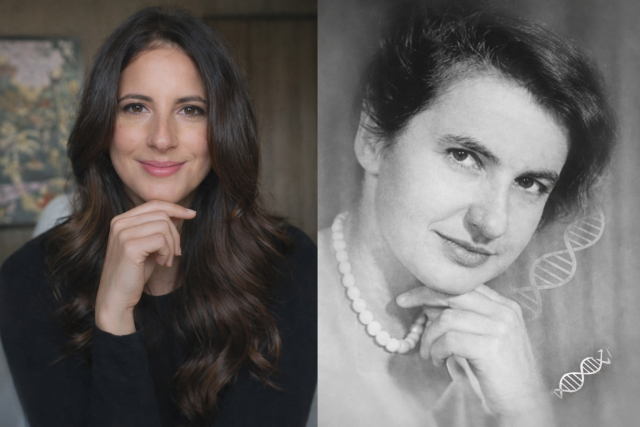
Sandra Chayo, businesswoman and lecturer, descendant of Lebanese and Bolivian Jews, uses her calm and engaging voice to tell the stories of personalities who transformed the world. In her series “Jews Who Changed the World”, she presents the life and legacy of Rosalind Franklin, the invisible scientist who photographed life itself.
Recognized for her role in the development of Brazil’s fashion industry, Sandra has been featured on Show Business with Sonia Racy on BandNews TV — a reflection of the strength and influence of her brand, Hope. Her family story is equally inspiring: her father arrived in Brazil with only a few coins in his pocket and went on to build a multimillion-dollar company, becoming a symbol of national entrepreneurship.
Rosalind Franklin — The Invisible Scientist
Profile and Education
Born in July 1920 in London, Rosalind Franklin grew up in a prominent British Jewish family. From an early age, she displayed extraordinary intelligence — at six, her aunt described her as “alarmingly clever.” By 15, she already knew she wanted to be a scientist. Despite her father’s preference that she pursue social work, Franklin insisted and entered Cambridge, where her scientific vocation took shape.
The Technique That Defined Her Career
At Cambridge, she discovered X-ray diffraction — a technique capable of revealing the internal structure of matter through crystal images. In Paris, under the guidance of scientist Adrienne Bale, a disciple of Marie Curie, Franklin built an international reputation in crystallography, publishing 21 studies on carbon structures in just four years.
King’s College and Photo 51
In 1951, she returned to England to work at King’s College London, where she faced a hostile environment. Her colleague Maurice Wilkins treated her as an assistant, disregarding her expertise and rigorous methods. In 1952, Franklin produced the clearest DNA diffraction image ever captured — the famous Photo 51. Without her consent, the image was shown to James Watson, who, alongside Francis Crick, deciphered the double helix structure and published the article that earned them the Nobel Prize in 1962.
Rosalind Franklin’s name was absent.
Final Years and Scientific Injustice
Diagnosed with ovarian cancer in 1956, Franklin continued her scientific work between hospital stays and travels. She dedicated herself to studying virus structures, paving the way for modern virology. She died in 1958 at the age of 37, unaware that her photograph had been the central proof in the discovery of DNA. Since the Nobel Prize cannot be awarded posthumously, her contribution remained invisible in the official recognition.
Legacy and Reflection
The double helix that appears in every biology textbook exists because Rosalind Franklin photographed it. Her story symbolizes the “invisible contribution” of countless women whose work sustains discoveries without receiving credit. Beyond the injustice, what endures is her integrity and passion for science. Franklin left a legacy that transcends formal recognition — the example of a scientist who, even silenced, shaped the future of humanity.
This article is part of the series “Jews Who Changed the World”, reminding us that science is also built on voices long kept at the margins, but which today deserve to be heard.
Source: Sandra Chayo
Video in Portuguese:
Silas Anastácio is a leading figure in fostering relations between Brazil and Israel. An author, lecturer, and institutional strategist, he works to strengthen dialogue among leaders, defend religious freedom, and combat antisemitism.
His initiatives bridge the cultural, diplomatic, and social spheres, promoting projects that highlight Judeo-Christian roots and reinforce cooperation between communities and institutions.