Robots to help with labor shortage
INTEGRATION:
The robots do not necessarily need to be humanoid, and any technology capable of serving people could become part of future development, an official said
-
By William Hetherington / Staff writer, with CNA
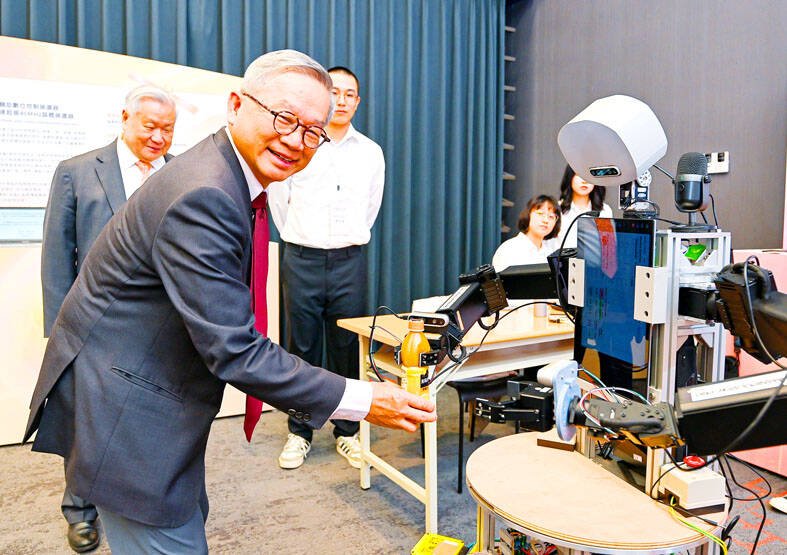
The government is investing in smart robots to help with labor shortages, with the first smart robots expected to enter the market within two years, National Science and Technology Council (NSTC) Minister Wu Cheng-wen (吳誠文) said on Thursday.
The government would combine Taiwan’s strengths in traditional manufacturing and technology industries to develop different types of robots, including caregiving and service robots, covering everything from chips and components to systems integration, Wu said.
The goal is to help address labor shortages and gradually introduce robots into households to assist people in their daily lives, he added.
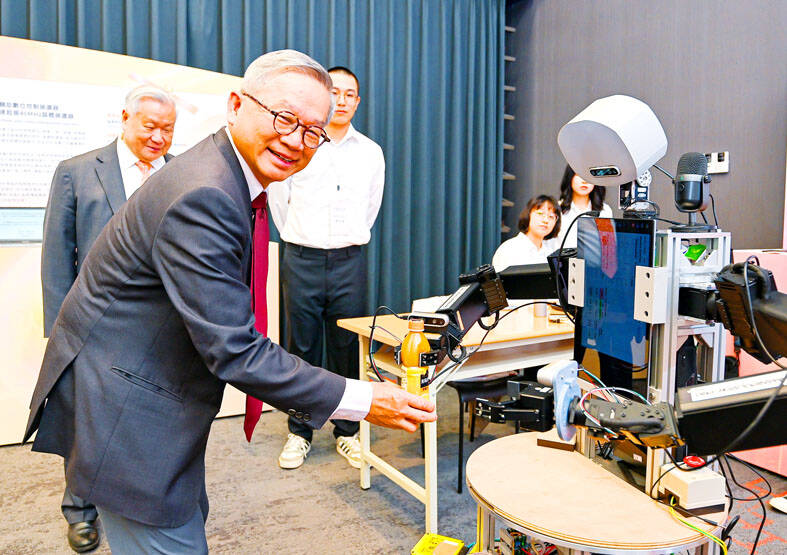
Photo courtesy of the Macronix Education Foundation
The Executive Yuan launched its Action Plan for the Senior Technology Industry in 2024, with the NSTC coordinating resources from the Ministry of Economic Affairs, Ministry of Health and Welfare, Ministry of Education and others. The plan aims to integrate senior-oriented technology into everyday life, from research and development to field testing and service applications.
The NSTC held a presentation on Thursday showcasing the program’s results.
The program set a goal of increasing annual revenue in the health and wellness industry to more than NT$300 billion this year, the council said.
The target was achieved ahead of schedule, with revenue reaching NT$336.4 billion (US$10.4 billion) last year, representing a compound annual growth rate of 8 percent from 2023 to last year.
Revenue is expected to reach NT$350 billion this year and NT$380 billion next year, the Ministry of Economic Affairs said.
Taiwan’s advantages in semiconductors, information and communications technology, and artificial intelligence (AI), combined with its medical and healthcare systems and cross-ministerial cooperation, provide a strong foundation for developing senior-oriented technologies, Wu said.
Facing the challenges of an aging society and declining birthrate, Taiwan must use technology to address labor shortages and respond to daily needs, he added.
The government is now helping traditional manufacturers work with technology companies to develop a complete robotics supply chain, from chips and components to system integration, he said.
Robots do not necessarily need to be humanoid, Wu said, adding that any technology capable of serving people could become part of future development, including caregiving and service robots.
“Smart robots will definitely arrive within two years,” Wu said, adding that some have already completed testing in long-term care facilities and could eventually be introduced into households.
Senior technology projects are often developed for specific programs, he said, adding that the government would conduct needs assessments and establish standards to allow companies to develop products based on those requirements.
Applications could include equipment for medical institutions, caregiving devices and exercise equipment, he said, adding that the goal is to develop the domestic market while also expanding internationally.
The NSTC said technology-assisted care services have already shown preliminary results.
Residential long-term care centers have introduced AI-based smart care systems that integrate care information with AI of Things devices, helping staff reduce the time spent on care records and administrative work.
After implementation, the systems reduced daily care-recording time by 7.5 hours, with user satisfaction reaching 92 percent, the NSTC said.
Smart operations management systems that integrate multiple Internet of Things devices have also helped facilities monitor residents’ conditions in real time and reduce incidents such as falls and missing-person cases, it said.
In addition, after introducing smart care products, daycare centers were able to increase their service capacity from 30 to 90 people with the same number of staff, while reducing monitoring workloads by 20 to 30 percent, it added.


![Autonomous Mobile Robots Market Size & Forecast [2035]](https://jobssz.com/wp-content/uploads/2026/07/report-header-scroll-logo.webp)