I’ve been teaching myself robotics over the last few months, and I wanted to share my latest project.
The main goal was simple: Build a self-balancing two-wheel rover using PVC pipe as the chassis while designing as much of the hardware myself as possible.
Nearly every structural part you see was designed in CAD and 3D printed.
Features
Self-balancing two-wheel rover
Long-range LoRa remote control
Live telemetry
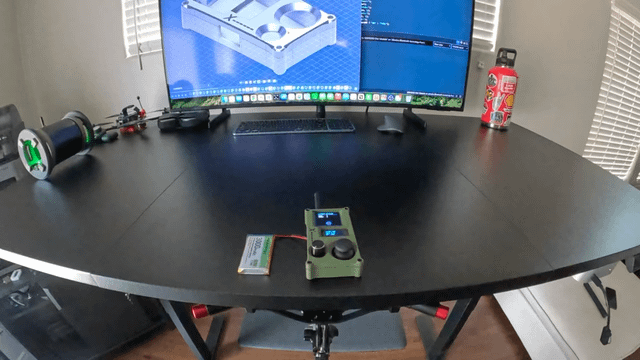
Custom handheld controller
Custom 3D printed drivetrain
Custom traction system
Fully 3D printed electronics mounts
Dual OLED displays on the handheld
Motion-controlled driving (tilt to drive)
Rotary encoder and joystick controls
RGB status display
Custom firmware written from scratch
Drivetrain
Instead of buying off-the-shelf wheels, I designed a modular traction system. The drive rings, traction pads, wheel hubs, motor mounts, and internal supports were all modeled and 3D printed. The body itself is simply a section of PVC pipe. I wanted to see how capable a robot could become using inexpensive materials combined with custom printed parts.
Electronics
Rover
Heltec ESP32 LoRa
BNO08x IMU
TB6612 motor driver
SX1262 LoRa radio
WS2812 LEDs
2S LiPo
Buck converter
Dual geared DC motors
Handheld Controller
Heltec ESP32 LoRa
1.5” RGB OLED
Built-in OLED
MPU6050 IMU
Hall-effect joystick
Rotary encoder
2S battery
Software
Everything is programmed in Arduino. Current features include:
PID balancing
Heading hold
LoRa communication
Telemetry
Battery monitoring
RSSI display
OLED UI
Motion control
Adjustable tuning
What’s Next?
Now that V1 works, I’m debating where to go next.
Option 1: Build a rotating pan/tilt turret with an ESP32 camera, laser, and object tracking.
Option 2: Start over on a V2 chassis using independent cantilever suspension, larger wheels, and a more capable drivetrain.
Which direction would you go?


![What if a model could only learn what trusted LoRA adapters can express? [R]](https://jobssz.com/wp-content/uploads/2026/07/t1vmc27m5vbh1.jpg)

![I built IMGNet – a face verification model that identifies people using sign patterns, not cosine similarity [R]](https://jobssz.com/wp-content/uploads/2026/07/otbyst8xt8ch1.png)