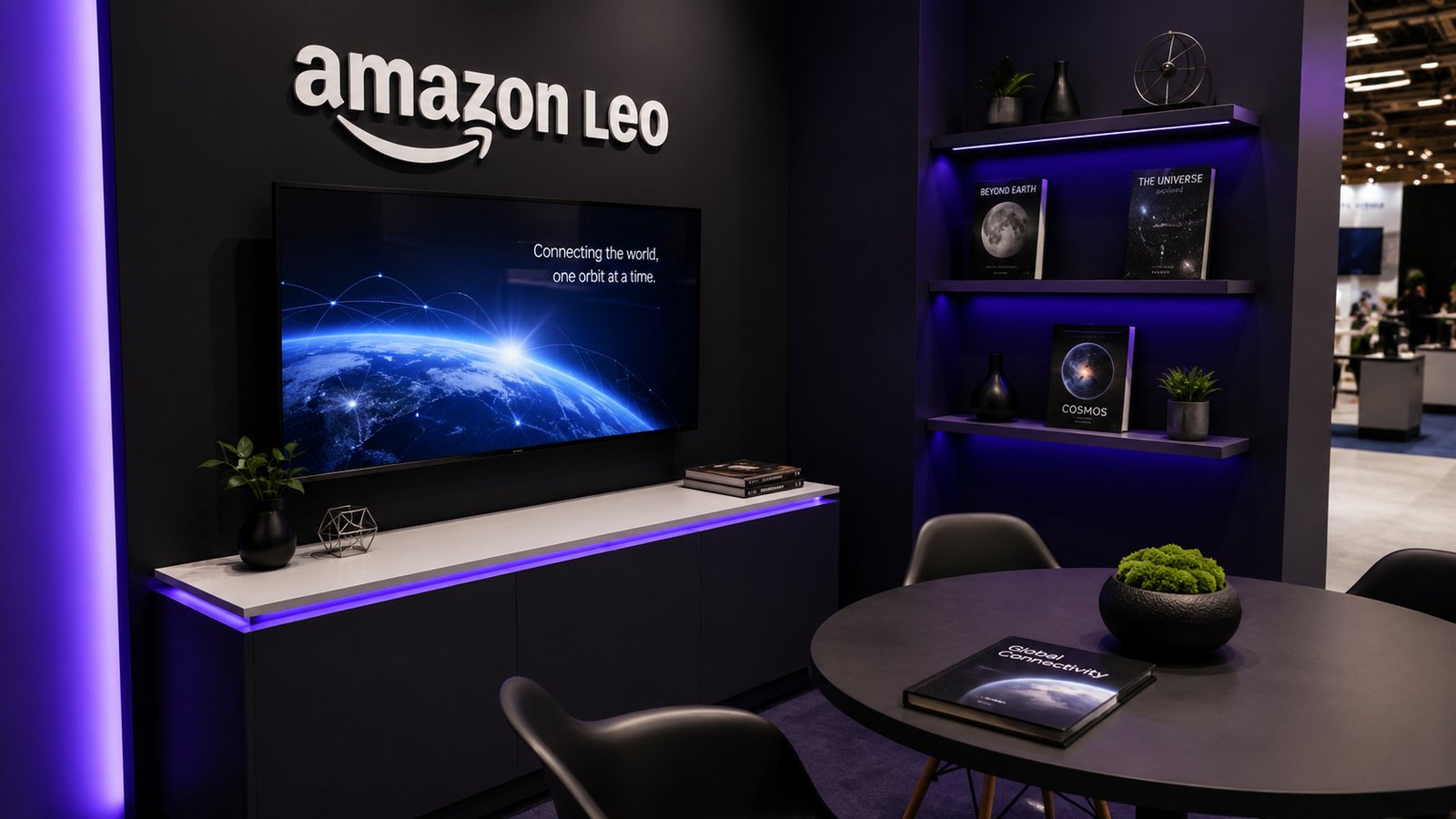
Amazon wants to launch 5,105 satellites to deliver internet directly to cell phones and challenge SpaceX in a competition that could change global telephony.
Amazon Leo project envisions satellite calls, messages, internet, and emergency services, even in areas without coverage from traditional operators.
Amazon intends to expand its presence in the space market with a large-scale project.
On July 27, 2026, Amazon Leo presented a proposal to place up to 5,105 satellites in orbit.
The new constellation is expected to connect satellites directly to smartphones, allowing voice calls, messages, and internet access.
-
Producing 2.644 million units and growing 3.5% in the year, Brazil’s vehicle production advanced in 2025, in a market where registrations reached 2.69 million and exports soared more than 30% in the country.

-
Generating 495 billion reais and surpassing the 455 billion from the previous year, the bar and restaurant sector in Brazil grew in 2025, with an increase that, when adjusted for inflation, was much more modest, at less than 1% in the country.

-
Grinding 195.8 thousand tons with a 14.6% decrease for the year, but receiving more beans, Brazil’s cocoa grinding fell in 2025 in a rare contrast, in a sector where the industry processed less but purchased more raw material in the country.

-
A robot weighing only 23 kilograms plants 60 seeds per minute on the seabed and carries 20,000 seeds in a 20-liter bag to try to restore the underwater meadows that the planet has lost.

The system may also offer emergency services in areas without terrestrial cellular network coverage.
According to information released by Reuters, the implementation is scheduled to start in 2028.
Project depends on approval from United States authorities
Amazon submitted the request to the United States Federal Communications Commission, known as FCC.
The company requested a quick review of the proposal to advance with the new constellation.
The FCC, however, had not officially commented on the request until the information was released.
The project still depends on authorization from U.S. authorities before it can begin operations.
Approval will be crucial for Amazon to start launching the satellites within the planned schedule.
Network will allow calls and internet away from antennas
The constellation was designed to enhance connectivity in locations without terrestrial telephony infrastructure.
The service is expected to allow voice calls, message sending, and data transmission directly via satellite.
The network may also provide internet access in regions far from conventional antennas.
Emergency services are part of the features planned by Amazon Leo.
The proposal aims to serve users who remain without signal in remote areas or outside operator coverage.
Partnerships with operators will expand service reach
Amazon intends to offer the technology in partnership with mobile operators from different countries.
The strategy will allow the integration of the space network with cellular services already offered by local companies.
The company announced partnerships with Vodafone, DirecTV, Herotel, and National Broadband Network, Australia.
These agreements should help in the expansion of coverage and distribution of satellite connectivity.
The model could also accelerate the arrival of the service to international markets.
https://en.clickpetroleoegas.com.br/taxa-das-blusinhas-pode-voltar-apos-disparada-de-compras-internacionais-e-governo-ja-admite-rever-imposto-sobre-encomendas-de-ate-us-50-vacs75/
Purchase of Globalstar strengthens Amazon’s plans
The future network will use the satellite spectrum owned by Globalstar.
Amazon agreed to buy the company in early 2026.
Globalstar already offers direct connectivity for millions of Apple device users.
The technology allows emergency messages, location sharing, and roadside assistance.
These features can be used even when there is no terrestrial network coverage.
The acquisition strengthens Amazon’s strategy to move beyond fixed satellite internet.
Competition with SpaceX, AST SpaceMobile, and Lynk Global
The new constellation expands the competition in the market of direct communication between satellites and cell phones.
Amazon will face competitors like SpaceX, AST SpaceMobile, and Lynk Global.
These companies are also developing technologies capable of connecting smartphones directly to satellites.
The competition involves a market with great potential for expansion in regions without terrestrial infrastructure.
Amazon’s entry could increase the availability of services and accelerate the development of this technology.

Amazon Leo already has about 390 satellites in orbit
Amazon Leo is already working on deploying its first generation of satellite internet.
The company has approximately 390 satellites in orbit.
The current system was developed to provide fixed internet through its own constellation.
The company intends to start offering the service in the first coverage areas as early as 2026.
The new proposal expands this plan by including direct connectivity with cell phones.
Lack of rockets may delay new constellations
The growing scarcity of rocket launch capacity represents a challenge for the sector.
The demand for space on missions has increased with the expansion of satellite constellations.
This limitation could affect the pace of implementation of the projects announced by companies.
Amazon will need to ensure sufficient launches to place thousands of devices in orbit.
The schedule will depend on the availability of rockets and the operational capacity of the companies responsible for the flights.
Dispute between Amazon and SpaceX reached the FCC
The competition between Amazon and SpaceX also sparked debates within the FCC.
Amazon criticized, in March 2026, SpaceX’s plan to launch a constellation with up to 1 million satellites.
The FCC chairman, Brendan Carr, rejected the criticisms presented by the company.
Carr stated that Amazon should focus its efforts on organizing its own launches.
The chairman of the agency also highlighted the pace and frequency achieved by SpaceX.
The statement increased the pressure on Amazon to accelerate its space constellation.
What changes with direct internet for cell phones?
The direct connection between satellites and smartphones could expand access to communication in isolated locations.
Users will be able to make calls and send messages even far from traditional networks.
The feature could also be important in emergencies, travel, and regions with little infrastructure.
Amazon bets that its constellation could occupy a significant position in this market.
FCC approval and the start of launches will be decisive for the project’s progress.
The competition with SpaceX, AST SpaceMobile, and Lynk Global is expected to grow in the coming years.
Do you believe that direct satellite internet could replace part of traditional cellular networks or will it continue to be a service mainly for emergencies and remote areas? Leave your opinion!