The Sky Today on Friday, July 10: Meet Mizar and Alcor
Famous double stars Mizar and Alcor in the handle of the Big Dipper are a visual challenge with the naked eye — can you split them?
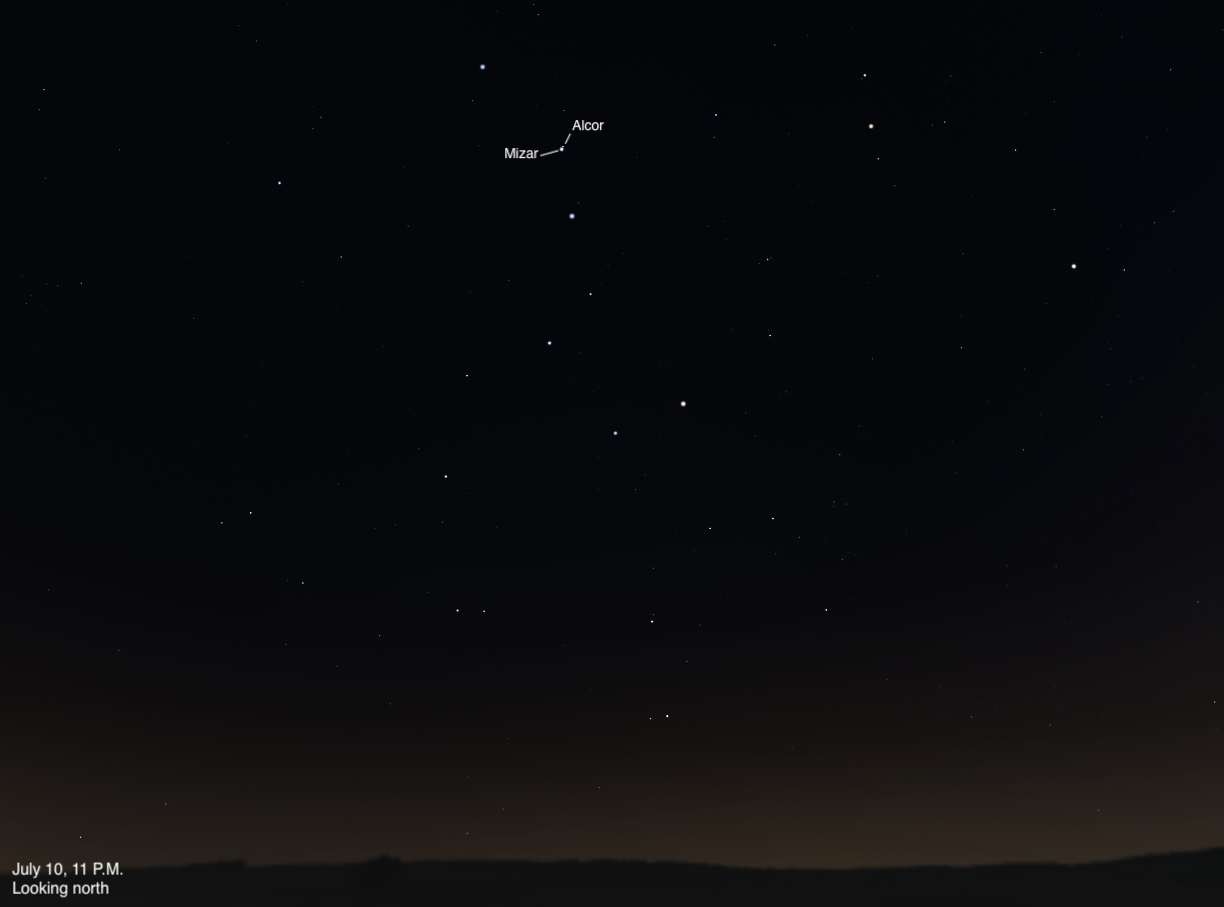
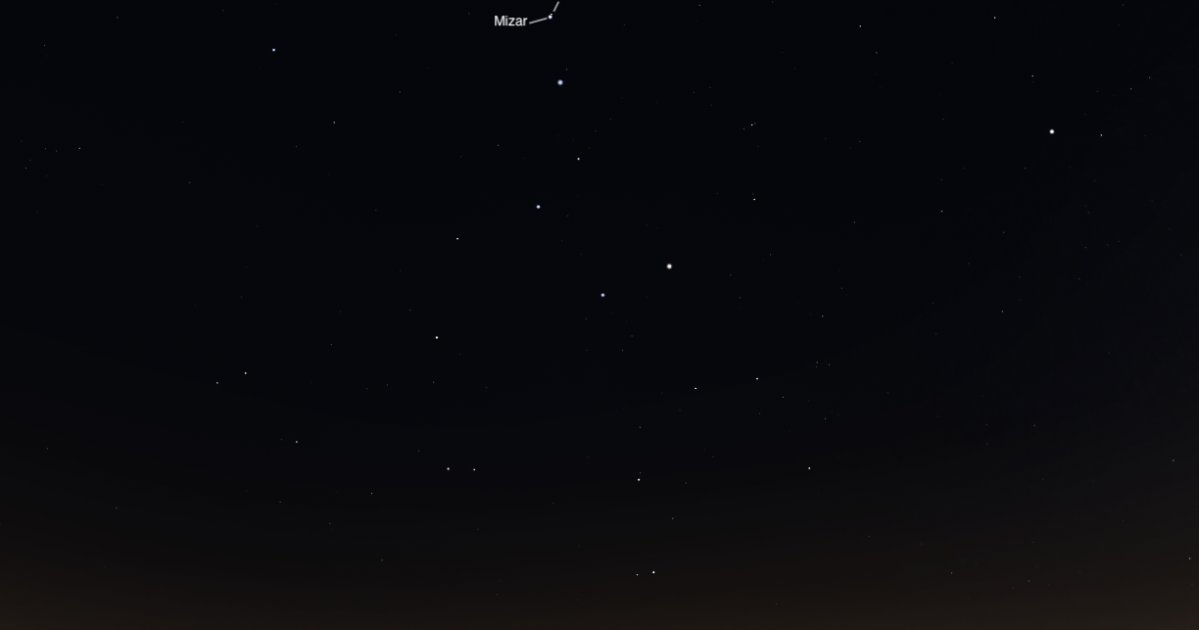
Look closely at the “kink” in the Big Dipper’s handle — can you make out two stars there, close together? These are Alcor and Mizar. If you can’t quite see them with the naked eye, you will easily separate them in any optics. Credit: Stellarium
Looking for a sky event this week? Check out our full Sky This Week column.
July 9: Venus stands above Regulus
Look north after dark tonight to spot one of the most famous asterisms in the sky: the Big Dipper. Late tonight, it lies to the lower left of the North Star, Polaris, with its cup below the curving handle.
That handle is where we’re looking tonight — specifically, the spot where the handle is kinked and changes direction, at the second star from the end. Look at this star — Mizar — closely. Do you see one star, or two? You may notice a small, faint star just to Mizar’s upper right (southeast): this is Alcor. Glowing at magnitude 4.0, Alcor is much fainter than magnitude 2.2 Mizar, but sits 11.8′ away, far enough to make out with the naked eye from a dark site and if your visual acuity is good. And because they are so widely separated, they will easily split into two in any optics, including binoculars or any size telescope.
This lovely pair is likely not physically bound, however, but is part of a loose cluster of stars all moving together through space, called the Ursa Major Moving Group. Also in that group are Merak, Phecda, and Megrez in the Big Dipper, as well as many more not part of this specific star pattern.
Sunrise: 5:41 A.M.
Sunset: 8:30 P.M.
Moonrise: 1:31 A.M.
Moonset: 5:01 P.M.
Moon Phase: Waning crescent (16%)
*Times for sunrise, sunset, moonrise, and moonset are given in local time from 40° N 90° W. The Moon’s illumination is given at 10 P.M. local time from the same location.
Alison Klesman is senior editor of Astronomy magazine. She holds a Ph.D. in astronomy and has studied a variety of topics, from minor planets to supermassive black holes.