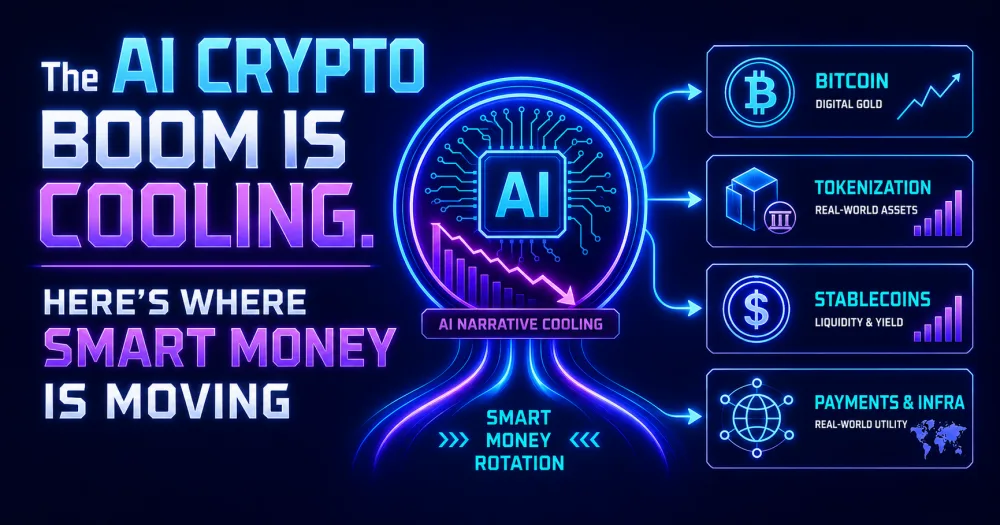
The AI Crypto Boom Is Cooling. Here’s Where Smart Money Is Moving
The AI crypto boom is cooling off as the market looks elsewhere for the next big thing. With gains across hundreds of tokens, investors are looking for something bigger than just a speculative story – money is flowing towards Bitcoin, Ethereum, tokenized assets, stablecoins, payments and blockchain infrastructure.

Contents
Why AI Crypto Tokens Are Losing Momentum
Slowing Investor Interest After Explosive Gains
The initial rush behind AI crypto was fueled by novelty, as investors assumed that artificial intelligence and blockchain technology would become foundational technologies.
As a result, almost anything tying itself to the space saw demand, even if the underlying project had little to do with either. This created a situation where price greatly exceeded adoption, and investors began to realize that not every proto-AI token would thrive.
Related: What’s the Next Big Crypto Narrative After AI Tokens? Top Sectors to Watch in H2 2026
Profit-Taking Across Leading AI Tokens
Profit-taking across the sector has caused short-term selling pressure, particularly for tokens close to major unlocks, but the broader market is looking elsewhere.
While the AI hype may well revive, investors are focusing on more substantive assets.
AI Narratives Give Way to Stronger Market Themes
As noted above, many AI crypto projects are speculative, with price gains driven more by hype than hard fundamentals. At the same time, other areas of crypto offer more attractive long-term value propositions, including tokenization, stablecoins, payments, and institutional adoption of Bitcoin.
While AI crypto tokens can certainly appreciate, they are no longer seen as the best way to gain exposure to foundational technological shifts. For similar reasons, investors are also gravitating toward blockchain infrastructure and custody.
What Is Replacing the AI Crypto Narrative?
Real-World Asset (RWA) Tokenization
Real-world asset (RWA) tokenization is emerging as a compelling alternative to AI-linked blockchain activity.
Tokenization creates value by bringing traditional assets such as sovereign bonds, private credit, and commodities onto the blockchain.
This trend spans custodians, identity management, smart contracts, and much more. Meanwhile, tokenization provides a pathway for wider adoption of digital assets, as it helps established financial instruments access permissionless blockchain systems.
Stablecoin Infrastructure
Like RWA tokenization, stablecoins are disrupting established financial markets by providing a permissionless medium of exchange.
The rise of algorithmic and fiat-backed stablecoins has fueled demand from institutional investors, but the asset class has further value as a medium for cross-border settlement and payments. As a result, capital is flowing into stablecoin infrastructure, including the underlying networks and protocols that facilitate their use cases.
Blockchain Payments
Blockchain payments seek to disrupt settlement and cross-border transfers, but faster settlement alone is unlikely to be sufficient for widespread adoption.
Instead, stablecoin-backed blockchain payment solutions and protocols can appeal to institutional investors by bridging the on-chain and traditional financial worlds.
Institutional Bitcoin Adoption
Bitcoin is the preferred institutional digital asset, due to its deep liquidity, scarcity, recognizable brand, and regulatory tailwinds, but it is also a safer bet in uncertain markets.
When it comes to institutional investing, Bitcoin typically draws more capital than other crypto asset classes, even if it has lower-profile use cases than many alternative tokens.
Related: AI Trading Firm Drops Deal for Trump-Linked Crypto Business
Where Smart Money Is Moving in 2026

Bitcoin Remains the Top Institutional Choice
When it comes to institutional adoption, Bitcoin is often the preferred choice. This is due to both its favorable risk/reward profile, as well as its superior liquidity, which makes it more attractive than most other digital assets.
In addition, institutional investors often prefer large-cap assets, rather than taking on the risks associated with smaller, more speculative tokens.
As a result, institutional interest in crypto is often funneled into Bitcoin, making any discussion of institutional adoption incomplete without acknowledging the importance of BTC▲$62,630.00.
Ethereum’s Role in Tokenization and DeFi
Ethereum provides institutional investors with exposure to two separate market themes: the rise of stablecoins and tokenization, as well as the growth of DeFi. The former represents a separate narrative, while the latter has seen institutional investors begin allocating capital to yield-generating on-chain assets.
Meanwhile, institutional investors are also keen to benefit from ongoing improvements to the Ethereum settlement layer, despite the possibility of value being displaced by Layer-2 solutions.
Infrastructure Projects Attracting Capital
Much institutional capital is being directed at custody, middleware, oracles, and security, as these solutions are critical enablers for other blockchain-based applications.
These plays can be compelling from an investment perspective, due to their potential for recurring revenue, as well as their capacity to strengthen the broader blockchain ecosystem.
The most successful infrastructure tokens are likely to have a multi-sided network effect, while also possessing a viable business model that benefits from the growth of the broader industry.
Read more: Robinhood Chain Memecoin Season: Top 10 Coins to Watch in Summer 2026
Blockchain Companies Benefiting From Institutional Demand
Individual tokens are not the only winners in the institutional adoption narrative, as custodians, exchanges, and payment processors also stand to benefit from increased institutional participation
In some cases, institutional investors may actually favor equity over crypto, due to the potential for more predictable cash flows.
As a result, the best crypto buys in 2026 may not always be individual tokens, but rather firms whose services are being utilized by institutional investors.
Which Crypto Sectors Are Seeing the Biggest Capital Inflows?
Tokenization Platforms
Tokenization platforms facilitate interaction between blockchains and traditional financial markets by enabling the creation of on-chain representations of real-world assets. In doing so, they help digitize financial instruments, while also fueling further adoption of crypto by institutional investors.
However, it is important to differentiate between platforms and their native tokens, as the latter may struggle to gain traction, despite the network effect created by the former.
Stablecoin Ecosystems
The rise of stablecoins has created value across the ecosystem, from underlying networks to lending protocols and payment processors.
As a result, institutional investors are seeking exposure to this burgeoning asset class, which has the potential to disrupt traditional finance.
The main areas of focus include base layers, exchanges, lending desks, and payment solutions. However, risks should be considered, including stability of reserves, potential concentration risk among issuers, depegging risk, and regulatory scrutiny
Layer-1 Blockchains
Settlement remains a vital function within the financial system, and institutional investors are keen to participate in this area of crypto, as it supports other aspects of the ecosystem, including stablecoins and tokenization.
However, institutional adoption may be concentrated among certain L1 blockchains, which possess desirable attributes such as developer-friendly tooling, stablecoin liquidity, and a robust app ecosystem, rather than being spread across the entire market.
Crypto Infrastructure and Middleware
Much like custody infrastructure, middleware links other applications and services on-chain and off-chain, thus facilitating their interactions.
With institutional adoption of crypto, the need for price aggregation, messaging, and settlement middleware is likely to grow, making such solutions compelling from an investment perspective.
At the same time, infrastructure is a competitive space, with some tokens failing to gain sufficient traction, despite offering valuable services.
Why Institutions Are Shifting Their Investment Strategy

Lower-Risk Digital Assets
Institutional investors tend to seek out crypto assets with deeper liquidity and wider adoption, as these typically carry lower risk, compared to lesser-known offerings.
This dynamic applies to most asset classes within crypto, spanning tokens, apps, and traditional financial instruments.
At the same time, the relative appeal of different narratives can change, as institutional investors may favor certain areas based on risk/reward considerations.
Regulatory Clarity
Many institutional investors are waiting for clarity on regulation, as ambiguous rules around custody and reporting can add complexity to their operations.
The resolution of these issues, as well as more explicit rules around stablecoin issuance and tokenized asset distribution, could spur crypto adoption among institutional investors and improve asset prices for certain tokens.
Long-Term Adoption Over Speculative Narratives
Institutional investors make decisions on a longer time horizon, and so they are likely to favor areas of crypto with the most adoption potential.
This is already shaping the market, as capital is flowing into institutional custody, payments, and settlement, rather than narrative-driven tokens.
In essence, institutional investors are looking to capitalize on the next major wave of adoption, while being mindful of the risks associated with speculation-driven markets.
Related: Borrow Against Your Altcoins: Top 3 Crypto Loan Platforms in the US
Can AI Crypto Make a Comeback?
What Could Reignite the AI Narrative?
The hype around AI in crypto could see a revival if there is sufficient demand from institutional investors for blockchain-based solutions.
A robust market for decentralized computing resources, data networks, and autonomous agents utilizing on-chain payments would see a resurgence in prices.
However, a return to speculative excess would require fundamental improvements to the adoption prospects for such solutions and the economics of individual tokens.
Risks Facing AI-Related Crypto Projects
Much like the hype around blockchain and DeFi in 2020, many investors are trying to capitalize on the next big thing.
As such, it is important to distinguish between projects which provide valuable services to institutional investors, and those which utilize AI as a buzzword to drive hype and generate volume.
Some protocols may also struggle against bigger, more established cloud computing solutions, or suffer from inflationary supply dynamics, inferior governance models, weak data privacy, and dependence on third-party infrastructure.
Indicators Investors Should Monitor
Investors should assess developments across multiple indicators, including revenue, user growth, demand for on-chain computation, developer activity, token unlocks, and strategic partnerships.
While social media attention can drive hype, a paradigm shift is likely to occur when user adoption and token utility rise alongside improved liquidity.
Which Cryptocurrencies Could Benefit the Most?
Bitcoin
Bitcoin is well-positioned to benefit from the move toward bigger names with wider institutional adoption, as it is both liquid and deeply integrated with institutional investing in crypto.
While it is unlikely to see the same percentage-level gains as some speculative tokens, Bitcoin possesses greater upside potential than most narrative-driven assets.
Ethereum
Ethereum’s institutional prospects span the entire tokenization value chain, including stablecoins, yield infrastructure, and DeFi.
While some institutional capital may shift toward Layer-2 solutions, Ethereum remains a compelling settlement layer, with investors eager to benefit from broader demand for tokenized assets.
Leading RWA Projects
Leading RWA projects can benefit from a combination of favorable macro conditions and institutional adoption, but individual tokens may struggle to gain traction due to a fragmented market landscape.
Stablecoin and Payment-Focused Tokens
Some stablecoin, payments, and blockchain infrastructure tokens can see their value accrual potential realized if institutional adoption of these services accelerates.
| Asset/Sector | Main Thesis | Key Risk | 2026 Outlook |
|---|---|---|---|
| Bitcoin | Institutional reserve asset | Macro pressure | Strong |
| Ethereum | DeFi and tokenization infrastructure | Competition | Positive |
| AI Crypto Tokens | AI-powered blockchain applications | Weak utility | Selective |
| RWA Tokens | Real-world asset tokenization | Regulatory complexity | Strong |
| Stablecoin Tokens | Payments and settlement | Regulation | Positive |
| Infrastructure Tokens | Oracles, interoperability and middleware | Weak token economics | Promising |
Final Thoughts. Is the AI Crypto Boom Over?
The speculative frenzy around AI crypto may well cool, but the space is poised to see a next big thing emerge soon.
Blockchain technology has the potential to disrupt traditional markets, including computing, data, information verification, and M2M payments.
However, the current environment is unfavorable for proto-AI tokens that seek to utilize hype to generate value, rather than possessing a viable value capture mechanism and institutional adoption.
As a result, capital is flowing toward assets which represent a deeper shift, including Bitcoin, Ethereum, tokenization platforms, stablecoin ecosystems, payments, and custody.
What Investors Should Watch Next
The institutional adoption, tokenized-asset boom, stablecoin value capture potential, regulatory developments, and infrastructure revenue growth are all worth keeping an eye on in the coming years.
In addition, investors should watch out for institutional adoption of AI-linked solutions, as well as their ability to convert technical improvements and partnerships into broader user growth and yield generation.
The next big thing in crypto may well involve deeper integration with the traditional financial system, and institutional investors can profit from the disruption by investing in appropriate tokens.
FAQ
What Is Causing AI Crypto Tokens to Lose Momentum?
Prices ramped up faster than adoption, early investors are cashing out, and money is flowing into more mainstream narratives.
Where Is Smart Money Moving in 2026?
Institutions are bullish on Bitcoin, Ethereum, tokenization, stablecoins, payments, infrastructure, and digital asset enablers.
Can AI Crypto Coins Recover?
Recovery is possible, but it is likely to be slow and requires significant adoption, revenues, meaningful DeFi services, and better tokenomics.
What Could Become the Next Crypto Narrative?
RWA tokenization, stablecoins, institutional adoption, and infrastructure development.
Are Bitcoin and Ethereum Safer Than Smaller Narrative Tokens?
They are less risky assets, but volatility is still present, and their underlying infrastructure and liquid markets offer more security.
Which Sector Has the Strongest Long-Term Potential?
Tokenization, stablecoins, payments, and infrastructure are all compelling, but adoption, regulation, and value capture potential dictate outcomes.