Africa’s startup space is moving in right direction when it comes to gender diversity
African tech has a serious gender problem when it comes to women within leadership positions at startups, yet there has been tangible progress on this front since 2023.
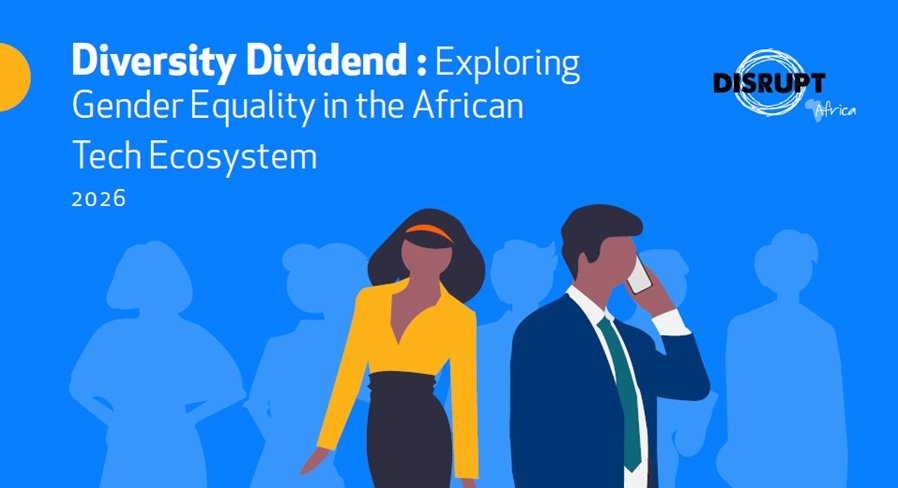
That is according to the third edition of “Diversity Dividend: Exploring Gender Equality in the African Tech Ecosystem”, the regular deep-dive into the state of gender diversity in the African startup and VC ecosystems released by Disrupt Africa in partnership with Madica, Thinkroom and Jumpstarter Crowdfunding.
The report contains both quantitative and qualitative data – quantifying female founders in the ecosystem, as well as their access to funding and opportunities, and speaking to them – and investors – directly about their experiences within the ecosystem. It also features personalised case studies, and is free to download here.
The 2026 edition finds slow but steady progress has been made in terms of gender diversity over the last few years. Back in 2023, when Disrupt Africa released the first version of the report, only 350 (14.6%) of the 2,395 startups tracked had at least one female co-founder, and just 230 (9.6%) were led by a female CEO. That improved marginally in 2024, when 483 (17.3%) of the 2,786 startups had a female co-founder and 310 (11.1%) a woman CEO.
This edition, with the benefit of a further two years, analysed more startups than ever before, and found gender diversity to have reached unprecedented heights. Of the 3,331 startups tracked for the purposes of this publication, 641 (19.2%) had at least one woman on their founding team, and 402 (12.1%) were led by a female CEO.
Clearly African tech remains a male-dominated landscape, and there is much to be done to ensure that more women enter the space, and co-found or lead tech startups. But increases of almost five percentage points, in the case of female co-founders, and three percentage points, for female CEOs, over just three years are not to be sniffed at. These increases suggest the ecosystem is moving in the right direction, and that is worthy of praise.
Gender diversity varies significantly from country to country, but no one market has more than 29 per cent of its startups with a female co-founder or CEO. Typically, the better performing markets for gender diversity are smaller ones, such as Zambia, Uganda, Senegal and Rwanda, but over the last few years the so-called “big four” markets of South Africa, Nigeria, Egypt and Kenya have closed the gap. Much of the improvement in gender diversity figures since 2023 can be attributed to improvements in those four markets.
Nigeria saw female representation within founding teams grow to 22 per cent from 20.7 per cent in 2024 and 16.5 per cent in 2023, while the percentage of startups with female CEOs increased to 13.1 per cent from 12.1 per cent in 2024 and 10.8 per cent in 2023. In South Africa, the percentage of startups with a female co-founder grew to 19.1 per cent from 18.1 per cent in 2024 and 13.6 per cent the previous year. The percentage with women CEOs also grew, to 12.3 per cent from 11.6 per cent and 8.8 per cent respectively.
In Kenya, female representation within founding teams hit an impressive 23.6 per cent, up from 20.6 per cent in 2024 and 16.6 per cent in 2023. The percentage of ventures with female CEOs was also up, 16.7 per cent from 14.1 per cent in 2024 and 11.2 per cent the year before. Egypt saw the number of ventures with a female co-founder increase to 15 per cent, and the share of female CEOs grow to 7.6 per cent.
Growth has been more patchy elsewhere, and in smaller markets the trends are more random. Tunisia and Cameroon saw decreases in both the share of startups that had a female co-founder or CEO. Senegal, Rwanda and Tanzania made positive steps in terms of co-founder diversity but fell back in terms of the share of female CEOs. Ethiopia had a smaller share of female co-founders but a higher percentage of women CEOs. In some relatively developed markets, like Ivory Coast, there is barely a woman to be found among founding teams, but in others, like Zambia, almost one-third of co-founders are female and just short of a quarter of CEOs.
So though there has certainly been an increase in gender diversity within the African tech ecosystem, it is not happening at the same rate across all countries.
When it comes to sectors, the best performing verticals within the African tech startup ecosystem from a diversity perspective are legal-tech, e-health, ed-tech, recruitment and HR, e-commerce and retail-tech, agri-tech, and entertainment, but only legal-tech has passed the 30 per cent mark for any metric – the share of female co-founders.
Fintech, by far the leading vertical in terms of number of startups, and indeed investment, continues to perform relatively poorly, with just 16.5 per cent of fintech ventures having a female co-founder and only 8.9 per cent having a woman CEO. It did see some growth, however, as indeed did all of the leading five verticals by startup numbers.
To download the report for free, please go here, or email Gabriella on [email protected], or Tom on [email protected].

![[Korean Startup Weekly News #126] Physical AI Takes Center Stage](https://jobssz.com/wp-content/uploads/2026/07/Korean-Startup-Weekly-News-126-cover-image-1-1-768x432.jpg)