Atoms Raises $1.7 Billion to Bring CloudKitchens, Restaurant Software and Robotics Under One Roof |

By Dustin Stone, RTN staff writer – 7.31.2026
Atoms, the industrial automation company led by Uber co-founder Travis Kalanick, has announced a $1.7 billion investment that brings CloudKitchens and several related food technology businesses into a single corporate structure. Andreessen Horowitz led the investment, with participation from Uber, Bain Capital, Fifth Wall, Chemistry, A*, K5 Global, Abstract, SV Angel and Alpha Square Group. Andreessen Horowitz co-founder Ben Horowitz will join the Atoms board.
Atoms described the transaction as a $1.7 billion equity investment. The company separately listed Bank of America, Goldman Sachs, Wells Fargo, JPMorgan and Barclays as debt partners without disclosing the size or terms of their facilities. The Financial Times characterized the broader financing as a combination of debt and equity, so the total capital available to Atoms may extend beyond the equity portion highlighted in the company’s announcement.
The size of the financing places Atoms in a rare category among restaurant technology companies. Most kitchen automation vendors are trying to perfect one machine or solve one operational problem. Kalanick is assembling the real estate, software, robotics and logistics needed to influence nearly every stage of off-premises food production.
Atoms currently lists seven businesses or operating areas. Its food portfolio includes CloudKitchens, restaurant technology platform Otter, kitchen robotics developer Lab37, workplace meal-delivery service Picnic and food-production real estate company ProFood. Atoms also owns autonomous mining technology provider Pronto and is developing a transportation automation business that has not yet been formally introduced.
Kalanick has framed Atoms as the next stage of a project he began at Uber and continued at CloudKitchens: using software to understand, predict and control activity in the physical world. In the restaurant business, that means treating kitchens, equipment, ordering systems and delivery networks as parts of one coordinated production system rather than as separate investments.
That vision is ambitious, but the first restaurant product is deliberately narrow. Lab37’s Bowl Builder automates the assembly of salads, grain bowls and other customizable meals, a category that has attracted significant robotics investment because the production process is repetitive and ingredient portions can be standardized.
Restaurant employees prepare ingredients and load them into temperature-controlled dispensers. Bowl Builder then handles the process from dispensing the container through assembling the order and closing the bag, including modifications and ingredient exclusions. Lab37 says the system can reduce makeline labor costs by as much as 50% while improving portion accuracy, throughput and consistency, although those performance claims have not been independently validated across a broad group of restaurant operators.
Lab37 has been testing Bowl Builder through several restaurant concepts operating from CloudKitchens facilities. The concepts include Hungry Cowgirl, Meat + Rice, Farmstand and Pita Dust, with operations reported in Pittsburgh, Los Angeles and New York. The company’s current product materials say Bowl Builder is already operating in restaurants across the United States, but it has not disclosed the number of systems in commercial use.
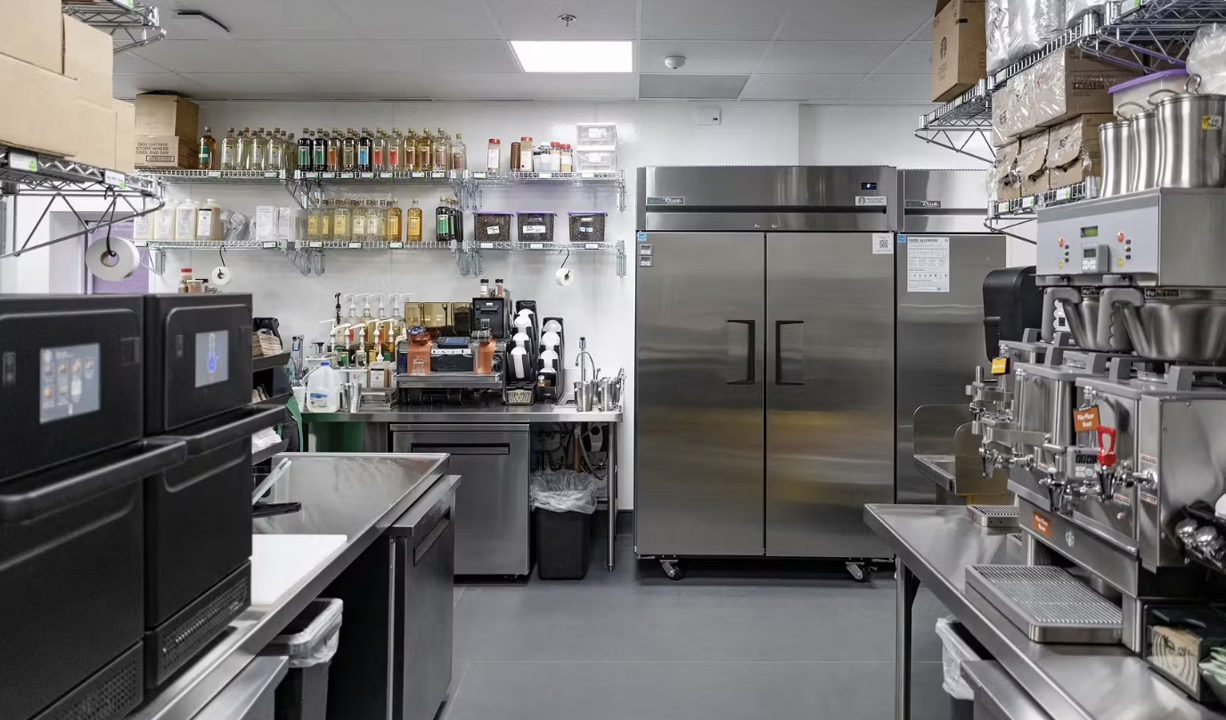
CloudKitchens gives Lab37 something many restaurant robotics companies lack: a controlled environment where machines can be tested against live orders before outside operators are asked to adopt them. The facilities also place multiple restaurant businesses under one roof, potentially allowing automated equipment, support teams and other infrastructure to serve more than one concept.
That shared environment could improve the economics of kitchen robotics. A machine used by one restaurant for a few peak hours each day may struggle to generate an acceptable return. The same equipment could be more productive if several concepts use it over longer operating periods and combine enough demand to keep it running closer to capacity.
Otter provides another part of the equation. The platform connects online ordering channels, point-of-sale functions and kitchen workflows, giving Atoms a software layer capable of routing orders into production equipment and tracking their progress through the kitchen. Atoms says Otter is being developed for use across thousands of restaurants, including locations that need to keep ordering and kitchen devices synchronized when internet connections are unreliable.
Picnic adds a different source of demand. The service aggregates workplace lunch orders into scheduled delivery windows, allowing meals from several restaurants inside the same CloudKitchens facility to be transported in larger batches. Atoms argues that concentrating restaurants, orders and delivery destinations can lower fulfillment costs while preserving menu variety.

These businesses are already related through common ownership, but Atoms has not yet shown how completely their technology and operations have been integrated. The company’s challenge is to turn a collection of assets into a system that produces measurable benefits for restaurant operators rather than simply creating a larger corporate portfolio.
CloudKitchens itself offers both an advantage and a cautionary history. The company raised at least $1.25 billion in earlier rounds and was valued at a reported $15 billion following an $850 million financing completed in 2021. That valuation reflected intense investor enthusiasm for delivery-only kitchens during the pandemic, but the category later encountered tenant churn, site closures and questions about whether individual restaurant operators could generate sustainable demand and profits from the facilities.
Automation could help address some of those weaknesses by lowering production costs and improving consistency. It cannot, however, solve weak restaurant concepts, high digital marketing expenses or insufficient customer demand. Atoms will still depend on the quality of the brands operating from its kitchens and their ability to generate repeat business.
The closest comparison is Wonder, the food technology company founded by Marc Lore. Wonder raised $650 million in July at a $9 billion pre-money valuation and plans to use the capital for additional locations, artificial intelligence, robotics and supporting infrastructure. Its footprint has grown from 46 to 140 locations since May 2025.
Wonder has also assembled a vertically integrated food platform, but it approaches the market from the consumer side. It operates physical food halls and delivery-focused restaurants, owns Grubhub and Blue Apron, and allows customers to combine meals from several restaurant concepts in a single order. Its Infinite Kitchen robotics platform is already being used for automated bowl production in live commercial settings.
Atoms begins with a different set of assets. CloudKitchens primarily provides infrastructure to restaurant businesses, while Otter sells software to operators and Lab37 develops production equipment. That structure could eventually allow Atoms to serve outside brands without requiring them to become part of a consumer-facing Atoms restaurant network.
Wonder has greater control over the recipes, menus, kitchen layouts and customer experience inside its own locations. That makes it easier to design each operation around automation. Atoms may have more flexibility to support a wider variety of restaurant concepts, but that variety makes the engineering problem harder because menus, ingredients, portion sizes and preparation methods differ from one operator to another.
The competition also includes companies focused on individual parts of the kitchen. Hyphen has developed an automated makeline that assembles bowls and salads below a conventional food-preparation surface, allowing employees to continue making other orders manually above it. Chipotle has invested in Hyphen and tested the equipment alongside Autocado, an avocado-processing system developed with Vebu.
Miso Robotics has concentrated on the fry station with Flippy. In June, Miso acquired the hardware, software and intellectual property of failed pizza robotics company Zume, including more than 300 patents covering food preparation, delivery and packaging. The acquisition gives Miso a larger technology portfolio, but Zume’s collapse also serves as a reminder that sophisticated equipment and substantial venture funding do not guarantee a workable restaurant business.
Sweetgreen has taken another path. The restaurant chain acquired Spyce to develop Infinite Kitchen, deployed the system in its own restaurants and later sold the automation business to Wonder while retaining plans to use the equipment in future locations. Sweetgreen expects roughly half of its new restaurants opening in 2026 to include Infinite Kitchens.
These competitors illustrate the main strategic choices taking shape in restaurant automation. Chains such as Sweetgreen and Chipotle are designing systems around their own menus. Companies such as Miso and Hyphen offer more focused equipment to outside operators. Wonder is building automation into a consumer platform, while Atoms is trying to create a broader infrastructure layer that links kitchens, software, robots, real estate and logistics.
The Atoms model could create advantages if each part strengthens the others. CloudKitchens can provide locations and live production environments. Otter can direct orders and capture operating data. Lab37 can automate food assembly, while Picnic can concentrate demand and make delivery routes more efficient.
The same breadth brings risk. Real estate, restaurant software, food production, robotics, delivery logistics, mining equipment and transportation automation have very different capital requirements and operating cycles. Atoms will need disciplined management to prevent its industrial ambitions from distracting attention from the practical needs of restaurant customers.
Bowl Builder will be judged less by the sophistication of its engineering than by the daily realities of a working kitchen. Restaurant operators will want to know how long the equipment takes to clean, how it handles sticky or irregular ingredients, what happens when a dispenser jams and how quickly a technician can restore service during a lunch rush.
Food safety and allergen controls will also matter. The machine must consistently dispense the correct ingredients, maintain safe temperatures and prevent cross-contact while accommodating the substitutions and modifications common in digital orders.
Labor savings require careful examination as well. Bowl Builder may reduce the number of employees needed on the assembly line, but restaurants still need people to receive products, prepare ingredients, refill dispensers, clean the equipment and deal with exceptions. The relevant figure is the net reduction in total labor hours, not simply the number of employees who no longer stand at the makeline.
Kalanick has argued that specialized machines are better suited to high-volume industrial work than humanoid robots attempting to imitate employees. That view is consistent with the restaurant systems that have advanced furthest: purpose-built equipment handling a fryer, avocado preparation or bowl assembly rather than a general-purpose robot trying to perform every kitchen task.
Uber’s participation in the financing adds another layer of interest. No new commercial partnership between Uber and Atoms was announced, but Uber brings considerable experience in delivery demand, routing and marketplace logistics. Its investment also reconnects Kalanick with the company he co-founded nearly two decades ago.
The $1.7 billion investment gives Atoms the resources to develop and deploy hardware at a scale few restaurant automation companies could match. It also raises expectations. Restaurant robotics has a long history of impressive demonstrations followed by slow installations, expensive maintenance and disappointing returns.
Atoms has a better testing environment than most startups and a collection of businesses that could support each other. The next step is proving that the combination works outside carefully designed pilots and can deliver attractive economics for restaurant brands that Atoms does not own.
If Bowl Builder can operate reliably, reduce the full cost of production and integrate cleanly with existing restaurant workflows, CloudKitchens could become more than a landlord for delivery-only restaurants. It could serve as the deployment network for a broader automated food-production platform.
That remains an unproven outcome, but Atoms now has the capital, software, facilities and robotics expertise to make a serious attempt. The company’s progress will offer a useful test of whether restaurant automation is best sold one machine at a time or built into the infrastructure on which restaurants operate.