Scientists Discover Smart Way to Supercharge Soft Robotics and Better Support Rehabilitation Patients
Newswise — Researchers have found an ingenious way to make soft robots and wearable technology more than three times more powerful by harnessing the surface tension of a tiny liquid metal droplet smaller than a rain droplet.
Their breakthrough, demonstrated in a new study led by the University of Bristol, with collaboration of North Carolina State University, shows how charging a metal droplet with even a low electrical voltage can hugely boost the performance power of an artificial muscle, soft robot and other assistive devices in a range of settings from drug delivery to wearables.
The discovery is important because until now if engineers wanted a device to have greater force or movement, it would need to become larger, more complex, and consume extra power.
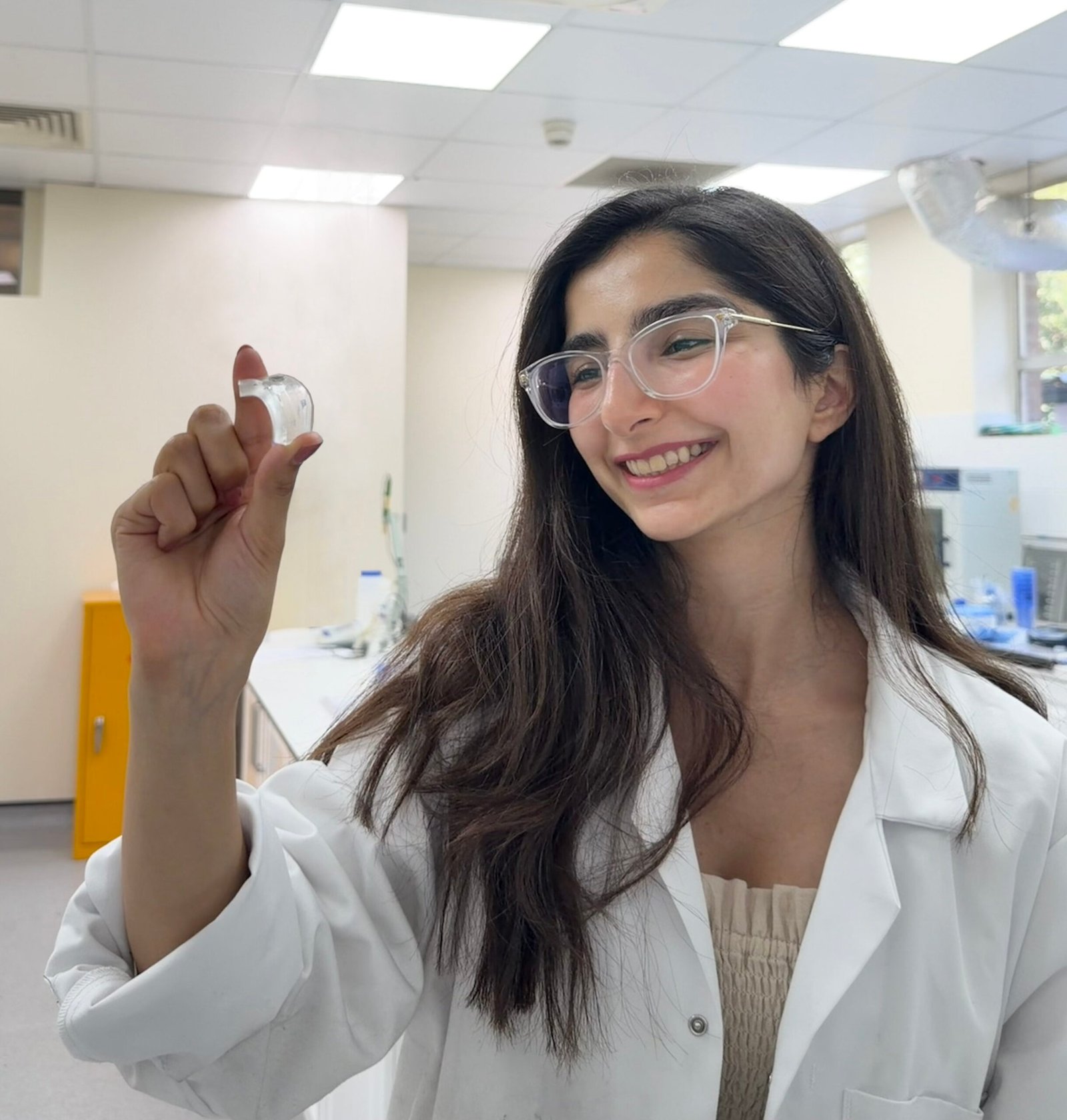
Lead author Saba Firouznia, Research Associate at the University of Bristol Soft Robotics Lab, said: “In nature, muscles use internal biological mechanisms to amplify force and movement. We have demonstrated a similar concept in an engineered system, where a very small electrical signal can significantly increase the force and movement generated by the device without requiring larger motors, pumps or additional mechanical complexity.”
The charged liquid metal droplet technology – called an Electrocapillary-enhanced Magnetohydrodynamic Pump (EMP) – could be deployed in soft robotic systems, inspired by insects, fish and other organisms, to generate stronger movement. For instance, wearable assistive devices used by rehabilitation patients could be more lightweight, flexible, compact and comfortable with this pioneering fluidic system. Similarly, miniature biomedical technologies and lab-on-a-chip devices could transport fluids more effectively in very small spaces, enhancing the capability of diagnostic medical devices and drug delivery systems.
Findings in the study showed that event a low electrical current, of between 0.5 and 2 volts, can act as an amplified, increasing the EMP’s output by up to 3.5 times, while requiring a negligible amount (0.083%) of extra charge.
Saba explained: “The pump uses a droplet of liquid metal as its active component, which continuously shapeshifts to generate fluid flow. We improved its performance by simply manipulating the physics of the liquid metal interface, avoiding the need to add any mechanical complexity.”
In their previous work, the team demonstrated the feasibility of integrating such transduction technology into wearable devices by developing a wristwatch equipped with a miniature liquid metal–based pump. The wristwatch-powered a fluidic skin, which can be used to provide protection against UV light. Only a small electrical charge enabled the pump to circulate the fluid faster and cover a larger expanse, improving the level of protection.
Study co-author Jonathan Rossiter, Professor of Robotics at the University of Bristol who is famed for developing a pair of pioneering robotic trousers dubbed ‘the right trousers’ and head of the Soft Robotics Research Group, added: “The system can generate greater pressure and flow without requiring larger motors, compressors, or batteries. Overall, the work presents a new way to amplify fluidic power in soft machines, which paves the way for more capable soft robots, wearable devices, and compact biomedical technologies.”
Paper
‘Electrocapillary Modulated Interfacial Tension Amplifies Liquid Metal Transduction’ by Saba Firouznia et al. in Advanced Functional Materials