I’ve seen the Galaxy Z Fold 8’s crease-free ‘Flex Titanium’ display — and Apple should be nervous
Samsung has actually done it. After seven years of making foldables, it has found a way to make a foldable display nearly crease-free while also making it more durable — and somehow even thinner. And I almost didn’t believe my eyes at first.
This breakthrough, coming to the Galaxy Z Fold 8 series, is made possible because of a new technology called Flex Titanium. And it could be a real game-changer, especially as Samsung prepares for Apple to enter the foldable phone arena with its iPhone Ultra.

I got the inside scoop on how the Flex Titanium innovation came together, and also saw the new panel torture tested here at Samsung Display’s headquarters in South Korea ahead of Samsung Unpacked. In fact, I’m one of only five journalists in the world who have ever stepped inside Samsung Display.


There I sat down with two key Samsung executives, including Byung Duk Yang, Executive Vice President of the Core Component Technology Team and KyungJin Yoo, EVP & Head of Team Mobile Display Product Development Team, to learn more about how Samsung is reinventing the foldable experience.
What is Flex Titanium?

Samsung has used titanium in its foldable phones before for improved toughness and dispersing any distress, but this is the first time it has employed Flex Titanium, which consists of a titanium-alloy film and a titanium plate.
The titanium-alloy film supports the display and sits below the OLED panel. It offers 20 times greater stiffness than plastic films while also being 30% the thickness of human hair. The result is a slimmer display panel that’s also super strong.
“Titanium is not flexible. This time we used a new titanium alloy because we needed some stretchability,” said Yang.

Meanwhile, the titanium plate is a flexible structure that supports the display module from beneath. Since it allows for tighter bonding with the display module, air gaps are eliminated between the module and plate adhesive.
The result? Dramatically reduced crease visibility and a more immersive viewing experience.

“What we have done is come up with a lattice structure for the fold area and then we use a laser hole process (to fill the gaps in the lattice design),” Yoo said. “We have come up with precision processing to increase the integrity and completeness of the structure.”
500,000 folds?! (plus a fun ball drop test)

500,000. That’s how many times Samsung Display bends its foldable displays to make sure they’re durable enough to live inside devices like the upcoming Galaxy Z Fold 8 series.
I see the robotic arms in action testing four phones on one level and two others on a top level inside a large metal box, folding and unfolding 24 hours a day. There are eight cameras pointed at the phones so engineers can check to see exactly when a device may have failed or to diagnose any issues.
The other benefit of doing all of this testing inside a sealed box? Samsung will ratchet up the temperature all the way up to 140℉ (60℃) and all the way down to -4 ℉ (-20℃) to make sure the folding can keep going in all sorts of conditions.
At room temperature, Samsung Display will fold a display up to 500,000 times. At the coldest temperature, the panels can fold up to 60,000 times and up to 300,000 times at the highest temp.
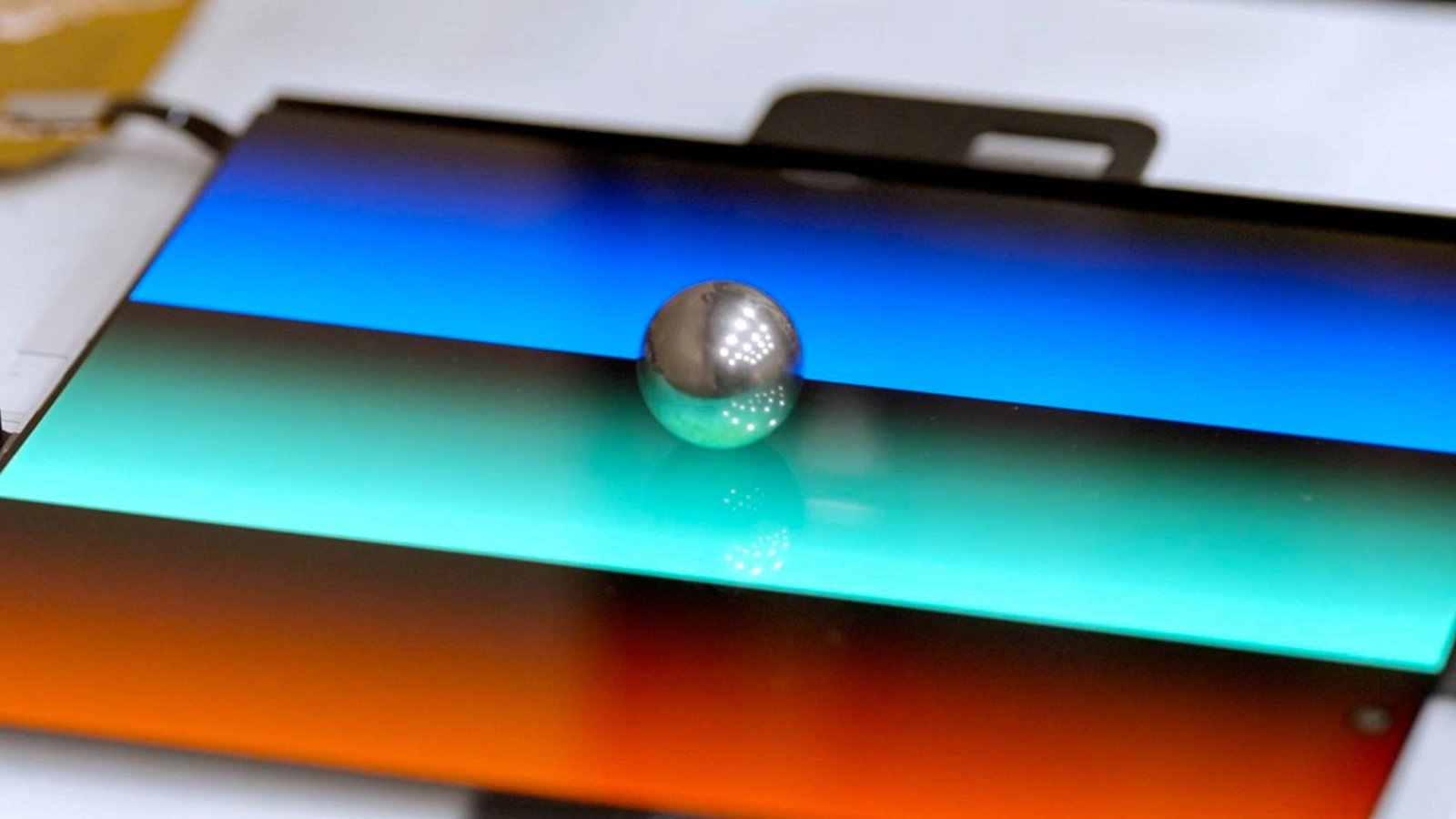
In another room, we were able to drop a 21.7-gram (0.76 ounce) metal ball on top of Samsung’s foldable display at various heights, going all the way up to 50cm (19.7 inches). There was not a scratch on the panel.
“We have to understand the user behavior and various display challenges, like dropping or pressure with large objects or tiny objects,” Yang said. “We have developed very comprehensive and sophisticated evaluation methods to understand the user behavior and real-world usage patterns.”
Extreme image quality testing
Typically at Tom’s Guide we’ll use a colorimeter and software to test a phone display head-on, measuring its brightness, color reproduction and accuracy (Delta-E). But Samsung Display goes way, way beyond this in its labs.
Inside another machine, Samsung Display performs image quality testing and reflection testing with a spherical light source that’s coated with a barium sulfate material to achieve the highest reflection rate possible. The doors are also shut to block any outside light.
Samsung Display then measures the light bouncing back and how much light is reflected from the panel itself. The lower the number the better.
But it’s important to emphasize that Samsung does this in eight different directions, and that more than 20 points are detected for just one direction. So that’s 160 points total for a total 3-minute test. The phone is continually turned the entire time.
The Apple threat (and opportunity)

It’s no secret at this point that Apple plans to enter the foldable market in September with the iPhone Ultra/iPhone Fold. But Samsung doesn’t seem worried about its rival and in fact “loves” another big player entering the space.
“As we minimize the crease, which has been a perennial issue with consumers, we believe that the market is really going to expand even further.”
— KyungJin Yoo, EVP & Head of Team Mobile Display Product Development Team, Samsung
“We cannot comment on rumors, but we think it’s more than welcome because when other competitors and companies join the market,” Yang said. “I think the market will expand and the awareness will increase. Competition is good for the users and we mean it, we love other companies joining this market.”
For Yoo, Samsung’s key advantage over Apple is experience.
“When Samsung first came up with the foldable in 2019, of course this was a big innovation and also was touted by the market, but we needed continuous improvement on the thickness and the weight as well as the durability,” Yoo said. “As we minimize the crease, which has been a perennial issue with consumers, we believe that the market is really going to expand even further, and perhaps that is the kind of validation that we are now going to get from companies like Apple.”
Yang also touted that the company has been at this for several years, so it gives them an advantage over competitors. And if it’s able to address users’ durability concerns, it should be able to help to grow the foldable phone market overall.
“I think we can enhance or extend the market and provide a better experience to users with foldable devices,” Yang said.
Bottom line
Samsung started showing the world foldable displays way back in 2009, but the first Galaxy Fold didn’t land on store shelves until 2019, so it’s clear that the company is playing the long game with foldables as the category evolves.
If the Galaxy Z Fold 8’s Flex Titanium tech manages to finally push foldables into the mainstream, it will be because of the mad science happening inside these very labs. Stay tuned for our full hands-on impressions as we gear up for the Unpacked launch.