Is this the first known binary system to produce two supernova remnants?
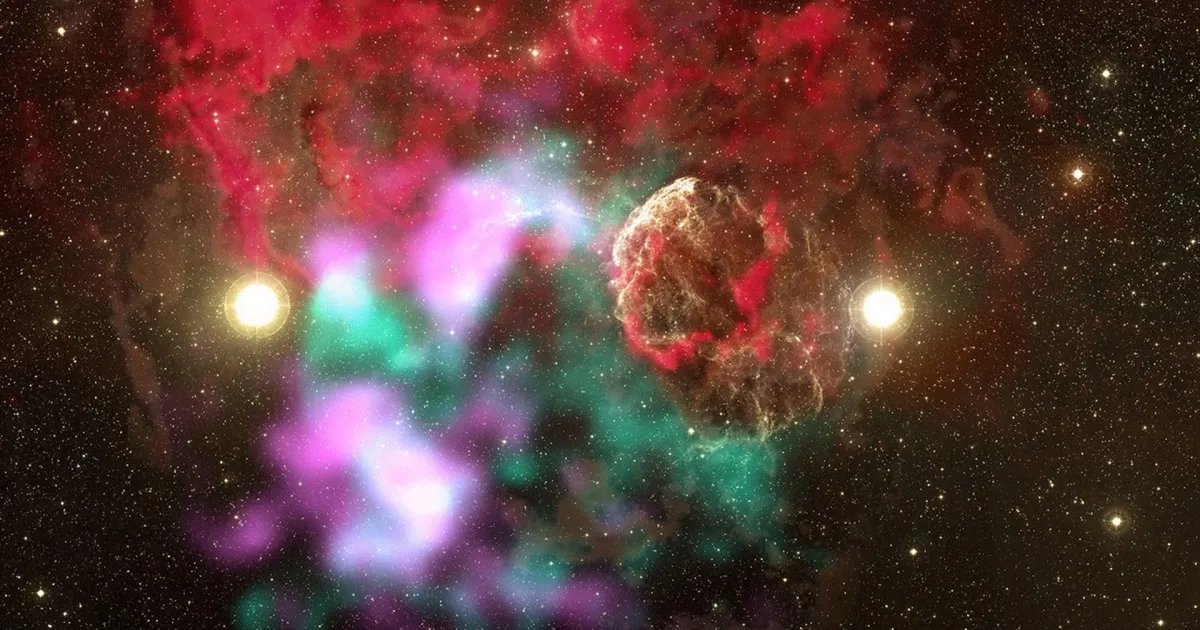
G189.6+3.3, a faint supernova remnant, appears as a mottled cloud of blues, greens and magentas, overlapping the well-known Jellyfish Nebula (IC 443; just right of center) in a multi-wavelength composite that strips away IC 443’s bright emission to reveal its neighbor. A filament of gas arcing between the two remnants (center; shown in violet) marks where G189.6+3.3’s shock wave has collided with the same molecular cloud IC 443 is pushing against, meaning both objects are at the same distance and supporting the case for a shared origin. In the image, the molecular cloud appears in red, orange, and brown from infrared and radio observations; IC 443 glows yellow in visible light; the arcing filament appears in violet; G189.6+3.3’s hot expanding shell is colored blue-green from X-ray data; and magenta marks G189.6+3.3’s gamma-ray emission. Credit: NASA Goddard Space Flight Center and M. Michailidis et al. 2026; radio, MWISP and ESA/Planck; infrared: NASA/WISE/JPL-Caltech/UCLA; optical: DSS; ultraviolet: NASA/Swift; X-ray: SRG/eROSITA; gamma ray: NASA/DOE/Fermi LAT Collaboration
When massive stars die, they explode, leaving behind supernova remnants. Given how common binary star systems are — more than half the stars in our galaxy have a companion — it stands to reason that paired supernova remnants would also be common. But astronomers have never found one. Now, hiding in the bright shine of IC 443, the supernova remnant also known as the Jellyfish Nebula, they may have found the first.
A second, fainter supernova remnant has been spotted lurking in the same patch of sky as IC 443. A new study makes a compelling case: The two remnants may trace back to a single binary star system. The two progenitor stars may have been gravitational partners, circling each other for millions of years before one detonated, flung the other across space, and left it to eventually explode on its own. If so, the two supernova remnants now left behind represent the first known instance of a binary star system where both members left behind remnants, which now overlap.
Miltiadis Michailidis, a postdoctoral fellow in physics at Stanford University, presented the results June 17 at the 248th American Astronomical Society meeting in Pasadena, California. An upcoming paper describing the work will be published in Nature Communications. The research draws on 16 years of observations from NASA’s Fermi Gamma-ray Space Telescope, an orbiting observatory built to detect gamma rays — the highest-energy form of light, invisible to the human eye — and map them across the universe.
“We found compelling evidence that this object, alongside its famous neighbor IC 443, may be the remnants of two massive stars that were born together in a binary system millions of years ago,” Michailidis said during the press conference. “The first star exploded, disrupting the system and sending the companion on a journey through space. Tens of thousands of years later, the second star also exploded. Today, we may be witnessing the remarkable outcome of those two explosions: two overlapping supernova remnants that have effectively been reunited after their stars died.”
Uncovering a hidden neighbor
When a massive star runs out of fuel, it dies in a supernova explosion. The resulting shock wave sends stellar debris into space at thousands of miles per second. That expanding wreckage, known as a supernova remnant, interacts with the surrounding interstellar medium of gas and dust. Where the outrushing material collides with nearby gas, a shock front forms, accelerating particles until they approach the speed of light.
While supernova remnants can be observed across the electromagnetic spectrum — from radio waves to visible light to ultraviolet wavelengths and beyond — astronomers often turn to X-rays and gamma rays to study their physics in detail. X-rays reveal hot gas, showing the structure of the expanding shell. Gamma rays occur where particles are accelerated, showing astronomers where energetic interactions, such as high-energy protons (also called cosmic rays) colliding with surrounding gas, are occurring. Together, the two wavelengths offer complementary views of the same object — and it was this combination that helped astronomers discover the supernova remnant hiding next door to IC 443.
The Jellyfish Nebula is not an obscure object. It ranks among the most-studied supernova remnants in the Milky Way and is one of the brightest sources in our galaxy when viewed in gamma rays. In 2013, Fermi data helped explain IC 443’s exceptional brightness: It stems from cosmic rays from IC 443’s shock front slamming into Sharpless 249, a vast nearby cloud of hydrogen gas. And that brightness is in part what kept neighbor invisible for so long.
That neighbor, designated G189.6+3.3, was first discovered in 1994 in X-ray data from the German-led Roentgen Satellite (ROSAT) mission as a faint, ambiguous shell-like structure east of IC 443. It was easy to dismiss as a secondary feature of the Jellyfish rather than a remnant in its own right, and for three decades it lingered in that uncertain status.
It wasn’t until 2023 that astronomers using observations from eROSITA, a more sensitive X-ray satellite that viewed the region four times between 2020 and 2021, showed that G189.6+3.3 was a genuine, separate supernova remnant — and that it likely overlapped with IC 443. They also noted the two remnants appear to be interacting with the same gas cloud, which would indicate they are at the same distance, raising the possibility of a shared binary origin. But this was a hypothesis, not a conclusion — one that Michailidis and his team set out to prove.
Using 16 years of Fermi data, Michailidis and his team examined the region at higher gamma-ray energies. At lower gamma-ray energies, the entire area looks like a single bright source, so astronomers long assumed the gamma rays were coming solely from IC 443. But at higher energies, the picture changes. Once Michailidis’ team removed IC 443’s contribution, a distinct second gamma-ray source emerged, sitting right where X-ray observations placed G189.6+3.3. This shows the object is actively producing its own gamma rays.
The team could now ask the harder question: Are the two remnants physically related? To make that case, they needed to show the two objects share the same distance — and to do that, they needed to show they are interacting with the same material. The gamma-rays were again key. G189.6+3.3’s gamma-ray emission is brightest at the remnant’s northern boundary, the only place it overlaps with Sharpless 249. There, a filament of gas marks the point where the shock wave has slammed into Sharpless 249, generating the same type of specific gamma-ray signature as the one astronomers have observed for years in the places where IC 443 has been pushing against the same gas cloud. Thus, the two remnants interacting with the same cloud must lie at the same distance.
One chance in a thousand
With both remnants interacting with the same cloud and now placed at a distance of roughly 6,000 light-years, the team had established the physical connection they needed. The next question was whether the evidence supported a binary origin specifically, or whether this could still be a cosmic coincidence — two unrelated but nearby stars that both went supernova and are now overlapping.
The team ran simulations of one million massive binary star systems, asking whether any could produce two remnants with a separation and age difference matching what they observed. The Jellyfish Nebula is roughly 8,000 to 9,000 years old; G189.6+3.3’s estimated age spans a wide range, roughly 20,000 to 110,000 years. Even with those uncertainties the simulations showed that yes — close binary systems could readily produce exactly this kind of outcome, with the first explosion kicking the companion star into space, where it would then explode tens of thousands of years later.
Also according to the simulations, the chance that two completely unrelated supernovae would appear this close in the sky and at the same distance is less than 1 in 1,000. “This means that this is very unlikely to be a cosmic coincidence. So we may be witnessing the final chapter of an evolution that started millions of years ago. Today, we see the result of two stars once [bound] by gravity orbiting each other, now as supernova remnants,” Michailidis said.
An unprecedented opportunity
More than half of all stars form in binary or multiple systems. For massive stars — the ones that result in supernova remnants like IC 443 and G189.6+3.3 — that number sharply increases. The physics all but guarantees that paired supernovae remnants should exist. Yet this is the first candidate system ever identified.
“Despite the prevalence of those binary [star] systems, we have never observed two supernova remnants originating from the progenitors of a system in a binary,” Michailidis said. “Since this is the first and only candidate system, it opens a new window, an unprecedented opportunity to understand better how massive stars evolve in a binary, how supernova explosions unfold, and ultimately what is their impact on their cosmic environment.”
Brooks Mendenhall is a staff writer for Astronomy and is based in Chattanooga, Tennessee.