Some Hydrothermal Explosions Can Hurl Water and Rock 600 Feet in the Air — Here’s How Yellowstone National Park Monitors Them
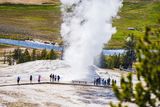
On April 15, 2024, scientists claimed a first as monitoring equipment picked up a steam explosion from Yellowstone National Park’s Norris Geyser Basin. No other explosion had ever been recorded using modern equipment, according to a report in Geophysical Research Letters.
Researchers are now installing monitoring equipment across the park to track and monitor hydrothermal explosions. Michael Poland, Scientist-in-Charge at the Yellowstone Volcano Observatory, told Discover that it’s all part of a plan to better understand and, one day, potentially forecast this underappreciated hazard.
“When we look at Yellowstone geologic hazards, I think most people tend to immediately think about a supervolcano, which is a term I absolutely hate,” he said. Researchers have poured cold water on the idea that Yellowstone is due for a mega-explosion any time soon, according to a study in Nature.
“The real hazards on human timescales in that area are big tectonic earthquakes, like the magnitude 7.3 that happened in 1959, and these steam explosions,” Poland said.
Read More: Watch a Mischievous Wolf Pup Run Off with a Park Sign In Yellowstone National Park
Hydrothermal Explosions at Yellowstone National Park
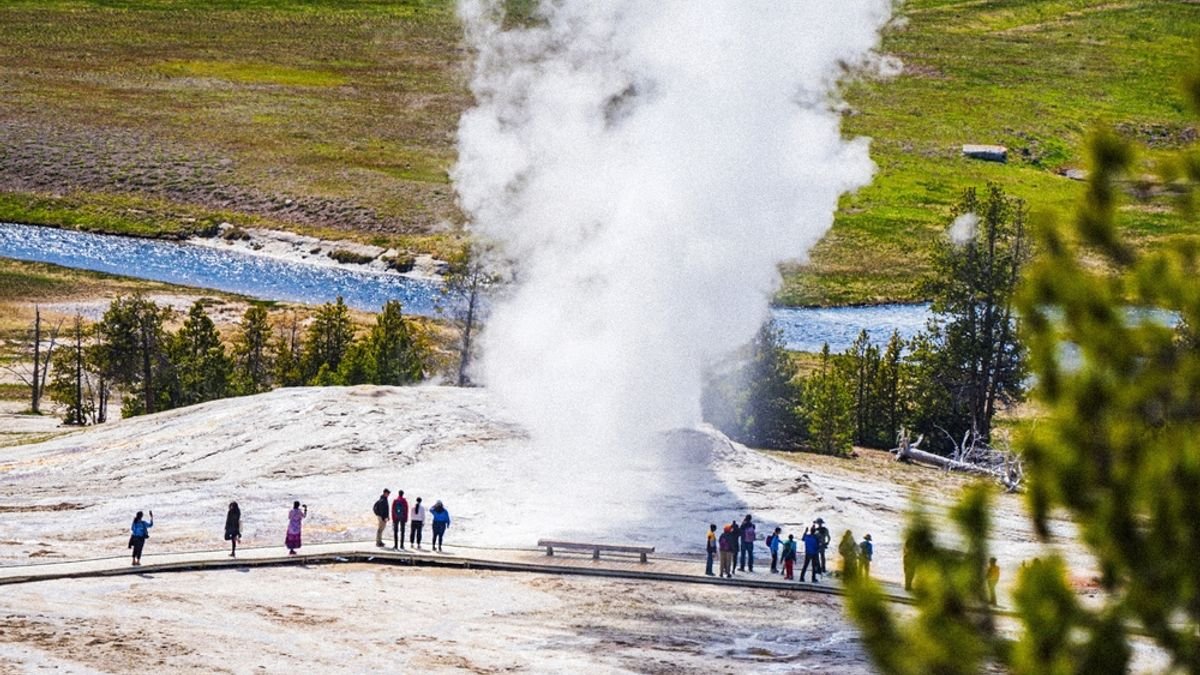
Shortly after the Norris Geyser Basin explosion, another occurred on July 23, 2024, in Biscuit Basin. This eruption threw a plume of water and rock some 600 feet into the air and obliterated a nearby boardwalk.
Poland describes that event — a hydrothermal explosion during peak summer at a well-visited geyser — as his “perfect nightmare.” Though visitors had to flee, fortunately, no one was injured.
“All of the big rocks mostly fell towards the river and not in the direction of [the] boardwalk,” Poland said. “The boardwalk was still smashed. If anyone had been standing right there when the rocks were falling, they would have been at least seriously injured.”
His team installed a similar monitoring station in the area in the wake of the explosion. That station picked up another, smaller explosion that occurred on June 13, 2026, in the Biscuit Basin area at Black Diamond Pool. It was also caught on camera.
Adding More Monitoring Stations to Yellowstone
Poland’s team plans to install several additional stations in the coming years, using both seismic and acoustic data from thermal basins. Another will be installed in the Old Faithful Area in the near future.
Those units also track infrasound, said Poland: “Which is very low frequency acoustic energy, not something we can hear, but it travels very far. It’s generated by explosions.”
“We’ve mostly avoided the hydrothermal systems when we’ve installed equipment in Yellowstone, because if you want to locate a magnitude one or 0.5 earthquake, or whatever, the last thing you want to do is have your seismometer right next to a pot of boiling water,” he said.
It’s hoped that these monitoring stations could, eventually, be used to forecast hydrothermal explosions. That could consist of numerous instruments, such as geochemical geothermometers deployed to track changes in subsurface temperatures and gather other data.
In an ideal situation, they would detect changes in hydrothermal systems, allowing park authorities to know when they are becoming unstable and potentially hazardous.
But right now, it’s not known whether or not there are any measurable signs that an explosion is imminent, Poland said. His team noted that in the years before the Norris Geyser Basin explosion, increased thermal water discharge altered the color, temperature, and level of a nearby small lake. Similar changes have occurred in advance of other explosions.
“There may be changes in temperature of the water or the subsurface [or] maybe there are electromagnetic signatures,” he added.
How Geothermal Forecasting Can Help the Park
With those uncertainties, Poland sees geothermal forecasting as something that is “still pretty far into the future,” with a lot of data and research required to even begin laying the groundwork for such an undertaking. “We’re still in sort of a research and exploration phase in that sense,” he said.
In the coming years, the plan is to install more monitoring stations at other hydrothermal basins and continue gathering data to fill knowledge gaps about steam explosions.
“At this point, we don’t even really know how frequently events like this happen,” Poland said. “What we’re hoping to do is just characterize how often this kind of thing happens in the basins.”
In his view, the added attention this potential hazard is now receiving following the Biscuit Basin explosion is a major positive, and rolling out more monitoring stations could help improve visitor safety in the long run. “Biscuit Basin showed what a hazard those explosions can be,” Poland said.
“It may be there’s some geyser basins where we don’t see these sort of explosions at all, because the conditions aren’t right, and they may be very common in other geyser basins,” he said. “That can help the park plan for how they would organize its visitation and which areas to have boardwalks, that sort of thing.”
Read More: Massive Magma Reservoir Comparable in Volume to Yellowstone Discovered Beneath Tuscany
Article Sources
Our writers at Discovermagazine.com use peer-reviewed studies and high-quality sources for our articles, and our editors review for scientific accuracy and editorial standards. Review the sources used below for this article: