The Sky Today on Thursday, July 16: The Moon passes the Lion’s heart
Earth’s satellite sits near Regulus in the heart of Leo the Lion this evening, with blazing Venus nearby in the western sky after sunset.
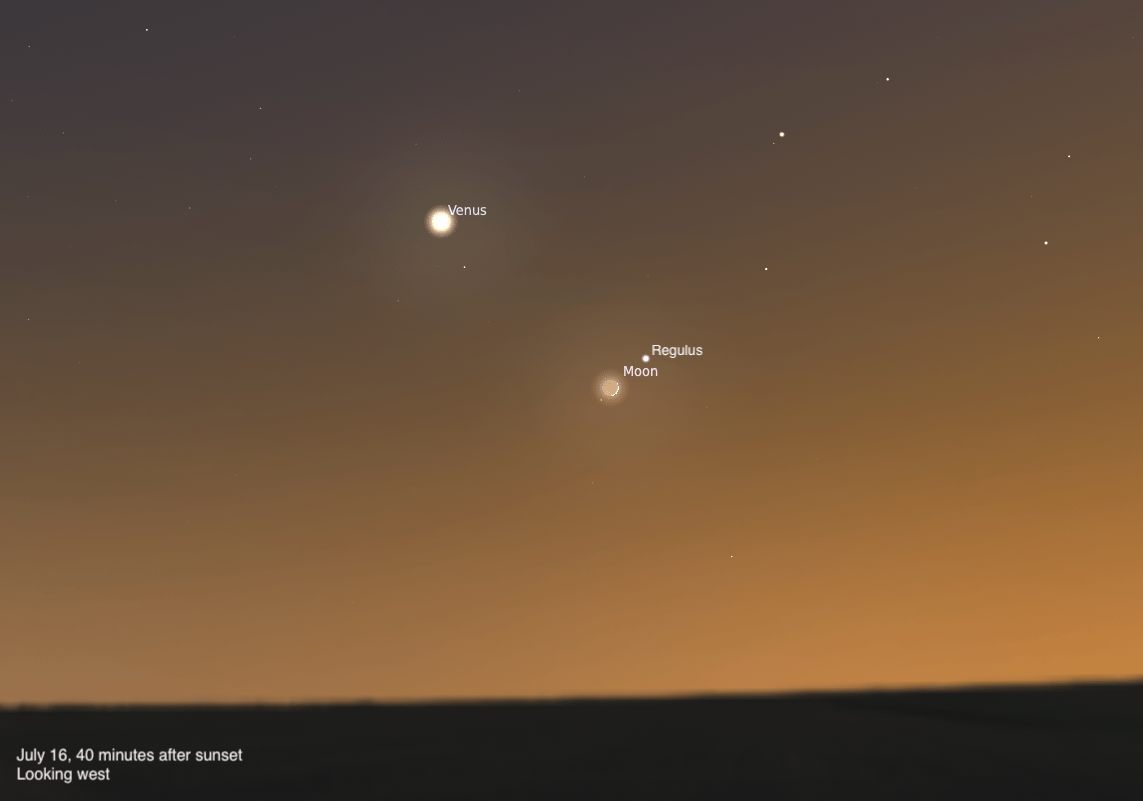
Shortly after sunset, catch the Moon and Venus together in Leo, near the Lion’s brightest star, Regulus. Credit: Stellarium/USGS/Celestia/Clementine
Looking for a sky event this week? Check out our full Sky This Week column.
July 15: The Summer Triangle overhead
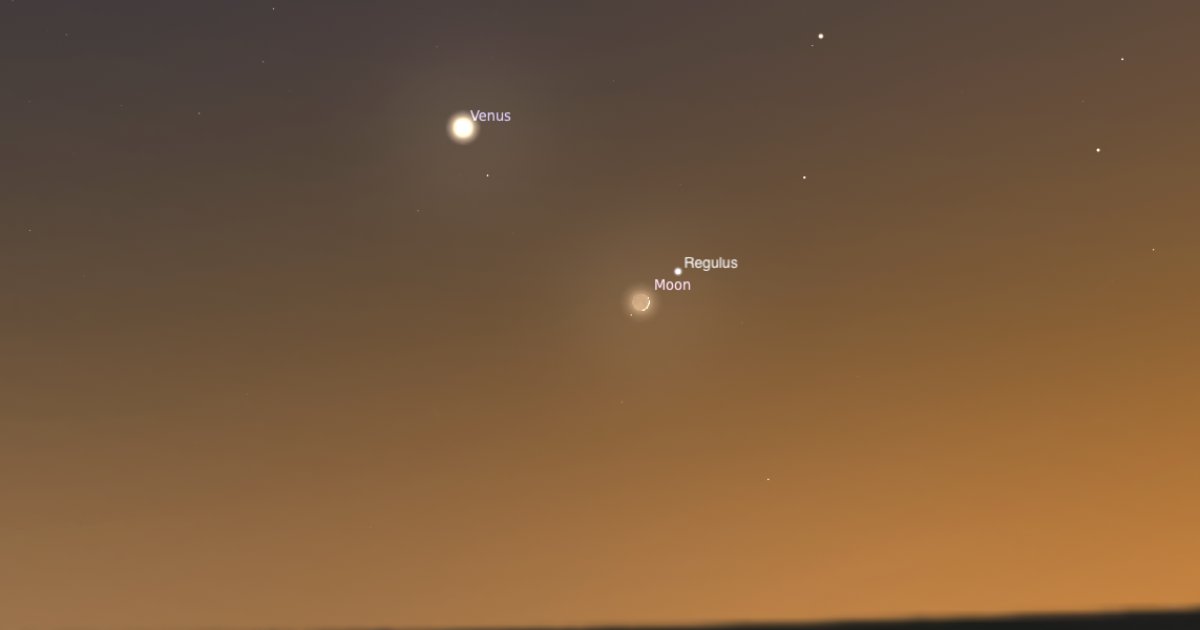
The nearly three-day-old Moon passes 0.5° south of Regulus, the heart of Leo the Lion, at 9 P.M. EDT. Just after sunset, you’ll be able to spot the delicate crescent Moon in the west, with bright Venus to its upper left, some 8° east of the Moon. As the sky starts to grow dark, watch just to the Moon’s upper right, where magnitude 1.4 Regulus will appear. Follow the Moon and star as long as you can — this region sets within two hours of sunset.
Venus remains visible a little longer, setting just over two hours after the Sun. Take some time to focus on the planet with a telescope, and you’ll see that its 18”-wide disk is roughly 62% lit. Unlike, say, Mars, we’re not seeing down to the surface of Venus when we observe this planet in the sky. Instead, we’re seeing sunlight bouncing off its opaque cloud tops, which hide our view of the surface beneath. Images of that surface come only from radar, which can penetrate the thick shroud, or the few probes we have sent to land on the planet.
Sunrise: 5:45 A.M.
Sunset: 8:27 P.M.
Moonrise: 8:18 A.M.
Moonset: 10:11 P.M.
Moon Phase: Waxing crescent (10%)
*Times for sunrise, sunset, moonrise, and moonset are given in local time from 40° N 90° W. The Moon’s illumination is given at 10 P.M. local time from the same location.
Alison Klesman is senior editor of Astronomy magazine. She holds a Ph.D. in astronomy and has studied a variety of topics, from minor planets to supermassive black holes.