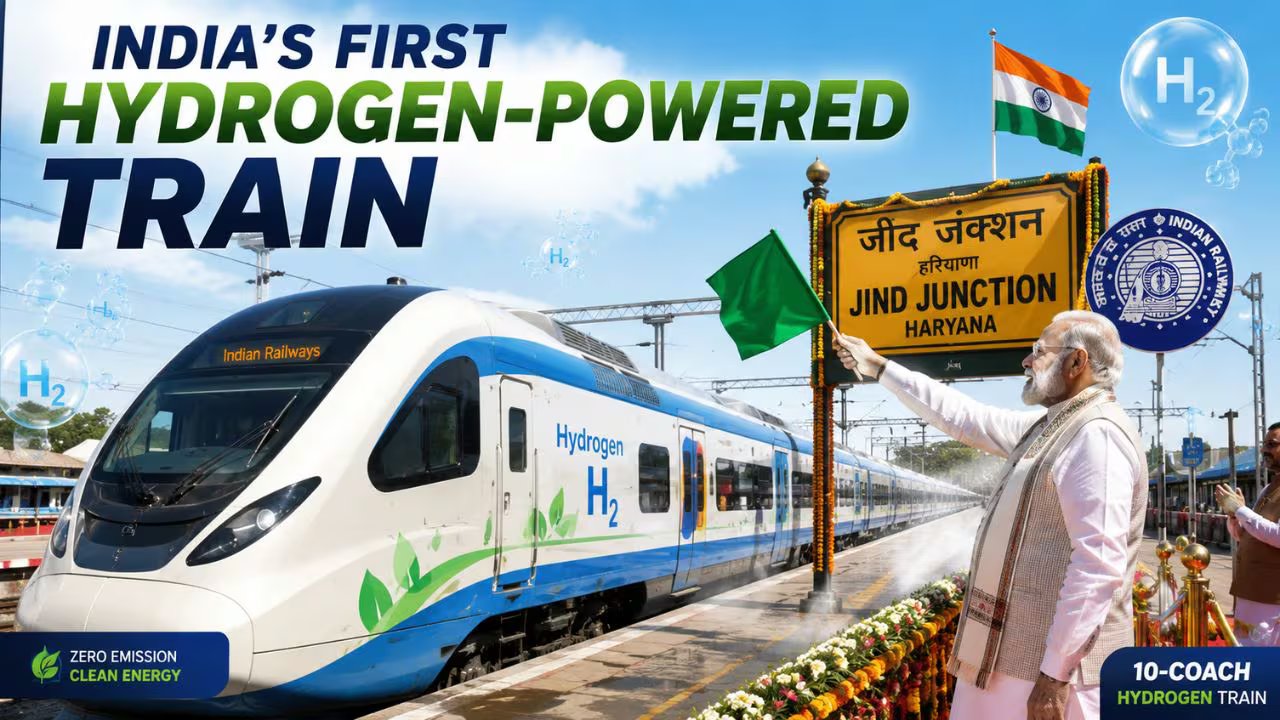
PM Narendra Modi to inaugurate India’s first hydrogen-powered train in Haryana
India is going to witness one of the landmark moment in Railway history as Prime Minister Narendra Modi will flag off first Hydrogen-powered train. This passenger train will be operated from Jind railway station in Haryana. This step marks one of the major milestones in the country’s push towards sustainable and clean rail transportation. The area covered by this Hydrogen train will be Jind-Sonipat section. On top of this, it is the first hydrogen fuel cell powered train developed and designed entirely in India.  Also Read: Digital India completes 11 years: PM Modi highlights AI, startups and digital growth
Prime Minister Narendra Modi, during his visit to Haryana will also lay foundation stone along with dedicating multiple development projects. These developments and initiatives are worth around Rs 14,700 crore, scheduled to take place at Eklavya Stadium in Jind. Also Read: PM Modi meets Amazon CEO Andy Jassy, raises India investment to $48 billion
India’s stand on the global hydrogen rail club
India joins group of selected countries, including the United States, Japan, Germany, and China with the launch of its hydrogen powered train. All these countries already have potential hydrogen trains, helping country to grow in support of sustainable growth and development. Also Read: PM-WANI Wi-Fi network adds QR login and short recharge plans – but what is it? Explained
The hydrogen powered train project has been developed under the Atmanirbhar Bharat. In addition, the design approvals and technical specifications are prepared by the RDSO: the Research Design and Standards Organization.
आज भारत को पहली हाइड्रोजन ट्रेन मिलने का सपना साकार होने जा रहा है। यह आत्मनिर्भर भारत और सतत विकास की दिशा में एक बहुत बड़ा दिन है। मैं इससे जुड़े सभी लोगों को बहुत बधाई देता हूं।
प्रभूतं कार्यमल्पं वा यन्नरः कर्तुमिच्छति।
सर्वारम्भेण तत् कार्यं सिंहादेकं प्रचक्षते।। pic.twitter.com/aAbVNt9GCb
— Narendra Modi (@narendramodi) July 17, 2026
India’s largest hydrogen powered passenger train
Why this project is so important for India is because it sets a new global benchmark in terms of passenger capacity. In contrast to hydrogen trains already running in countries such as China and Germany, which majorly operates with only two or three coaches, India’s hydrogen train consists of 10 coach trainset. This set is capable enough to carry approximately 2,600 passengers.
Besides this, the newly running train will comprise of two Hydrogen Driving Power Cars, called DPCs. Notably, it will also have eight Trailer Coaches, TCs, which will be powered by a 1,200 KW hydrogen fuel cell propulsion system. What’s interesting here is that it is equivalent to around 3,200 horsepower, hence, makes it one of the most powerful hydrogen powered trains currently operating worldwide.
Talking about the speed, it has been approved for a maximum speed of 75 kmph, however, its design speed is 110 kmph.
Here’s how hydrogen fuel cell technology really works
The train is powered by a Proton Exchange Membrane Fuel Cell (PEMFC) that produces electricity aboard the train by chemically reacting hydrogen and oxygen. When it’s operating, only water vapour and heat are produced as by-products – it doesn’t emit carbon.
Hydrogen trains are not continuously overhead electrified trains as they will produce electricity on board from hydrogen fuel cells.
Hydrogen has also much higher energy density than diesel, producing about 120 MJ/kg compared to 43 MJ/kg of diesel, and has a lower maintenance requirement and a much lower carbon footprint.
What are routes and stations covered
The hydrogen train will run from Jind Junction to Sonipat via Gohana Junction and other halting stations.
Running points:
- Jind City
- Pandu Pindara junction
- Lalit Khera Halt
- Bhambhewa
- Isapur Kheri Halt
- Butana Halt
- Khandrai Halt
- Rabrah Halt
- Lath Halt
- Mohana
- Barwasni Halt
- Sonipat New
Dedicated infrastructure at Jind
Indian Railways has set up the nation’s largest railway hydrogen store and refuelling station at Jind to enable hydrogen rail operations.
This indigenous facility has a capacity to store almost 3,000 kg of hydrogen, and has been given the necessary licence from the Petroleum and Explosives Safety Organisation (PESO). Designed to meet international standards, such as NFPA-2 and the ISO 19880 series, it has been subjected to a third-party safety evaluation by TÜV SÜD Germany.
It is equipped with hydrogen compression systems, standby compressors, technical support infrastructure and dedicated refuelling equipment to guarantee continuous operations.
What are advanced safety systems in hydrogen train
In the interest of safety, Indian Railways has taken several precautions for hydrogen powered operations. The train and infrastructure are fitted with hydrogen leak detectors, flame detectors, smoke and heat sensors and a continuous ventilation system.
In case of any abnormal condition, the system can automatically turn off the hydrogen supply. The locomotive also has an emergency operating mode which will allow the train to be safely moved if necessary. Adequate trained personnel, regular inspections, continual monitoring and maintenance schedules have also been established to ensure safe operations.
How India is supporting India’s green mobility goals
The project’s introduction of a hydrogen train is a major milestone towards meeting the goals of the National Green Hydrogen Mission and India’s long-term vision of becoming a net-zero carbon emission nation.
The programme also lays the groundwork for the introduction of a new train as well as the infrastructure, operational procedures, maintenance ecosystem and technical expertise required for hydrogen-powered rail transport on a larger scale. This also provides a further boost to Indian Railways’ push towards cleaner and greener mobility.
Haryana and Punjab is at the centre of development projects
Other than inaugurating the hydrogen train project, Prime Minister Narendra Modi will also lay foundation stone of development project worth Rs 4,700 crore in Haryana.
Later in the day, he will visit Jalandhar in Punjap, inaugurating projects worth more than Rs 5,470 crore.

Features at glance:
| Parameter | Details |
| Train type | Hydrogen fuel cell-powered passenger train |
| Launch | Flagged off by PM Narendra Modi |
| Launch station | Jind railway station, Haryana |
| Route | Jind–Sonipat |
| Coach configuration | 10 coaches |
| Power cars | 2 Hydrogen Driving Power Cars (DPCs) |
| Trailer coaches | 8 Trailer Coaches (TCs) |
| Passenger capacity | Around 2,600 passengers |
| Propulsion system | 1,200 kW hydrogen fuel cell |
| Power output | Around 3,200 HP |
| Maximum operating speed | 75 kmph |
| Design speed | 110 kmph |
| Fuel | Compressed hydrogen |
| Technology | Proton Exchange Membrane Fuel Cell (PEMFC) |
| Electricity generation | Onboard through hydrogen fuel cells |
| Carbon emissions | Zero during operation |
| By-products | Water vapour and heat |
| Overhead electrification | Not required |
| Developed by | Indian Railways with RDSO |
| Manufacturing | Designed and developed in India |
| Hydrogen storage | 3,000 kg facility at Jind |
| Safety systems | Leak, flame, smoke and heat detection |
| Monitoring | 24×7 hydrogen refuelling monitoring |
| Maintenance depot | Shakurbasti, Delhi |
| Environmental benefit | Clean, sustainable and zero-emission transport |
| National mission | Supports National Green Hydrogen Mission |
| Global significance | India’s first and world’s highest-capacity hydrogen passenger train |