Did this black hole grow up before its galaxy?
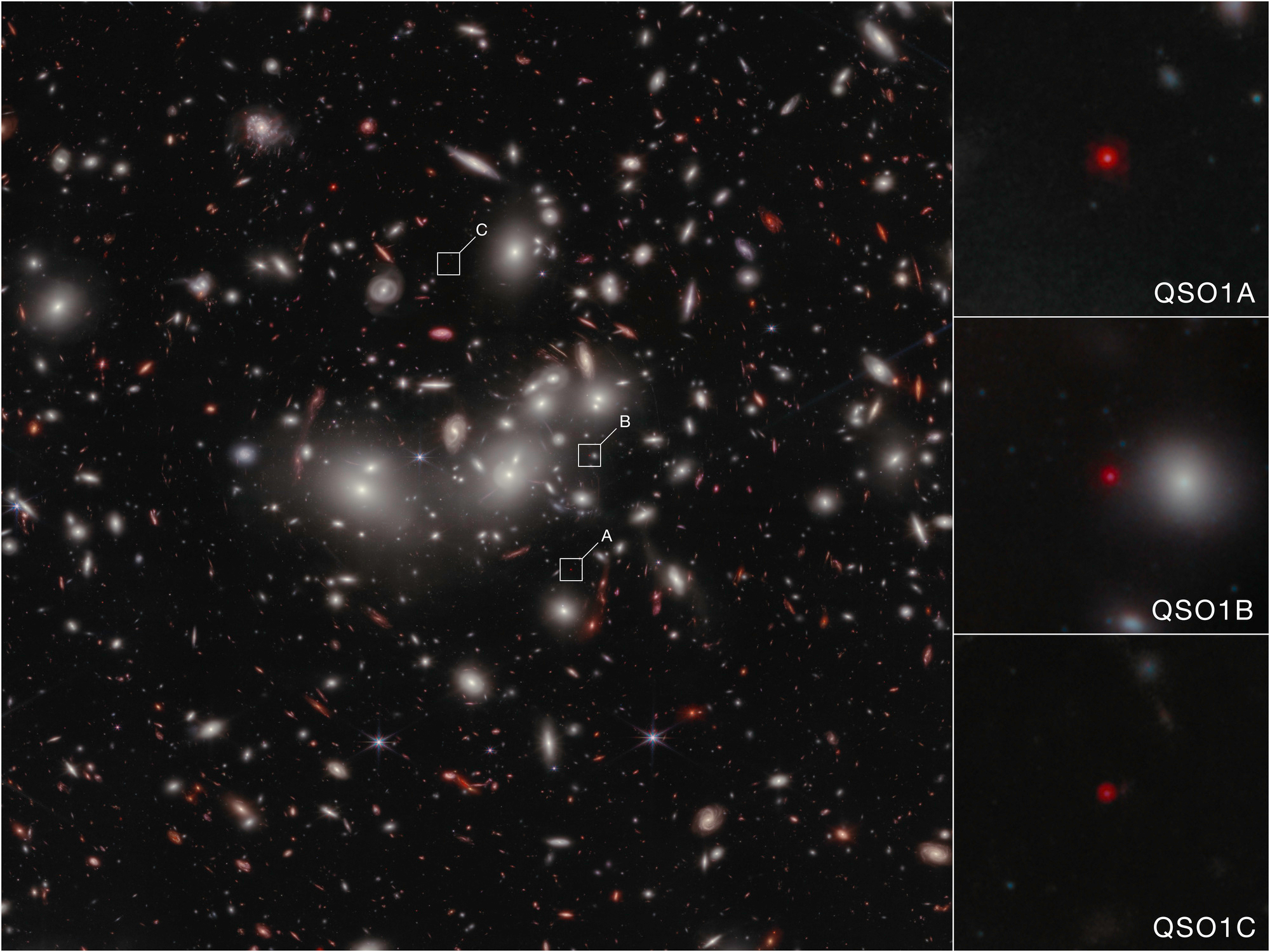
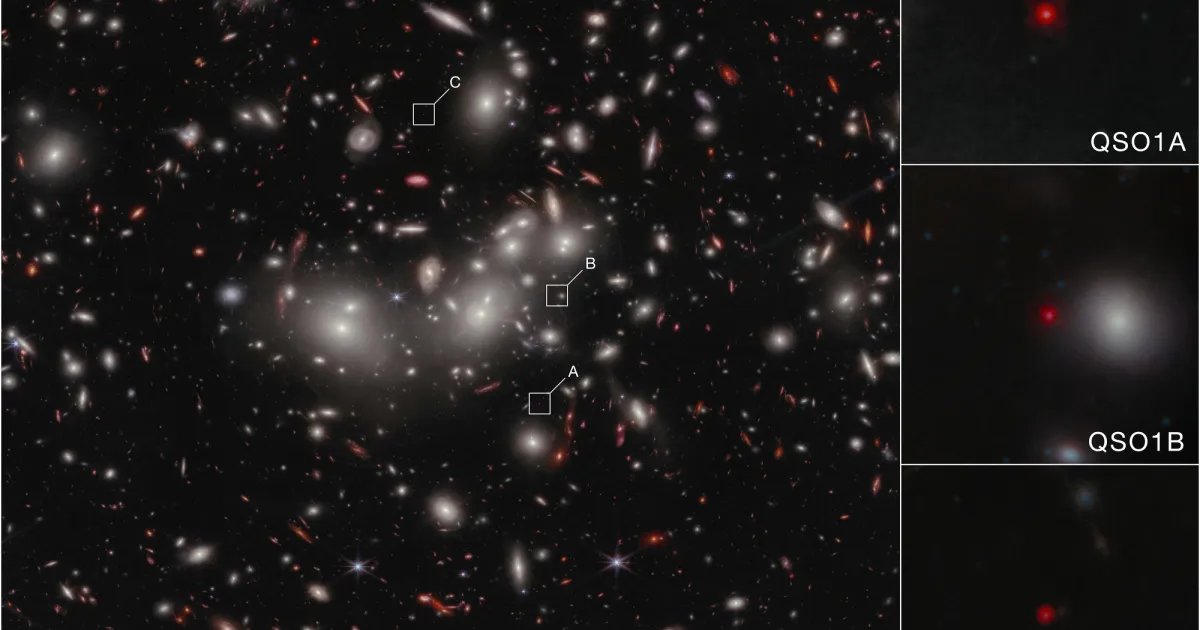
At left is an image of the galaxy cluster Abell 2744; marked are three lensed images of the distant background galaxy Abell2744-QSO1 (QSO1), a type of galaxy known as a Little Red Dot. Credit: Image: NASA, ESA, CSA, Lukas Furtak (Ben-Gurion University); Image Processing: Alyssa Pagan (STScI)
For decades, astronomers have pictured galaxies and their central black holes growing together. In the familiar story, a young galaxy forms first. Gas gathers. Stars ignite. Somewhere near the crowded center, a smaller “seed” black hole begins feeding on gas and dust. Over millions or billions of years, it swells into a supermassive black hole, one with millions or even billions of times the mass of the Sun.
But a strange object in the distant universe is now complicating that story.
Using the James Webb Space Telescope (JWST), astronomers have directly measured the mass of a black hole in Abell2744-QSO1 (QSO1 for short), a compact red object seen when the universe was less than a billion years old. The black hole weighs roughly 50 million solar masses. More surprisingly, the data suggest it may be more massive than the young galaxy around it, if a substantial host galaxy exists there at all.
That raises a startling possibility: in at least some cases, the black hole may have grown before the bulk of its galaxy.
“The observations are consistent with scenarios in which the black hole formed before the bulk of its host galaxy,” says Roberto Maiolino, an astrophysicist at the University of Cambridge and a member of the research team, whose work has been published in Nature and Monthly Notices of the Royal Astronomical Society. “However, we cannot exclude the possibility that a small galaxy embryo formed first and that the black hole subsequently grew much faster than its stellar component.”
Either way, QSO1 is not behaving like a normal young galaxy.
A little red dot with a huge secret
QSO1 belongs to a growing class of objects nicknamed Little Red Dots (LRDs). JWST began finding these compact, reddish sources in the early universe soon after it started science operations. At first, some appeared to be surprisingly massive, evolved galaxies that had formed extremely early — perhaps too early for comfort.
That triggered debate among astronomers. Were these truly mature galaxies already assembled within the first few hundred million years after the Big Bang? Were astronomers misreading their light? Or were some of them powered by actively feeding black holes rather than by stars alone?
“Since the James Webb Space Telescope discovered the Little Red Dots, their exact nature has been intensely debated,” says Anslyn John, an astronomer at Stellenbosch University in South Africa, who was not involved in the studies. “Initially they were thought to be massive, evolved galaxies that formed very early in the universe’s history. This was quite surprising as galaxies with that level of complexity are believed to have developed over much longer timescales.” QSO1 now offers one of the clearest clues yet. The object lies behind the galaxy cluster Abell 2744, also known as Pandora’s Cluster. The cluster’s gravity acts like a natural cosmic magnifying glass, bending and amplifying light from objects behind it. This effect, called gravitational lensing, gave JWST a sharper look at QSO1 than astronomers would otherwise have had.
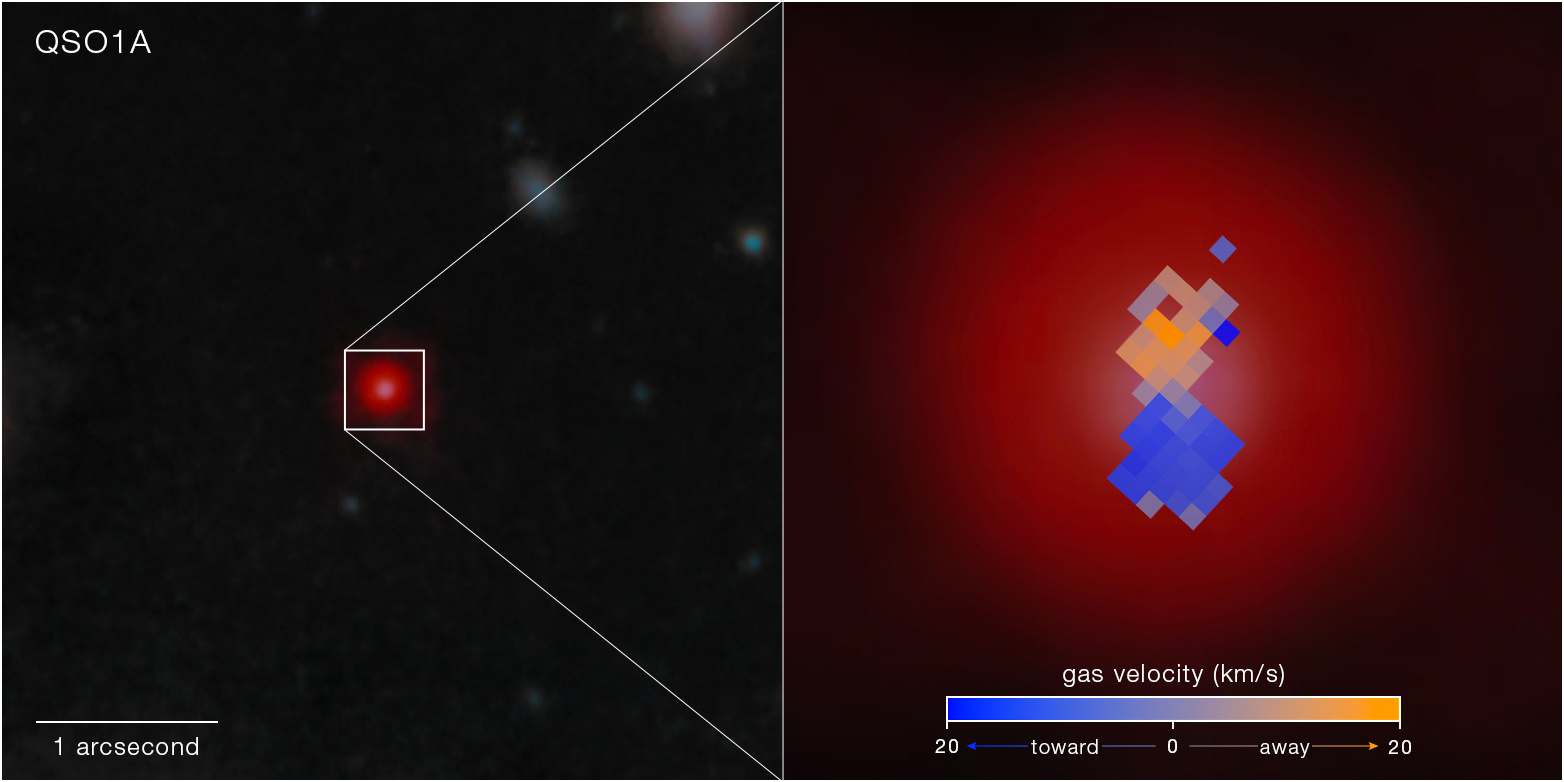
That magnified view allowed researchers to track gas moving around the object. What they found was a nearly perfect Keplerian rotation pattern, the kind of motion expected when material orbits a compact central mass.
It is the same basic logic astronomers use closer to home: just as the motion of planets reveals the mass of the Sun, the motion of gas around QSO1 can reveal the mass of whatever dominates its gravity. “Because the gas around QSO1 follows an almost perfectly Keplerian rotation pattern, we can directly infer the mass of the central object from its gravitational influence using the laws of gravity,” Maiolino says.
The result points to a black hole of about 50 million solar masses.
Not much room for a galaxy
That number alone is remarkable for such an early cosmic epoch. But the bigger surprise is what appears to be missing.
In the nearby universe, central supermassive black holes are usually only a small fraction of the mass of their host galaxies. The Milky Way, for example, contains a central black hole of about 4 million solar masses, but the galaxy itself is vastly more massive — about 1.5 trillion solar masses.
QSO1 looks very different. Maiolino says there is “not much room left” for a normal galaxy or stellar cluster to account for the gravity needed to produce the observed rotation. The team can only place a tight upper limit on the mass of the host galaxy.
“Most of the mass of QSO1 is concentrated in the black hole at the center,” said Ignas Juodžbalis, a graduate student at the University of Cambridge and lead author of the Nature paper, said in a press release. “If the mass were more distributed, as it would be if there were a lot of stars, the gas would not have this perfect Keplerian rotation.”
“Astonishingly, the current data imply that any host galaxy must be less massive than the black hole itself,” he says, “making this one of the most extreme black hole-galaxy systems ever identified.”
The object’s chemical makeup adds another twist.
Astronomers call elements heavier than helium metals, and those elements are forged mainly inside stars and spread into space when stars age, explode, or shed material. A gas cloud with only tiny traces of heavier elements has not been heavily processed by generations of stars.
JWST found very few metals in the gas around the black hole. Maiolino describes QSO1 as “one of the most chemically pristine systems ever found.” That matters because a rich population of stars would be expected to leave a stronger chemical fingerprint. Instead, the environment around QSO1 appears to have experienced very little star formation.
For John, the core mystery is now clear. “The standard model of cosmology remains intact,” he says. “The mystery here is how such a black hole got to be so massive so early.”
Born big?
The finding does not mean all supermassive black holes formed this way. Nor does it prove that black holes generally came before galaxies. But it does make one conventional route harder to defend for this particular object.
A common idea is that the first black holes formed from the collapsed remnants of massive stars. These stellar-remnant black holes could then grow by feeding on gas and merging with other black holes. But starting from such small seeds and reaching tens of millions of solar masses so early requires extremely rapid growth.
“These observations make that scenario considerably more challenging,” Maiolino says. “While rapid growth from a stellar-remnant seed is not impossible, it would be difficult to reconcile with the apparent lack of a substantial stellar population and the very low level of chemical enrichment observed around QSO1.”
That leaves heavier seed models.
One possibility is a direct-collapse black hole. In this scenario, a massive cloud of pristine gas collapses under its own gravity, forming a black hole directly rather than first fragmenting into many stars. These objects are still hypothetical, but they have long been proposed as a way to explain how supermassive black holes appeared so early in cosmic history.
Another, more exotic possibility is a primordial black hole. These would have formed not from stars or gas clouds, but from dense regions in the very early universe, possibly within the first fractions of a second after the Big Bang. Recent simulations have explored whether massive primordial black holes could reproduce some of QSO1’s strange properties, including its extreme black-hole-to-stellar-mass ratio and lack of metals.
John says primordial black holes are “good candidates” for explaining Little Red Dots such as QSO1, but stresses that they remain hypothetical. “We have no direct evidence for their existence,” he says.
Maiolino is also cautious. Some aspects of the data may be easier to reconcile with primordial black hole models, he says, but the evidence is far from conclusive. Direct-collapse models may also improve as theorists refine them.
“I don’t think that it will be possible to easily distinguish between these two scenarios in the specific case of QSO1,” he says.
Finding similar objects at even earlier cosmic times could help. If astronomers discover massive black holes so early that direct collapse becomes difficult to arrange, primordial black hole scenarios may gain ground.
Engines of early galaxies?
The stakes are larger than one strange object.
“Galaxy evolution is intimately connected to the evolution of their central black holes,” John says.
So, if some massive black holes formed first, they may have helped shape the galaxies that later grew around them.
Growing black holes can heat, stir, and expel gas — the same raw material needed to form stars. In some phases, they may suppress star formation. In others, they may help structure the gas around them and influence how a galaxy assembles.
“Black hole and galaxy formation and growth can be both symbiotic and competitive processes, in different phases,” Maiolino says.
That is why the “which came first?” question matters. It is not a cosmic version of the chicken-and-egg problem for its own sake. It goes to the heart of how structure formed in the universe: whether galaxies built black holes, black holes helped build galaxies, or both happened through different pathways in different environments.
“Our picture of galaxy formation may be wrong,” John says.
Still, both astronomers warn against overstatement. The Big Bang model is not in trouble. The age of the universe does not need to be rewritten because of QSO1. Instead, JWST is exposing gaps in the details of galaxy and black hole formation.
“The standard model of cosmology, the Big Bang theory, is still in good shape,” John says. “What we are uncovering are surprises in galaxy and black hole formation.”
Maiolino says the most dangerous overinterpretation would be to assume that all massive black holes formed through the same route.
“QSO1 may represent one extreme pathway,” he says, “but the universe likely produces massive black holes through multiple formation and growth mechanisms operating in different environments and at different cosmic epochs.”
To test the interpretation, astronomers need more data. For QSO1 itself, Maiolino would like to trace the cold gas around the black hole and its surroundings. He would also like to detect faint signatures from the few stars that may have produced the tiny traces of oxygen seen in the system. Both goals are difficult with current facilities.
Future Extremely Large Telescopes may help by delivering sharper images than JWST and probing the gravitational influence of distant black holes in greater detail. JWST, meanwhile, is expected to find more LRDs and, crucially, more gravitationally lensed examples like QSO1.
John says high-precision data and independent mass measurements will be essential. “More observations of LRDs, especially gravitationally lensed objects like Abell2744-QSO1, would strengthen this case,” he says.
For astronomers, the early universe is becoming less empty, less simple, and far more active than expected. JWST has already shown that galaxies formed quickly. Now it is suggesting that some black holes may have grown just as fast, or faster.
“JWST has been revealing that the early universe was much more dynamic than we thought,” Maiolino says. “Everything happened much faster than previously envisaged.”
And in that faster, stranger young cosmos, some black holes may not have waited for galaxies to grow around them. They may have helped start the story themselves.
Akashni Raghubar-Latchanna is a journalist, scriptwriter, and producer based in Johannesburg, South Africa.