Euclid spots the oldest known quasars
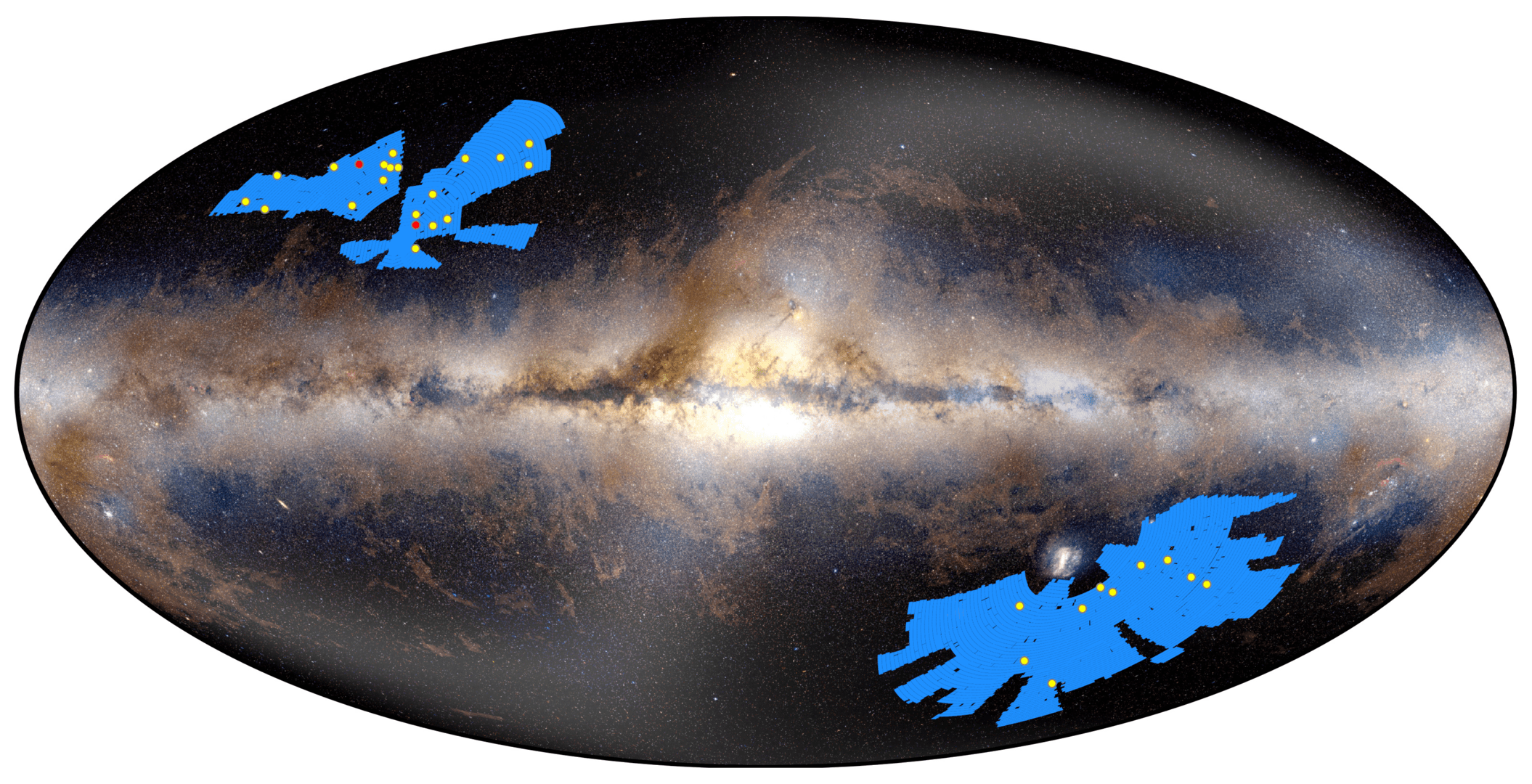
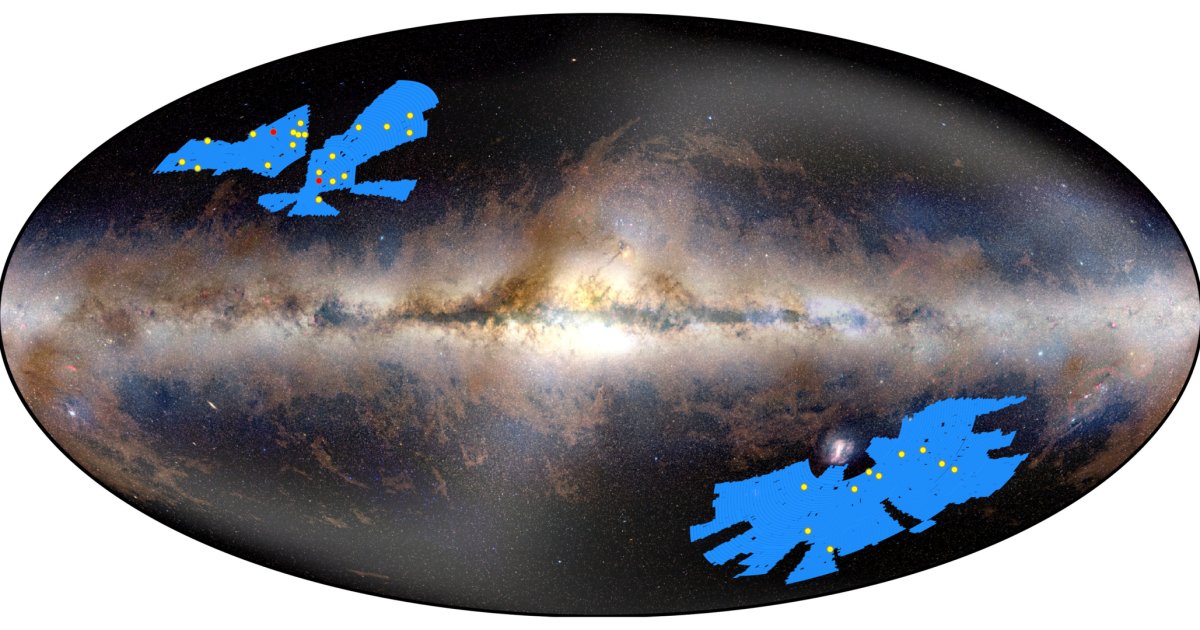
Yellow dots mark the locations of 29 quasars newly discovered by ESA’s Euclid space telescope, set against its survey footprint (blue) and an all-sky map from ESA’s Planck mission. The two red dots are the record-breakers — EUCL J172902.75+641018.1 and EUCL J125308.55+705432.3 — the oldest quasars ever identified. Credit: ESA/Euclid/Euclid Consortium/NASA/Planck Collaboration/A. Mellinger; Acknowledgment: Jean-Charles Cuillandre, João Dinis)
Astronomers searching the deep sky with the European Space Agency’s (ESA) Euclid space telescope have turned up the oldest quasars ever recorded — bright galactic cores that came to life when the universe was only 670 million years old.
Euclid identified 31 new quasars dating to the universe’s first billion years, including two record-setters whose light had to travel roughly 13 billion light-years to be seen by Euclid. The discovery, led by Daming Yang of Leiden University and published July 6 in Astronomy & Astrophysics, gives researchers their first look at ancient so-called ordinary quasars to study, rather than a handful of extremely bright outliers. A companion study led by Silvia Belladitta of the Max Planck Institute for Astronomy followed up on one of the quasars, using a ground-based array in the French Alps to measure star formation inside its host galaxy.
“The Euclid team has taken a true ‘census’ of quasars at the dawn of the universe for the first time. It’s a big step toward understanding these fascinating objects on a more fundamental level,” said Antonio La Marca, a Ph.D. candidate at the Netherlands Institute for Space Research and a research fellow on the Euclid team, in a press release.
What is a quasar?
At the center of nearly every large galaxy sits a supermassive black hole. A quasar marks the violent period where matter spiraling into that black hole heats up and radiates so fiercely that the galaxy’s nucleus can outshine its own stars, sometimes by a factor of thousands. The name compresses “quasi-stellar” into one word because these objects were first mistaken for unusually bright stars. A quasar’s light is actually a supermassive black hole’s accretion made visible. Scientists believe the oldest quasars could offer direct evidence of how the first supermassive black holes managed to grow so quickly in the early universe — a puzzle whose answer has eluded astronomers, since the known physics of black hole growth struggles to account for objects this massive so soon after the Big Bang.
How Euclid reveals ancient light
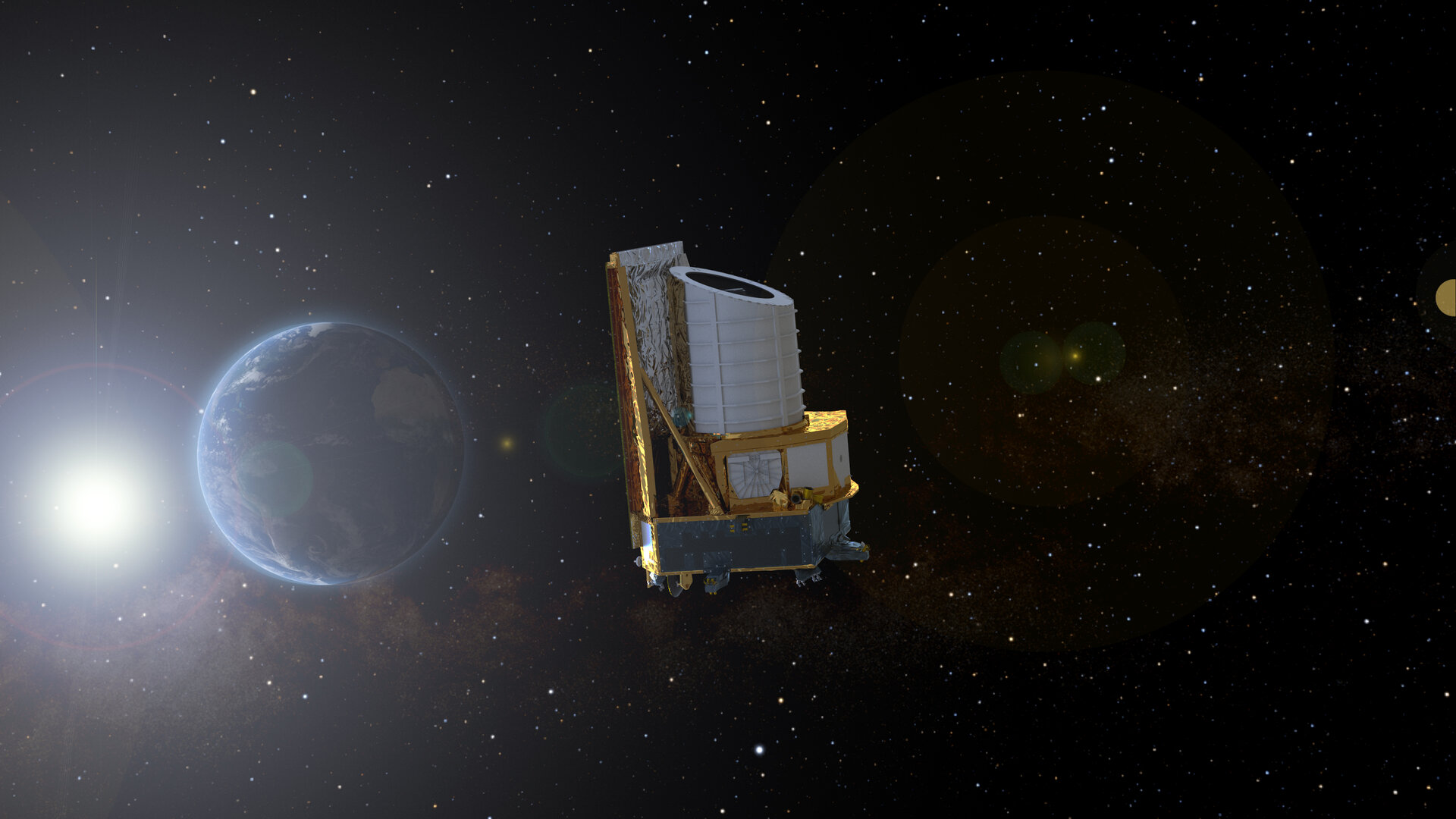
Euclid, named for the Greek mathematician who invented geometry, launched in July 2023 and began its main mission the following February. Over six years, its job is to reveal the geometry of the dark universe by surveying a third of the sky and cataloging billions of galaxies in order to map dark matter and probe the nature of dark energy. Euclid carries two instruments: VIS, a visible-light imager that captures sharp, high-resolution images across huge areas of sky, and NISP, a near-infrared spectrometer and photometer built to catch light that’s been stretched into infrared wavelengths by the universe’s expansion. That pairing lets Euclid cover wide swaths of sky and still pick out faint, distant objects. Since the most ancient quasars are dim and shifted deep into the infrared, Euclid is particularly good at spotting them — good enough that it broke the quasar redshift record twice within a few months of launching its search.
What is redshift?
As the universe expands, the space between us and a distant object stretches too — carrying that object’s light to longer, redder wavelengths the longer it travels. Astronomers measure that stretch using the parameter z, or redshift: the higher the number, the more the light has been stretched, and the longer it’s been traveling. A redshift of 7 corresponds to a light travel time of about 12.9 billion years — but because the universe kept expanding the entire time that light was in transit, a redshift 7 quasar itself is no longer 12.9 billion light-years away. It’s much farther; its light just took 12.9 billion light-years to reach us.
A quasar’s host galaxy is also far older than the light we’re seeing from it: A quasar with a redshift of 7 shone when the cosmos was under 700 million years old, a small fraction of that galaxy’s current age.
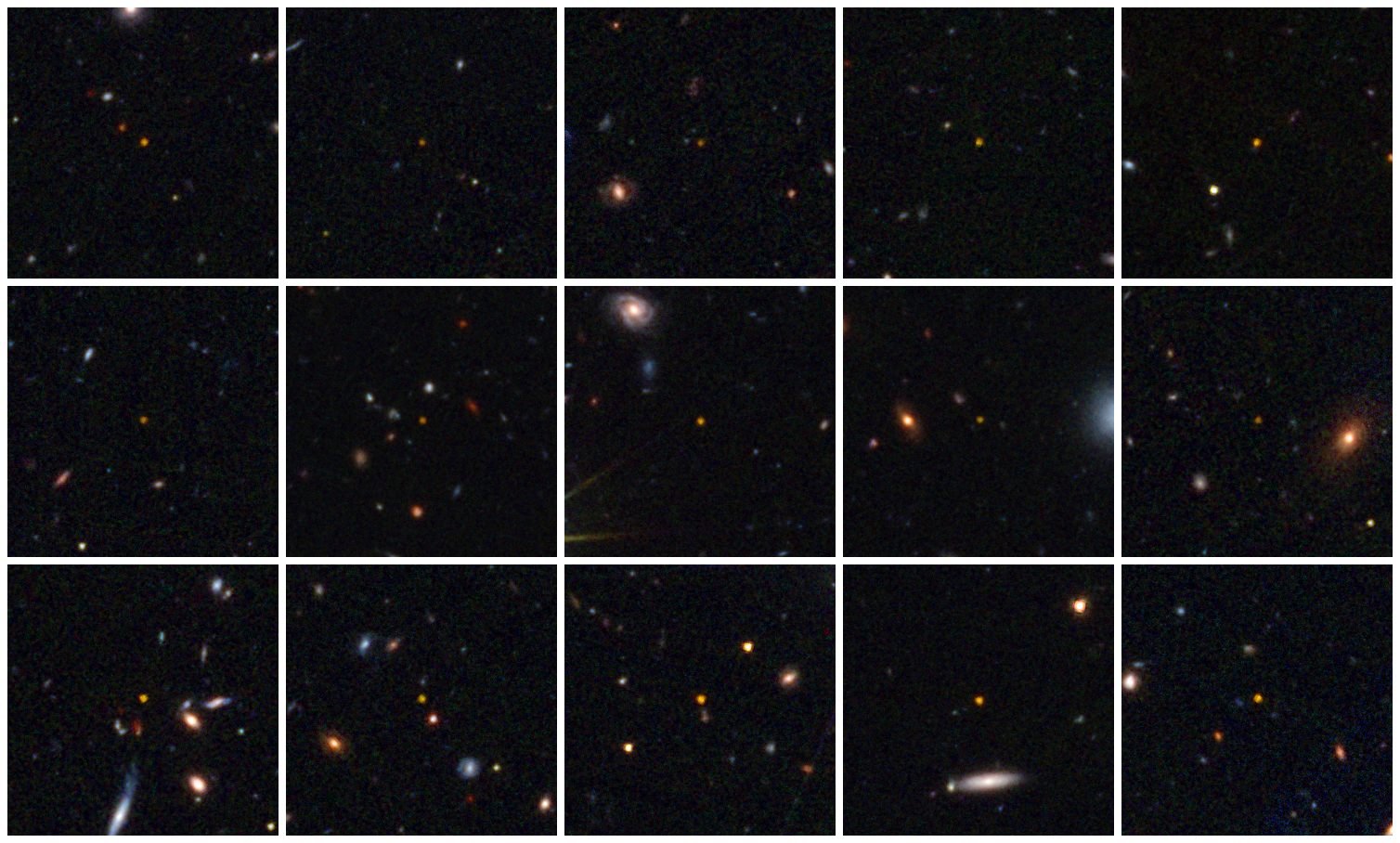
Combing through Euclid data, the team turned up 31 previously unknown quasars, 12 of them incredibly ancient, measured at a redshift of 7 or higher. Two of those 12 revealed record higher redshift than any other quasar on record: EUCL J172902.75+641018.1 and EUCL J125308.55+705432.3, with redshifts of 7.77 and 7.69. Those redshifts date them to the universe’s first 670 million years, surpassing the previous record of 7.64, set in 2021.
Ordinary quasars, extraordinary discovery
Despite dating back to the dawn of the universe, most of these newly identified quasars are considered “ordinary.” Quasars found before Euclid were outliers — bright enough to spot across enormous distances, but not representative of the broader population. “For the first time, we can study the typical early-universe quasar, not just exceptional outliers. We now have a real window onto how the bulk of the first black holes grew — and how they shaped the galaxies around them,” said Eduardo Bañados, Max Planck Institute astronomer and former Euclid Quasar Work Package co-lead. Euclid’s sensitivity lets astronomers catch fainter quasars hiding in the early universe — the objects that actually make up most of the early quasar population, rather than the rare extremes that happened to be visible before.
Peering inside an ancient quasar
This new discovery is already opening the door for follow-up work. One of those ordinary quasars, EUCL J125308.55+705432.3, drew closer scrutiny from Belladitta’s team, who pointed a powerful radio telescope, the Northern Extended Millimetre Array (NOEMA) on France’s Plateau de Bure, toward its host galaxy for a follow-up observation. The array traced two kinds of submillimeter light: one emitted by star-forming gas clouds, the other by cold dust. Together, the signals revealed a galaxy churning out stars at more than 250 solar masses a year — 250 times the Milky Way’s rate — while holding roughly 10 billion solar masses of material, about a tenth of our own galaxy’s heft. It’s a young system still under construction, Belladitta says, with plenty of raw fuel left to grow into something far larger.
Euclid is already helping astronomers build a picture of the earliest galaxies and supermassive black holes. These are still early steps, though. Hundreds more ancient quasars are expected to turn up once the telescope’s six-year survey is complete in 2030.
Brooks Mendenhall is a staff writer for Astronomy magazine and is based in Chattanooga, Tennessee.