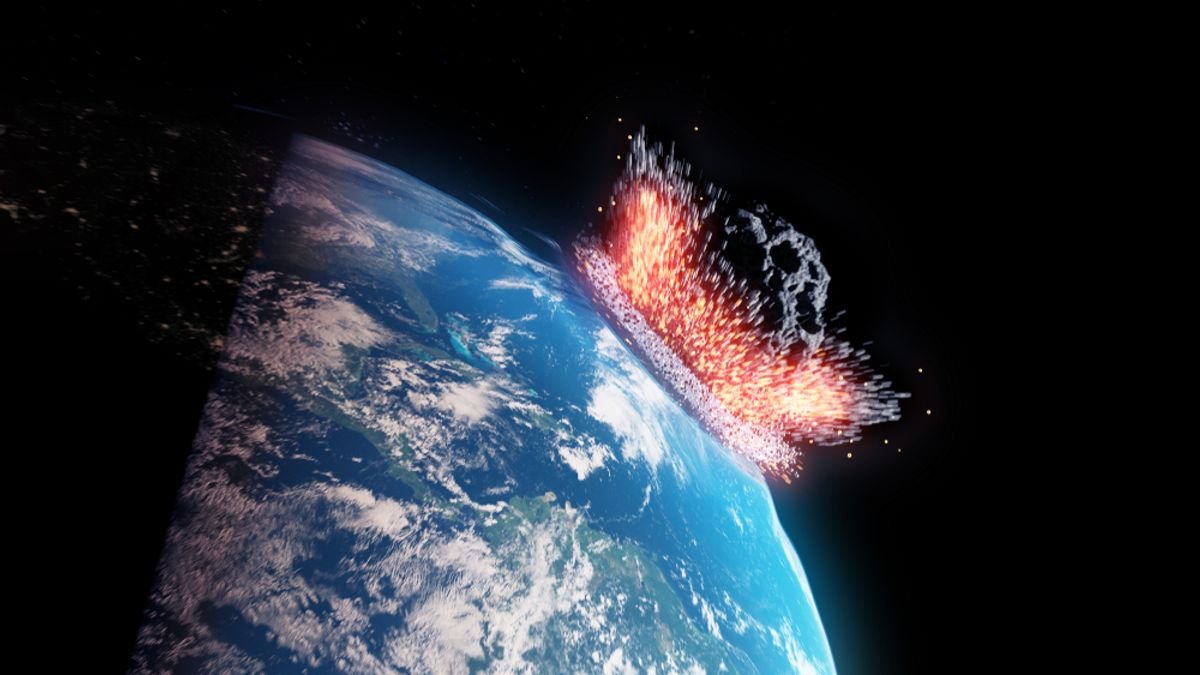
The Dinosaur-Killing Asteroid May Have Came From a Rare Class of Meteorites
Though the asteroid impactor struck Earth and likely spelled the end of the Age of Dinosaurs about 66 million years ago, researchers are still uncovering more about it.
Researchers from the University of British Columbia (UBC) and institutions in Paris, Brussels, and Vienna recently analyzed samples of the Cretaceous-Paleogene impactor (Chicxulub impactor) and found that its composition was relatively rare and could change what we know about the dinosaurs’ last days.
The meteorite was likely a carbonaceous chondrite, a stony type of meteorite that contains carbon, water, and other complex molecules. The elements within this meteorite, or lack thereof, could offer more insights into the extinction of the dinosaurs. The findings were published in Science Advances.
Read More: Evolving Plankton May Have Kicked Off Life’s Comeback After the Dinosaur-Killing Asteroid Impact
What Are Carbonaceous Chondrites?
Chondrites are an abundant type of stony meteorite and get their name from chondrules, the nearly spherical particles in the meteorite, according to the Buseck Center for Meteorite Studies. Far less abundant, however, are carbonaceous chondrites. Carbonaceous chondrites are separated into further categories based on their composition, according to Britannica. In this study, the impactor’s composition likely matched Oranans-class carbonaceous chondrites, also known as CO chondrites.

Residue of the Cretaceous-Paleogene impact.
(Image Credit: Dr. Philippe Claeys.)
According to Britannica, carbonaceous chondrites only make up about 3 to 5 percent of all meteorites on Earth. Because carbonaceous chondrites account for only a small percentage of meteorites found on Earth, the Chicxulub impactor appears to have been an unusually rare type of asteroid.
“Carbonaceous chondrites of the Ornans class are definitely not like the typical meteors you find in museum collections,” Philippe Claeys, who worked on the study as a visiting professor at UBC, said in a press release.
Uncovering Carbonaceous Chondrites
To learn more about the meteorite that likely wiped out the dinosaurs, the research team examined samples from a thin layer of marine clay formed by the impact using advanced nickel-isotope analysis. Through their analysis, the team was able to narrow down the meteorite’s composition.
“This is challenging work,” Claeys said. “Only a minute fraction of the projectile is preserved in the planet’s KT clay layer because the entire meteorite vaporized upon impact.”
The results show that the meteorite was likely a CO chondrite. A 2024 study in Science revealed that the impactor was composed of carbonaceous material. Now, thanks to the results of this current study, the research team knows which kind. Understanding the elements inside this meteorite helps put the pieces together on how much this impact affected the dinosaurs.
“A CO contains much less volatile elements — like carbon, zinc, water, and particularly [sulfur] — than other classes of meteorites we’ve discovered so far on Earth. It doesn’t alter our theory of what caused the extinction event — but it makes it less likely that [sulfur] contained in the impactor was the smoking gun. The fine debris thrown into the atmosphere would have [been] the primary factor,” Claeys said.
An Unlikely Strike
While carbonaceous chondrites make up only a small portion of the meteorites sampled on Earth, CO chondrites make up a very tiny fraction of those meteorites. According to the study, these types of meteorites are among the most pristine materials in our Solar System.
According to the study, the Cretaceous-Paleogene impactor was about six to nine miles wide and created a massive crater in the Yucatán Peninsula in Mexico. It was eventually named the Chicxulub crater.
“Being impacted by such a rare, distant projectile really underscores how unlucky the dinosaurs were,” Claeys said.
Read More: A Hydrothermal System May Have Helped Life Recover After Chicxulub Impactor
Article Sources
Our writers at Discovermagazine.com use peer-reviewed studies and high-quality sources for our articles, and our editors review for scientific accuracy and editorial standards. Review the sources used below for this article: