A USB-C dongle unlocked audio quality my phone was hiding all along
Lossless audio is more accessible than ever, with streaming services like Spotify, Apple Music, Tidal, and Amazon Music Unlimited offering access with low-cost monthly subscription services. Reaping the benefits of high-fidelity recordings is still tricky. Play lossless files through lossy means and introduce compression or resampling, and you’d miss out on their added detail. A cheap USB-C digital-to-analog converter (DAC) is all you need to get the best possible audio quality from your smartphone.
To be clear, your phone already has a DAC. Depending on your smartphone model, that DAC might already support high-resolution lossless music playback. The issue lies in the delivery mechanism. Most phones don’t have 3.5mm headphone jacks anymore, so people resort to using Bluetooth. The better option is to add a dongle DAC, which turns your phone’s USB-C port into a headphone jack while boosting its power output and providing bit-perfect audio.
Do you need a DAC for lossless audio? Maybe.
A DAC adds bit-perfect USB audio playback, delivering better sound
First things first, you don’t need a lot to enjoy music listening. I love listening to music, whether it’s playing on my iPhone Air’s mono earpiece speaker, my car’s middling sound system, or my expensive Dolby Atmos setup. For most people, listening to lossy music files will be just fine. In fact, your iPhone or Android phone already has an inbuilt DAC that can probably handle hi-res lossless audio playback over a cable. You don’t strictly need a DAC for lossless audio, but you will probably want one.
Lossless music playback comes at a cost. Even if a streaming service offers it for free with your plan, lossless files require more space to store and more bandwidth to stream. Those drawbacks may be acceptable if you’re receiving the perks of lossless audio. This is why you’d want a USB-C dongle DAC for your phone. It could be downsampling your hi-res audio files before playback, even with a wired set of headphones connected. Use a Bluetooth connection for listening, and your audio is certainly being compressed before it is delivered wirelessly.

Specifically, Android phones automatically downsample high-resolution audio to either 16-bit or 24-bit, 48kHz stereo PCM at the system level. Lossless files are often resampled, and this means your Android device can’t deliver hi-res audio in the exact same way it is encoded. We’ve explained before that 16-bit, 48kHz quality is more than enough for human ears. However, if your sole goal is a device that plays lossless files without any resampling or compression, you won’t be able to do it without adding a USB-C DAC.
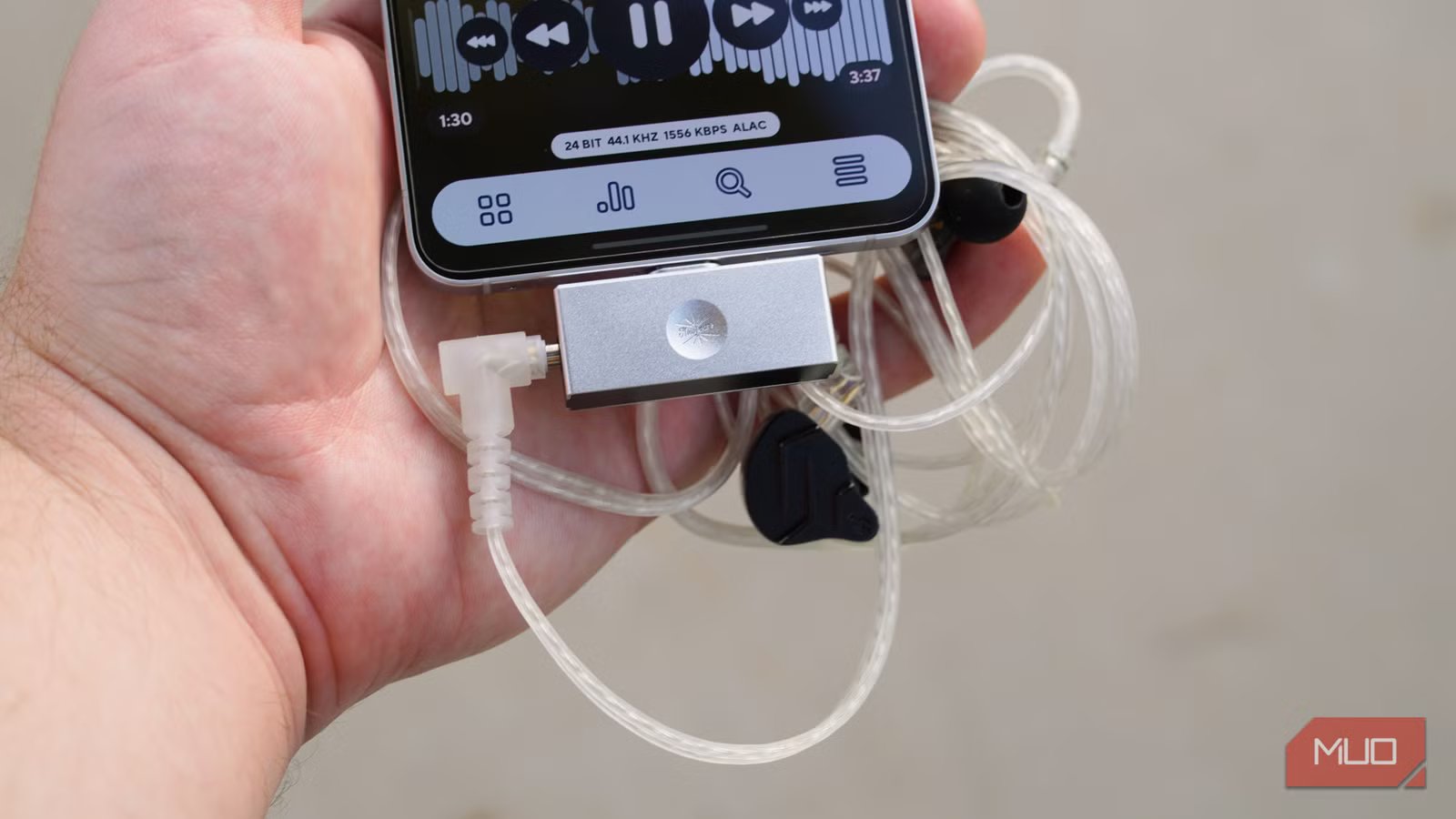
Smartphones support USB audio delivery through their USB-C ports, and this unlocks new possibilities for lossless playback. Android phones in particular can provide bit-perfect audio to USB accessories, given that a supported app is configured to bypass the AudioFlinger central Android system audio service. I use the Linsoul Kiwi Ears Allegro Mini, which is a sleek DAC that can play up to 32-bit, 384kHz audio through a phone’s USB-C port — avoiding the limitations of Android’s system audio server entirely.
While the 16-bit, 48kHz quality supported by your phone is good enough, it’s clear that USB-C audio accessories are actually doing something your phone can’t.
Dongle DACs do more than improve audio quality
They’re great for adding ports and driving high-impedance headphones

If you’re considering a dongle DAC for better sound quality, expect the difference to be negligible compared to using your phone’s USB-C port. The best perks of using a USB-C DAC have nothing to do with audio quality or fidelity. To enjoy lossless music at the highest quality possible, you don’t want to be using Bluetooth. Wireless audio playback is convenient, but it introduces latency, compression, and data loss in the delivery process. A cable is the solution, and a USB-C DAC helps you use it.
I don’t use a phone with a 3.5mm headphone jack anymore, so I need a way to connect my high-end wired headphones and cheap in-ear monitors (IEMs) over USB-C. While I could buy a budget adapter, I went with a dongle DAC instead. If I already need an accessory to connect my headphones, I might as well get one that brings bit-perfect USB audio playback to my Android phone too. That’s why I went with the Linsoul Kiwi Ears Allegro Mini — it takes one USB-C port and turns it into dual 3.5mm and 4.4mm outputs.
I could buy a USB-C to 3.5mm adapter, or use a pair of headphones that use USB audio out of the box. Neither of those options give me the same level of flexibility as the Linsoul Kiwi Ears Allegro Mini. With standard 3.5mm single-ended and 4.4mm balanced outputs, I can connect almost any pair of headphones or earbuds to my smartphone using this dongle DAC. I don’t have to worry about switching between 3.5mm and 4.4mm dongles, because this accessory has them both. As an aside, I also love how the Allegro Mini sits flush against my phone and doesn’t have a short cable that dangles around.
Aside from the output selection, I chose the Allegro Mini for its power output. Your phone’s inbuilt DAC, 3.5mm jack, or USB-C port aren’t designed to power high-impedance or high-sensitivity headphones. Connecting my Sennheiser HD 600 open-back headphones or a Fiio FT13 closed-back review unit directly to a smartphone results in a poor experience and low volume. If I put the Allegro Mini in between, with its left and right 30mW at 32 ohms output power, my phone can drive every set of headphones I have.
You don’t have to spend a fortune on a great USB-C DAC
You’ve probably already used one — you just didn’t know it

If you’re trying to get the highest audio quality out of your smartphone, the best advice I can give you is to avoid Bluetooth entirely. Wireless earbuds and headphones are neat, but even the most advanced Bluetooth audio codecs are lossy and compressed by nature. Wired audio is the way to get high-fidelity sound from your phone, and a USB-C dongle DAC helps you do it. Those with USB-C headphones or a phone with a 3.5mm audio jack might not need one, but for the rest of us, it’s the solution.
Being able to use your phone’s system audio service using USB audio is a nice-to-have benefit of buying a dongle DAC. I’d argue that the most impactful perks are the simplest ones, though. A dongle DAC adds a variety of balanced or single-ended analog audio outputs, and it has the power to drive high-impedance headphones. Those are the reasons you should buy one, and if your ears are good enough to pick up a quality improvement, consider it an added bonus.

- Type
-
USB-C DAC
- Phone Output
-
44.1-384kHz/32bit PCM
- Connectivity
-
3.5/4.4mm output
The Linsoul Kiwi Ears Allegro Mini is a tiny USB-C DAC that plugs into your device’s Type-C port. It uses a custom chip to deliver up to 32-bit/384kHz audio thanks to a custom digital-to-analog converter (DAC) chip. It has 3.5mm and 4.4mm headphone outputs.