AI Robots Hit 3,500 Garments Per Hour in Fashion’s Last Automation Holdout
Pedro PARDO/AFP via Getty Images
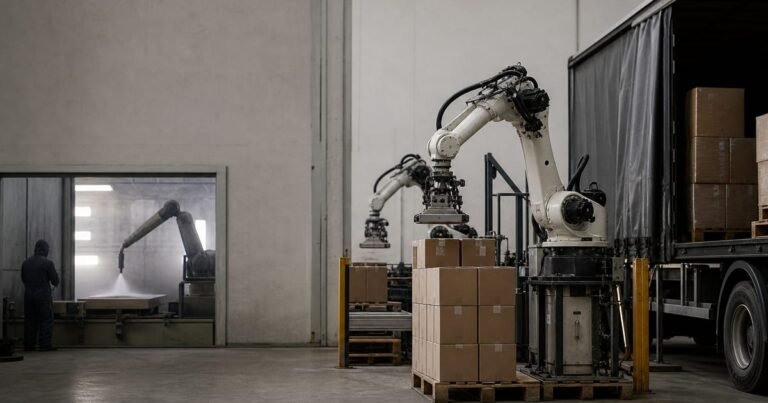
For decades, industrial robots went where the work was predictable: automotive chassis, semiconductor wafers, pharmaceutical vials. By 2024, more than 542,000 industrial robots were installed globally in a single year — more than double the figure from a decade earlier — but fashion logistics remained stubbornly manual. Fabric shifts, stretches, and folds unpredictably. Seasonal design cycles outpace the reprogramming windows rigid automation requires. And behind every sorted, labeled garment stood a human worker making micro-decisions that no fixed conveyor system could replicate.
That engineering reality has started to crack. A South Korean women’s apparel company has deployed autonomous AI-guided robots at its Yeoju distribution center that process up to 3,500 garments per hour — roughly four times the output of a manual operation — making it the first verifiable case of this class of robotics applied to fashion logistics at scale.
The implications extend well beyond one warehouse. What Baba Fashion has built in Gyeonggi Province is a working answer to a question the industry has debated for years: not whether robots can handle garments, but whether they can handle the data complexity that makes garment logistics so resistant to automation in the first place.
Baba Fashion’s AAGV: What the System Actually Does
Baba Fashion, the operator of women’s apparel brands Eyeiz Baba and Jigott, developed its AAGV (Autonomous AI-Guided Vehicle) system in partnership with Korean automation firm Cotek Electronics. The system handles 20,000 items daily at the Yeoju logistics center, dispatching product to 437 stores with minimal human staffing. Since deployment, the company reports achieving what it calls “zero loss” — meaning no picking errors or stockouts traced to logistics failures.
What distinguishes the AAGV from earlier conveyor-based automation is its navigation architecture. Traditional automated guided vehicles follow fixed paths — magnetic tape, embedded wires, or laser-reflector grids require physical infrastructure changes to the facility floor. The Baba Fashion system instead uses SLAM (Simultaneous Localization and Mapping), a navigation method in which the robots build a digital map of the warehouse using LiDAR sensors and cameras while simultaneously tracking their own position within that map. No floor markers are required. Layout changes are absorbed automatically for minor rearrangements; major reconfigurations require a fresh mapping pass that takes under an hour.
The operational loop works as follows: robots scan product barcodes on approach, cross-reference order and inventory data in real time through a synchronized data layer, determine the correct sorting destination, transport the garment autonomously, and return to a charging station — all without a human dispatcher. The fleet manages its own task sequencing. The 3,500-garment-per-hour throughput results from running multiple robots in parallel, eliminating the walking time, sorting-decision latency, and break cycles that constrain a manual operation.
The system handles garments that already carry machine-readable barcodes, presented individually. It does not solve the upstream challenge of picking or loading items into the logistics flow from bulk storage — that remains a partially human operation — nor does it address the downstream challenge of sewing or garment construction.
Moon Jang-woo, CEO of Baba Fashion, framed the deployment in explicitly strategic terms. “Logistics is the final touchpoint where customers experience a brand,” he said. “Delivery speed and accuracy are critical factors in brand evaluation.”
Why Apparel Resisted Automation for So Long — and Where That Resistance Remains
Understanding what Baba Fashion has achieved requires understanding what it has not. Fashion logistics and fashion manufacturing are different problems, and the robotics industry has solved only one of them.
The broader garment industry has an estimated automation penetration of 15 to 20 percent, compared with more than 80 percent in automotive assembly. The gap persists because fabric is a deformable material: unlike a car door or a microchip carrier, cloth bends, stretches, wrinkles, and behaves unpredictably under robotic manipulation. Researchers have described sewing automation as “the last mile” of textile automation — technically analogous in difficulty to autonomous driving, requiring not just better hardware but fundamentally new approaches to perception, planning, and control.
As of mid-2026, no fabric-handling control strategy for sewing has successfully moved from prototype to real-world commercial application at scale. The academic and industry literature is explicit: “To date, no fabric control strategy has successfully moved from the prototype stage to a tangible real-world application,” according to a 2025 paper from robotics researchers addressing the problem directly.
The AAGV system sidesteps this challenge entirely by focusing on sorted, individually barcoded items in the logistics phase — a domain where variability is data variability (which SKU goes where), not physical-material variability (how does fabric behave under a gripper). This is the engineering insight behind the deployment: attacking the problem that AI-guided vehicles can solve, rather than the problem they cannot.
That is not a criticism of the deployment. It is the accurate frame for understanding its significance. Fashion logistics automation is a real breakthrough. Fashion manufacturing automation remains a frontier.
A Sector-Wide Shift Is Now Underway in Korean Fashion
Baba Fashion’s deployment does not stand alone. South Korea’s fashion industry is converging on logistics automation from multiple directions simultaneously, with each company attacking a different part of the problem.
MUSINSA, one of South Korea’s leading fashion platforms and a destination for both independent Korean labels and luxury brands, is deploying Exotec’s Skypod robotic system at a new Yeoju logistics facility. The Skypod robots travel within storage racks up to 14 meters high at speeds up to 4 meters per second, retrieving any SKU in under two minutes. The system is modular — capacity can be added without rebuilding the infrastructure around it. “Korea is the most dynamic e-commerce market in Asia,” said Romain Moulin, CEO of Exotec. “Logistics demands in the apparel sector have increased significantly due to the global popularity of K-fashion.”
On the manufacturing side, Fashion Group Hyungji announced on June 30 that it will build a 6,600-square-meter sewing robotics research and demonstration center in Gochang, North Jeolla Province, near Samsung Electronics’ Smart Hub complex. The facility is positioned not as a production center but as what the company calls a “physical AI” hub — a site for verifying robotic soft-fabric handling, vision recognition, and automated cutting technologies on pilot production lines. The project is connected to South Korea’s government-announced “Three Mega Projects for Korea’s Great Leap Forward,” which directed investment into physical AI alongside semiconductors and AI data centers.
The two investments — MUSINSA’s logistics deployment and Hyungji’s manufacturing R&D center — represent the complete map of where the industry is focusing. Logistics automation is being deployed commercially. Manufacturing automation is being researched at scale for the first time.
South Korea’s Robot Density Sets the Context
The Korean fashion industry’s move toward logistics automation is not an isolated experiment. It occurs in the most robotically dense manufacturing economy on earth. According to the International Federation of Robotics’ World Robotics 2025 report, South Korea records 1,220 industrial robots per 10,000 manufacturing employees — the highest robot density of any country and a figure growing at roughly 7 percent annually since 2019. Germany ranks third globally at 449 units; the United States ranks eighth at 307 units. South Korea’s figure is nearly three times Germany’s.
That density reflects decades of investment in electronics and automotive manufacturing — but also the engineering culture and industrial ecosystem that produces deployments like Baba Fashion’s AAGV. When a Korean fashion company can co-develop a novel autonomous navigation system with a domestic electronics firm, it is partly because South Korea has built the industrial infrastructure to make that collaboration routine.
The macro picture across Asia reinforces the urgency of the shift. In 2024, Asia accounted for 74 percent of global industrial robot installations. China alone installed 295,000 units — 54 percent of the global total — and its operational robot stock exceeded 2 million units, the largest of any country. Chinese domestic suppliers have expanded into textiles, food processing, and wood products — sectors where they face virtually no foreign competition — according to analysis from the CSIS ChinaPower Project. That market dominance creates a feedback loop: early deployments in new automation categories generate operational data that feeds model training, reducing the cost and time required for subsequent deployments.
What This Actually Means for the Sector’s Transformation
The broader lesson from the Baba Fashion deployment is about sequencing. Fashion automation is not arriving all at once. It is arriving in the segments where the engineering problems have been solved.
Logistics and sorting are ready: barcoded items, defined sorting destinations, and data-driven navigation make AAGV deployment viable today. The economics favor high-volume operations with predictable product types — women’s blouses and standardized garments, not couture with complex construction variations. A system optimized for Eyeiz Baba’s catalog may require significant redeployment for a luxury brand with frequent limited-edition drops and multiple bespoke stitching requirements.
Sewing and assembly are not ready at commercial scale: the open research challenges in deformable material handling, fabric gripping, and seam correction have not been solved for general production environments. Fashion Group Hyungji is investing specifically to address this gap — the research center’s focus on robotic soft-fabric handling and vision recognition is targeted at the bottleneck that the AAGV system deliberately avoids.
By 2026, as California Apparel News noted in its industry forecast, “AI and digital tools are finally delivering tangible, practical value in fashion retail — moving beyond pilots to core operations that drive real cost savings and productivity gains.” The Baba Fashion deployment is the most concrete single data point confirming that forecast — but it is a logistics data point, not a manufacturing one.
The era of fashion logistics automation has arrived. The era of fully robotic garment manufacturing has not.
Frequently Asked Questions
Does this mean garment factories are going robotic anytime soon?
Not in the way the headline might imply. The Baba Fashion breakthrough applies specifically to logistics and sorting — the phase after garments are made and need to be transported, scanned, and dispatched to stores. Sewing automation, which is where the vast majority of garment manufacturing labor resides, remains an unsolved engineering challenge at commercial scale. No robotic system has successfully moved from prototype to full production for automated sewing of general apparel types. Fashion Group Hyungji’s June 2026 announcement of a dedicated sewing robotics R&D center signals that serious investment is now being directed at this gap — but research investment and commercial deployment are different timelines.
How do the AAGV robots actually navigate a fashion warehouse without human guidance?
The system uses SLAM — Simultaneous Localization and Mapping — a navigation method in which the robots build a digital map of the warehouse using LiDAR sensors and cameras while simultaneously tracking their own position within that map. No fixed floor markers, magnetic tape, or embedded wires are required. When a robot receives an order task, it cross-references a barcode scan against live inventory and order data, determines the correct sorting destination, and navigates there autonomously. The entire fleet — including charging, transport, sorting, and return cycles — runs through a shared data synchronization layer with no human dispatcher.
Why has apparel automation lagged so far behind automotive and electronics?
The core problem is physics: fabric is a deformable material. A car door has fixed dimensions and material properties; a knit blouse has different weight, stretch, and drape depending on its fiber content, construction, and even how it has been handled. Robotic grippers that work reliably on rigid objects fail consistently on soft textiles — the material shifts, slips, and wrinkles in ways that are extremely difficult to model computationally. Researchers describe the sewing automation challenge as analogous to autonomous driving in its complexity: not just a hardware problem, but a fundamental perception, planning, and control challenge. Industry estimates put apparel’s overall automation penetration at 15 to 20 percent, versus more than 80 percent in automotive.
Who is most affected by fashion logistics automation expanding across South Korea?
The most immediate impact falls on warehouse sorting workers at fashion logistics centers — the role the AAGV most directly replaces. South Korea’s fashion industry serves a global K-fashion demand that has put extreme pressure on fulfillment speed and accuracy, creating strong economic incentive for automation at companies like Baba Fashion and MUSINSA. In the medium term, analysts project that up to 40 percent of workers in developed-market apparel and logistics operations will need to reskill by 2030 as automation expands. The longer-term impact on manufacturing workers in garment-export economies — Bangladesh, Cambodia, Vietnam — depends on the timeline of sewing automation, which remains further out.