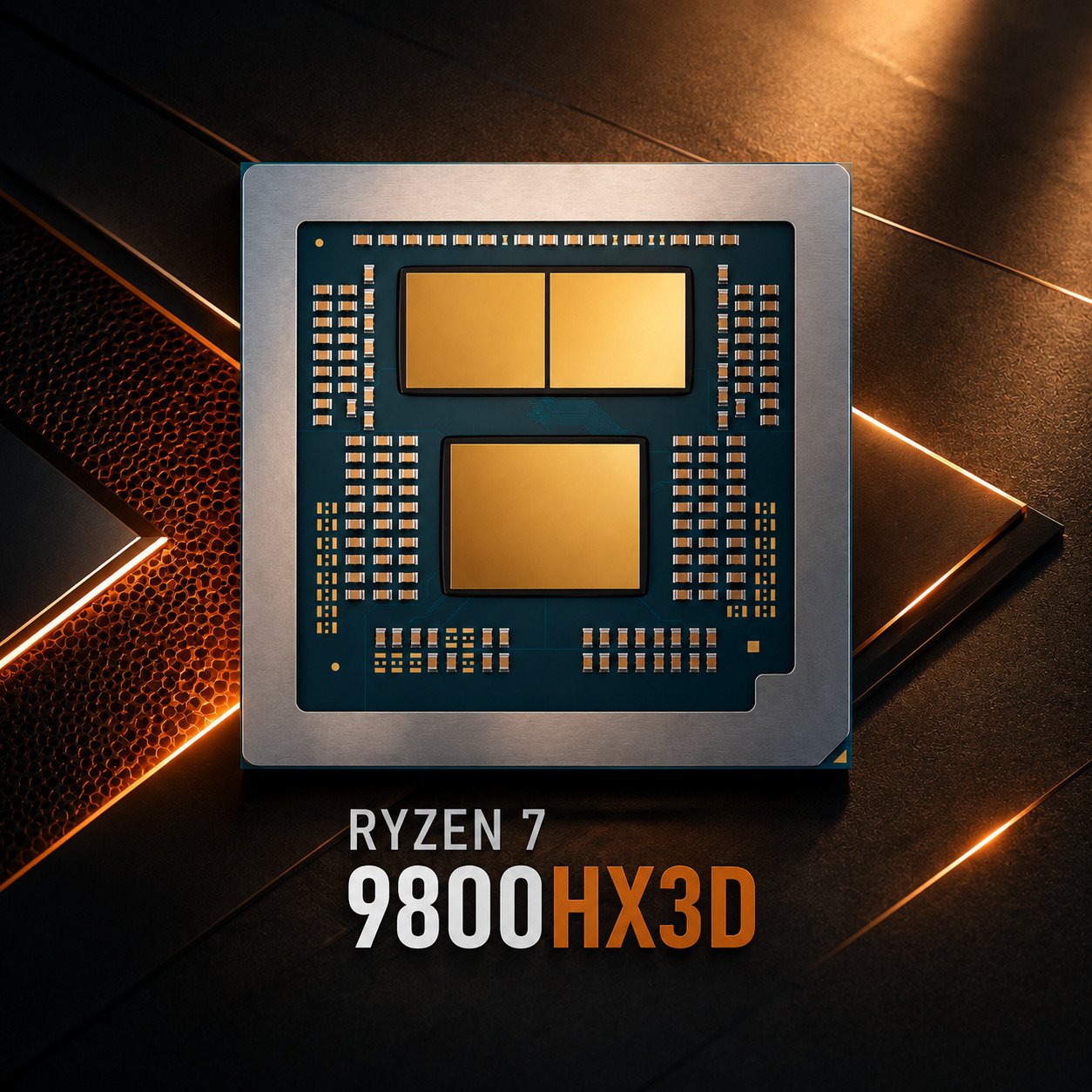
AMD Ryzen 7 9800HX3D: Mobile X3D for Gaming Notebooks
AMD has established a firm position among gamers with its X3D processors in the desktop segment. Models such as the Ryzen 7 7800X3D and the Ryzen 7 9800X3D are considered particularly strong gaming processors because of their large additional L3 cache. Current information now suggests that AMD could transfer this concept more strongly to the mobile segment for the first time.

The focus is on a processor designation that has not yet been officially confirmed, the Ryzen 7 9800HX3D. The chip is said to be specifically designed for high-performance gaming notebooks and to combine the advantages of 3D V-Cache with the current Zen 5 architecture. However, one point remains important: AMD has not officially announced the processor so far. The technical data currently known comes from leaks and not from a confirmed manufacturer release. Accordingly, individual details must still be treated with caution. Based on the information published so far, the Ryzen 7 9800HX3D is said to be based on eight Zen 5 cores and to support a total of 16 threads. The processor is said to reach a maximum boost clock of up to 5.1 GHz and, thanks to additional 3D V-Cache, to total around 96 MB of L3 cache. This additional cache is the central feature of the X3D series. AMD stacks additional SRAM memory directly on the processor die, making certain data available much faster. Games in particular benefit from this technology, as many game engines frequently retrieve small amounts of data repeatedly and can therefore benefit significantly from lower memory latencies. In the desktop segment, AMD has already shown with this approach that a processor with fewer cores can in some cases be faster than models with significantly more compute units.
The reason is that gaming workloads do not depend solely on the number of cores, but are strongly influenced by memory accesses and latencies. This technology could be particularly interesting for gaming notebooks. Mobile systems are always faced with a compromise between performance, temperature and power consumption. A larger cache can accelerate certain calculations without massively increasing power draw through significantly higher clock rates or additional cores. Especially in games with high frame rates, a mobile X3D processor could bring advantages. In combination with current notebook GPUs, the processor could help reduce CPU bottlenecks and achieve more stable frametimes. The actual benefit, however, depends heavily on the respective game, the graphics card and the notebook’s cooling. With a Ryzen 7 9800HX3D, AMD would be pursuing a strategy similar to that in the desktop market. Instead of relying exclusively on maximum core counts, an optimized eight-core processor could target gamers who are looking for the highest possible gaming performance. The exact positioning within the Ryzen mobile family remains open, however. Such a model would likely be placed below the Ryzen 9 HX series, but above classic Ryzen 7 processors without additional cache. This could allow AMD to create a dedicated premium gaming category. For notebook manufacturers, such a chip would be particularly interesting because gaming laptops increasingly try to offer desktop-like performance in mobile devices. An efficient X3D processor could help achieve high frame rates without making cooling systems even larger and heavier. In competition with Intel as well, a mobile X3D processor would be an important signal. Intel continues to rely heavily on high clock rates, hybrid architectures and broad platform integration in its high-performance notebook processors. AMD, by contrast, could create its own differentiating factor with cache technology. Whether the Ryzen 7 9800HX3D will actually appear and be marketed under this name remains open. Earlier leaks about AMD products have in some cases already mixed existing technical information with model names that were later changed. Only an official presentation by AMD will provide final clarity.
Conclusion
The possible Ryzen 7 9800HX3D would be an interesting step for AMD, as the successful X3D technology could be transferred consistently to the mobile gaming segment for the first time. If the leaked data is correct, an eight-core processor with a large cache could become a very attractive solution for gaming notebooks. At the same time, it remains to be seen how AMD implements thermal output, power consumption and availability in real devices.