Articulated Robot Market Size to Exceed $136.25 Billion By 2035
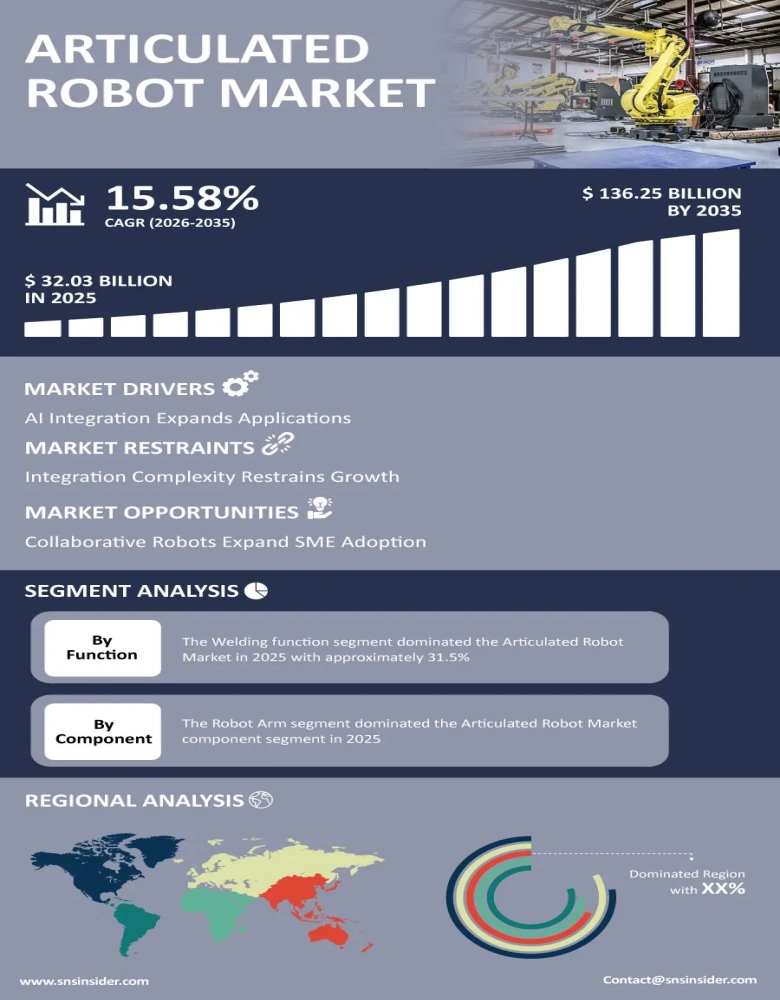
The global Articulated Robot Market is entering a period of accelerated expansion as manufacturers increase automation spending to address workforce shortages, rising labor expenses, and growing requirements for precision and production consistency. According to a recent study by SNS Insider, the global Articulated Robot Market size valued at USD 32.03 billion in 2025, is anticipated to grow to USD 136.25 billion by 2035, registering a CAGR of 15.58% over the 2026–2035 forecast period.
Multi-axis robots are becoming popular within manufacturing industries in applications such as welding, assembly, material handling, dispensing, inspection, and moving materials. With advancements in the realms of artificial intelligence, machine vision, and smart factories, it has become easier to utilize robotic systems that are versatile enough to do a variety of tasks.
The rise of electric vehicle manufacturing, semiconductor manufacturers, pharmaceutical companies, and electronics companies is also contributing towards increased need for automation that can ensure efficiency.
To Get Detailed Insights on the Articulated Robot Market – Request a Sample Report
AI-Enabled Automation Creates New Growth Opportunities
The combination of machine vision and intelligent control technologies is broadening the scope of articulated robots beyond the traditional use of repetitive manufacturing operations. With sensors that allow the detection of varying part locations and dynamic adjustment, such robots can assist in the process of quality control.
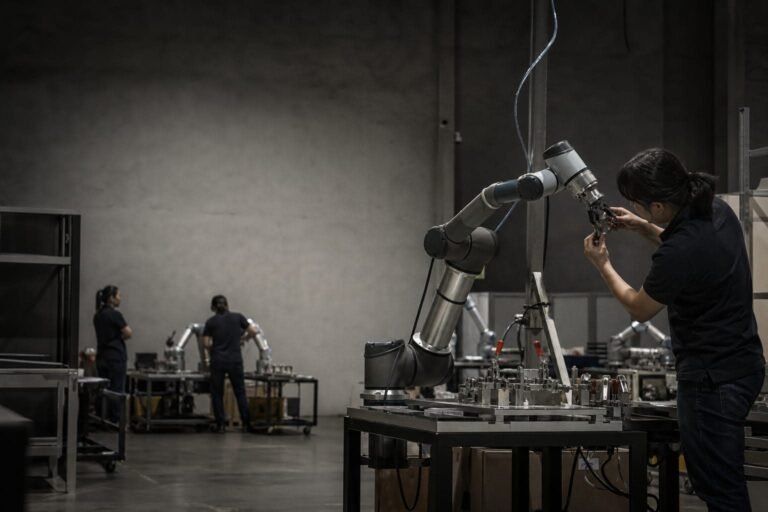
Collaborative robot solutions are also bringing up possibilities in the small and medium-sized enterprise sector. Small robots with highly developed safety features are able to work in proximity to human operators, providing the possibility of using flexible manufacturing arrangements where traditional robotic cells would not have been viable.
Moreover, the use of autonomous mobile manipulation systems that integrate robotic arms with mobile platforms increases flexibility within automated manufacturing setups. Such robots can relocate around the production facility to carry out multiple operations.
Key Market Insights Highlight Shifting Demand Patterns
By payload capacity, articulated robots exceeding 225 kg maintained their leading position in 2025, supported by extensive use in automotive, metal processing, machinery, and other heavy industrial applications requiring substantial lifting and positioning capabilities. Meanwhile, robots with payloads of up to 16 kg are projected to register the fastest growth through 2035 as lightweight automation expands across electronics, food and beverage, pharmaceutical packaging, and laboratory operations.
Based on function, welding accounted for approximately 31.5% of global market revenue in 2025, reflecting continued reliance on robotic systems in automotive body manufacturing and metal fabrication. Dispensing is expected to be the fastest-growing function as demand increases for highly accurate application of adhesives, coatings, sealants, and specialized materials in electronics, pharmaceutical, and packaging production.
By component, the robot arm segment held approximately 36.4% of market revenue in 2025, owing to its central role in determining the reach, movement, speed, and payload capabilities of an articulated system. End effectors are projected to grow at the fastest pace as manufacturers increasingly require specialized tooling designed for application-specific tasks and diverse product geometries.
In terms of end-use industry, automotive segment led with approximately 39.4% of market revenue in 2025. Pharmaceuticals and cosmetics are forecast to experience the fastest growth as manufacturers adopt robotics for sterile handling, cleanroom production, precision packaging, and compliance-driven manufacturing processes.
Flexible Manufacturing and EV Production Strengthen Demand
The demand for automated systems capable of adjusting to shorter production runs, product customization, and flexible production requirements is growing among manufacturers. This shift will contribute to the rising popularity of reprogrammable robots that can quickly switch from one operation to another.
The adoption of EVs will be especially significant since the production of batteries and automobiles requires a highly developed level of automation for component handling, assembly, sealing, testing, and material transportation. The semiconductor and pharmaceutical industries are generating further lucrative prospects for articulated robots.
North America Holds 42% Market Share in 2025 as Asia Pacific Emerges as the Fastest-Growing Region
Asia Pacific region is expected to continue dominating and has the highest growth among other regions growing at about 16.45%. Rapid industrialization, manufacturing, labor scarcity, and government supported intelligent manufacturing systems are contributing towards increased robot adoption in China, Japan, South Korea, and new production centers in Southeast Asia.
There is also high demand for robots in North America, where the US alone makes up for almost 78% of regional revenues in 2025. Manufacturing reshoring, investments in electric vehicle production, building of semiconductor factories, and production of aircraft contribute to high spending on automation.
In Europe, the market is also highly advanced due to technological advancements made by the German automobile and engineering industry. In Latin America and the Middle East & Africa regions, there is gradual adoption due to modernizing of factories.
Industry Participants Focus on Intelligent Robotics and Efficiency
The competitive landscape remains highly dynamic as robotics companies invest in AI-enabled vision, energy-efficient platforms, collaborative operation, advanced end effectors, and flexible automation systems. Manufacturers are increasingly focused on delivering solutions that reduce programming complexity while expanding robot deployment into new industries and smaller production environments.
Key companies operating in the global Articulated Robot Market include FANUC Corporation, ABB Ltd., KUKA AG (Midea Group), Yaskawa Electric Corporation, Kawasaki Heavy Industries Ltd., Mitsubishi Electric Corporation, Denso Corporation, Nachi-Fujikoshi Corporation, Epson Robots (Seiko Epson), Stäubli International AG, Universal Robots A/S (Teradyne), Comau S.p.A. (Stellantis), Omron Corporation, Yamaha Motor Co. Ltd., OTC Daihen Corporation, KION Group AG (STILL), Techman Robot Inc., AUBO Robotics Co. Ltd., Doosan Robotics Inc., and Kassow Robots ApS.
An SNS Insider analyst Sushant Kadam commented, “The convergence of artificial intelligence, machine vision, collaborative robotics, and advanced manufacturing is significantly broadening the commercial potential of articulated robots. As manufacturers prioritize productivity, flexibility, and workforce resilience, suppliers capable of delivering intelligent, energy-efficient, and easily deployable robotic systems will be well positioned to capture long-term opportunities across established and emerging industries.”
About the Author