Astronomers Use “Blind Stacking” to Uncover Invisible Space Junk Threatening Geosynchronous Orbit
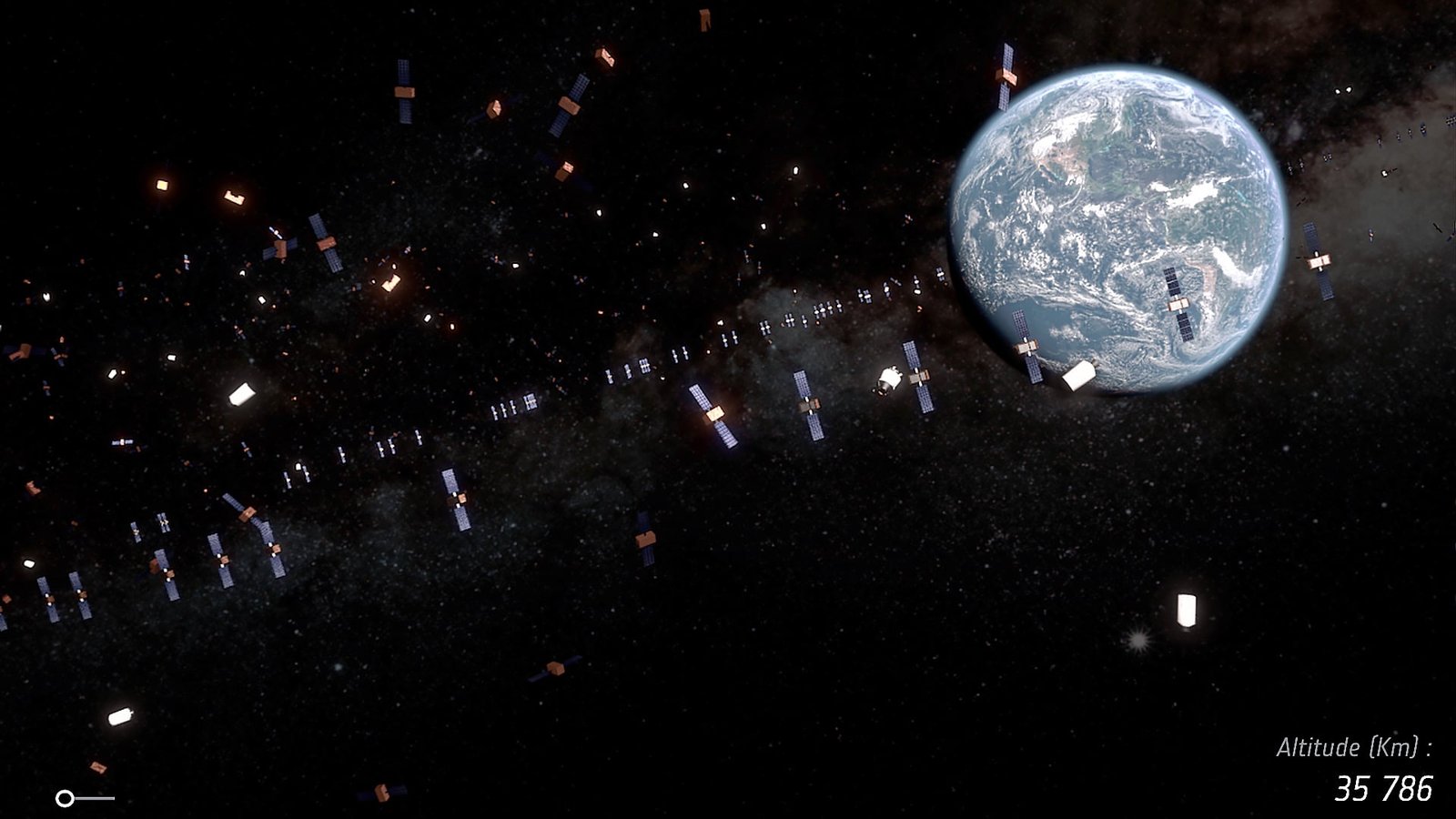
Geostationary orbit (GEO) is arguably one of the most important orbital spaces we have. So it’s critical that we keep it clear of debris that could destroy the valuable GPS, weather tracking, and communications satellites already in this orbit. Unfortunately, that is easier said than done; small pieces of debris at that altitude can slip past even our most sensitive sensors. But now, a new paper published in the Journal of Astronautical Sciences by James Blake and an international collaboration of researchers showcases how an advanced algorithm can help find tiny pieces of debris that would otherwise be missed by traditional surveys.
Debris itself is increasingly becoming a problem, especially at this height where there’s little to no air resistance that would eventually pull it back down to Earth. For example, the Intelsat 33e breakup in October 2024 alone added 36 fragments to the public Space-Track catalogue, though surveillance networks detected hundreds more initially. Ask any space debris expert and they will tell you breakup events like that one can create thousands of smaller fragments, forcing the satellites still in orbit there to fly essentially blind through a microscopic minefield.
The research team attempted to tackle finding some of these tiny fragments using the 2.54m Isaac Newton Telescope (INT) in La Palma, Canary Islands. Previous efforts by astronomers had looked for faint streaks of debris in single 10-second exposures. But this traditional technique hits a hard sensitivity limit, missing the smallest fragments. So the researchers employed an additional feature called a “blind stacking” algorithm.
Fraser talks about how to clean up space debris.
Blind stacking algorithms are a computationally intensive way to overlay multiple pictures on top of one another. First, the software combines multiple image frames taken over a “sequence.” Then it tests thousands of potential paths a moving target might take across the sky between successive frames. It then digitally shifts and stacks the images along these expected paths, amplifying the faint signal of a debris fragment while canceling out random background noise.
They also applied sophisticated mathematical processing to the image processing “pipeline.” To perfectly pinpoint the star trails, they utilized specialized mathematical functions, such as the Gaussian and the “Tepui” functions. This allowed the team to achieve sub-arcsecond astrometric precision—which is critical when you’re trying to make sure multiple images overlap just right.
With the data from the INT, the new algorithm found 25 new potential debris tracklets that had been missed by traditional single-frame extraction methods. The authors calculated that this pushed the sensitivity limit fainter by 1 magnitude—bringing the detection threshold down to objects around 5–10 cm in diameter.
Fraser talks about how we can use Star Trek tech to remove space debris.
But they didn’t stop there. They applied the same blind stacking technique to a dataset captured by a commercial-off-the-shelf (COTS) 36-centimeter robotic astrograph (RASA). Despite being nowhere near as powerful as the INT, the smaller telescope experienced a massive improvement in its debris-finding capabilities when its dataset was run through the algorithm. In fact, since it had a wider field of view and shorter readout times, it was actually even more suited for that algorithmic approach.
The algorithm discovered 62 new distinct tracklets in the RASA data, marking a sensitivity improvement of roughly two magnitudes over traditional detection methods. Impressively, the team was even able to recover many of the same debris pieces found in the INT dataset using the commercial RASA observations. In essence, they proved that affordable, commercial-grade telescopes can significantly contribute to Space Domain Awareness when paired with advanced algorithms.
But when space debris experts get access to larger telescopes, they will still always jump at the chance. The authors have already launched a follow-up campaign using telescopes like the 1.35m SkyMapper Telescope in Australia and the 1m Bisei Space Guard Center in Japan. Some of these sensors have high-speed CMOS detectors, which can significantly reduce dead time between images and help accelerate the collection of high-cadence data. As more and more pieces of debris are introduced to our more critical orbits, we’re going to need all the help we can get to find and track them—and this paper certainly seems like a step in that direction.
Learn More:
University of Warwick / EurekAlert – More than meets the eye: Astronomers dig deep to find tiny but dangerous space debris
J. A. Blake et al – DebrisWatch II: Digging Deeper for Geosynchronous Debris
UT – Tracking Satellites and Space Debris Using Radio Antennae