Beyond lithium: how sodium-ion batteries could change the world
The lithium-ion battery is the beating heart of the modern world. It powers eight billion mobile phones, hundreds of millions of laptops and rapidly growing fleets of electric cars and energy-storage banks. But there’s a new contender breaking into the battery market.
Batteries based on sodium promise to be cheaper, safer and much more environmentally friendly than lithium-ion cells. And this year could mark the start of the sodium era.
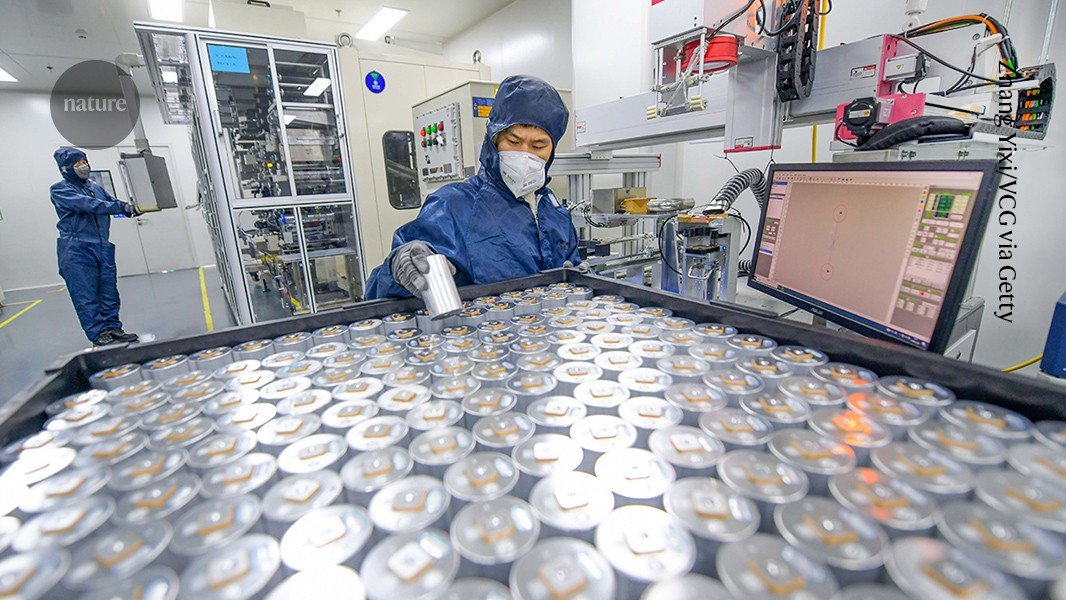
In April, Chinese firm CATL — the world’s largest battery producer — announced that it will start mass-producing sodium-ion batteries before the end of 2026. CATL, which is headquartered in Ningde, added that it had signed deals to sell the batteries both to a car manufacturer and to a provider of energy-storage stations for electricity grids.
Sodium-ion batteries were first developed in the 1980s, around the same time as lithium-ion ones. But early prototypes had some major shortcomings: they couldn’t hold as much energy as lithium-ion batteries, and they weren’t as durable, quickly losing their ability to recharge. For decades, therefore, research focused on lithium-ion technology. But interest and investment in sodium-ion batteries has ramped up in the past half-decade. Companies in China have already introduced motorcycles and small cars powered by sodium batteries, and have developed sodium-battery manufacturing facilities. CATL’s mass production promises to substantially increase the technology’s spread. Another Chinese firm, Shenzhen-based BYD, which is the biggest electric-car maker by global sales, is also investing heavily in sodium-ion batteries, analysts report.

Sodium-ion batteries made by CATL in China are used in electric cars (left) and energy-storage banks for electricity grids (right).Credit: CATL
What has surprised many observers is how rapidly companies claim to have improved on sodium-ion’s flaws. Auke Hoekstra, an energy analyst at Eindhoven University of Technology in the Netherlands, says he has been taken aback by the pace of advancement. “I honestly did not expect it to go that fast — and I am usually the guy who is seen as an optimist,” he says.
Hoekstra is known for his bullish predictions about renewable energy, which have often been correct. Now he is bullish on sodium-ion. Although other analysts and researchers are unsure how strongly the technology can compete with lithium-ion devices, he sees it as an innovation that will enable the price of batteries to keep falling, thus speeding up the electrification of the world’s economy. “For the future of energy, this really would be a game-changer,” he says.
Battery prices: decline and fall
The expectation that sodium-ion technology will cut battery prices rests mainly on the fact that its raw materials are cheaper and more abundant than those of lithium-ion batteries.
The prices of battery cells have already fallen by more than 90% since 2010 (see ‘Falling prices of lithium-ion batteries’). Most of this reduction is a result of improvements in the efficiency of industrial processes, as well as increases in battery production volumes. This means that the raw materials in the cells make up a larger share of the total cost than they did previously.

Source: Adapted from Our World in Data/BloombergNEF
For lithium-ion batteries, those raw materials include not only lithium — typically stored as ions in a graphite and copper electrode (the anode) — but also the components of the other electrode, the cathode, that draw lithium ions across when a battery discharges.
To boost energy capacities, materials scientists and engineers have developed cells that use the heavy-metal elements nickel, manganese and cobalt (NMC) to form ‘layered oxide’ microscopic crystals that hold lithium in the cathode. Because lithium ions can be packed so tightly and strongly in these crystals, commercial NMC cells have reached record capacities of more than 300 watt-hours of energy per kilogram (Wh kg−1) — enabling some high-end electric cars to cover more than 800 kilometres before they need to recharge.
However, some of these cathode elements are pricey and scarce, meaning that the trend of falling NMC prices is showing signs of levelling off. But in the past five years or so, many car producers, especially those in China, have adopted alternative layered-oxide cathodes that marry lithium with cheap iron and phosphate (together known as LFP).
Although LFP cells can store only around two-thirds of the energy that advanced NMC ones can, they can still give electric vehicles a range that is respectable — especially for cars, vans and motorcycles that are used mostly in cities. And they have taken over the global market for large-scale, stationary batteries that are used to store excess renewable energy for electrical grids. (see ‘Shifting energy balance’). Here, the lower energy per unit weight doesn’t matter as much.

Source: BNEF (global view)/IEA Global EV Outlook 2026 (electric vehicles)
LFP has helped the price of lithium-ion batteries to continue its precipitous drop, meaning that most of the cost of raw materials in the cheapest batteries now comes from the lithium, says Hoekstra.
Enter sodium
During the pandemic, when rising demand for electric cars collided with interrupted supply chains, lithium markets began to undergo a series of booms and busts. Suddenly, the world realized how little flexibility there was in the supply of this precious resource, most of which is mined in Australia and a handful of other countries. Although there’s no lack of lithium reserves to electrify the world’s economy, the volatility of lithium prices — and uncertainty over how fast mining can expand to meet ballooning demand — is the main reason for Chinese firms to invest in sodium technology, analysts say. “They want to make sure they have a stable supply chain,” says Yun Zhao, a researcher at Imperial College London.
Sodium for batteries can be extracted easily from the industrial chemical soda ash (or sodium carbonate), which is plentiful and more straightforward to mine than are most forms of lithium. “Sodium is an almost inexhaustible resource,” says Zhang Yizhi, a spokesperson for CATL. It is more than 1,000 times as abundant as lithium in Earth’s crust, and up to 60,000 times as plentiful in the ocean. Last month, industrial-grade sodium carbonate cost only US$200–280 per tonne, compared with $20,000–25,000 per tonne for battery-grade lithium carbonate, Zhang adds.
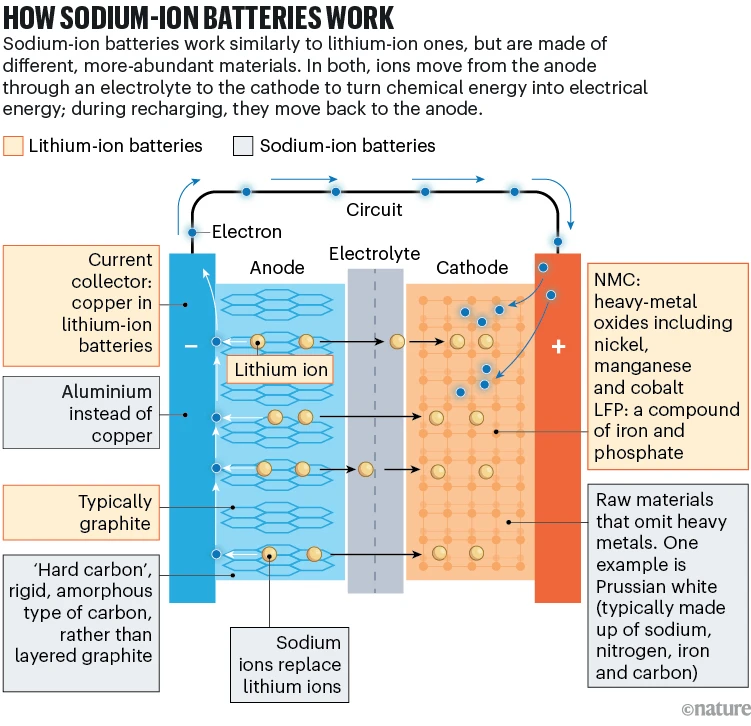
Sodium-ion batteries also use different raw materials in their layered-oxide cathodes (see ‘How sodium-ion batteries work’). Like their LFP cousins, sodium-ion batteries don’t usually contain the large amounts of toxic heavy metals that NMC cells do. For its first mass-produced batteries, CATL has adopted a layered oxide called Prussian white, which is made from sodium, nitrogen, iron and carbon and is similar to the pigment Prussian blue.
Sources: Adapted from G. Harper et al. Nature 575, 75–86 (2019) and G. Offer et al. Nature 582, 485–487 (2020).
For the anodes, sodium-ion batteries work effectively with cheap aluminium instead of copper. And easily manufactured carbon-based materials are better at storing sodium ions than graphite is. China dominates graphite’s global supply, and has been criticized for the pollution and environmental damage associated with graphite mining.
Sodium-based batteries are also less flammable than lithium-based ones (especially the NMC type), CATL says, which should make them safer. And they remain functional at much lower temperatures, down to −40 °C.
Price competition
But cars with sodium-ion cells can’t yet match the energy capacity and range of those with NMC lithium-ion batteries. CATL claims that its mass-market sodium-ion product packs an energy density of 175 Wh kg−1, and that innovations it has in the pipeline will bring this value up to 200 Wh kg−1. This value would put sodium-ion cells on a par with LFP batteries, but it is still only two-thirds of the energy density of advanced lithium-ion cells.
So, the competition is currently with LFP. Zhang says that CATL expects the costs of sodium-ion batteries to reach parity with those of LFP by the end of 2026. But some analysts think this will take years to happen. Most consultancy firms say sodium-ion batteries are pricier, for now, than the cheapest lithium-ion ones, and noone agrees on just how quickly sodium-ion manufacturing will ramp up or how rapidly costs will fall. The research firm Wood Mackenzie, in Edinburgh, UK, thinks that price parity with LFP will not be achieved until 2035.
Can we still escape catastrophic climate change? The hopes and hurdles in seven charts
“Because it’s a new technology, and it’s not widely deployed, estimations have a very wide error margin,” says Evelina Stoikou, who leads a team of battery-technology analysts at the energy research firm BloombergNEF in New York City.
It’s hard to compare the costs of lithium-based and sodium-based batteries because the sodium-ion industry is just starting to scale up. Such comparisons also require analysts to make assumptions about the price of lithium and the manufacturing costs of LFP, which will continue to drop. But the bottom line is that because of the cheaper raw materials, “sodium-ion cells will be cheaper in high volume compared to LFP”, predicts Mukesh Chatter, chief executive of Alsym, a sodium-battery start-up in Malden, Massachusetts.
Cars or energy-storage banks
For now, it’s difficult to know whether sodium-ion-powered cars will be a hit in Western markets. Most electric cars in the United States and the European Union at present use variants of high-range, high-capacity lithium-ion cells; the cheaper, lower-capacity LFP type have been making inroads mostly in China and emerging economies. Sodium-ion-powered cars could, at least to start with, follow the same pattern.
Another potential issue is that although sodium-ion batteries can be recycled similarly to lithium-ion ones, they are so cheap that recycling them would be a loss-making endeavour without government subsidy, Zhao’s team has calculated.
Sodium-ion technology should have a bigger impact in cutting the price of large-scale stationary batteries, say specialists including Hoekstra. Here, as the success of LFP has illustrated, it’s not so important to cram lots of energy into a small space. Hoekstra sees sodium-ion batteries as ideal for storing energy on a grid that’s powered mainly by solar and wind.