Blood-Vessel-on-a-Chip Models Can Now Grow and Redirect New Capillaries
An MIT research team has spent years asking living tissues to do something familiar: exercise. Stretched and tugged with a gentle back-and-forth motion, the artificial muscles and nerves in their lab changed how they grew in response. Their newest experiment turned that same approach on blood vessels.
Labs can already grow muscle, skin, liver, and kidney tissue from scratch, but most of it stays small and thin because cells only survive within a few hundred micrometers of a blood supply.
The team’s latest results show exercise may work on blood vessels, too. Gently and repeatedly stretching a lab-grown vessel caused it to sprout entirely new capillaries. Researchers could also choose which direction the new vessels grew, simply by changing which way they pulled.
The findings, published in the Proceedings of the National Academy of Sciences, come from a team that built a blood vessel on a chip, a device small enough to balance on a fingertip, to test how mechanical force shapes vessel growth.
“We’re finding that moving is good, which is always the takeaway of everything we do in our lab,” Ritu Raman, the study’s co-lead author, said in a press release. “Mechanical forces play an important role in our bodies. That means that if you want to grow more or less vessels, or shorter or longer vessels, or vessels in certain directions, we now know how to do that.”
How Stretching Reshapes a Lab-Grown Blood Vessel
3D printing can produce the body’s major vessels without much trouble, but capillary networks are a different challenge, delicate enough that a printer’s nozzle simply can’t trace them. Left alone to grow their own way instead, vessel cells tend to spread out with no real pattern.
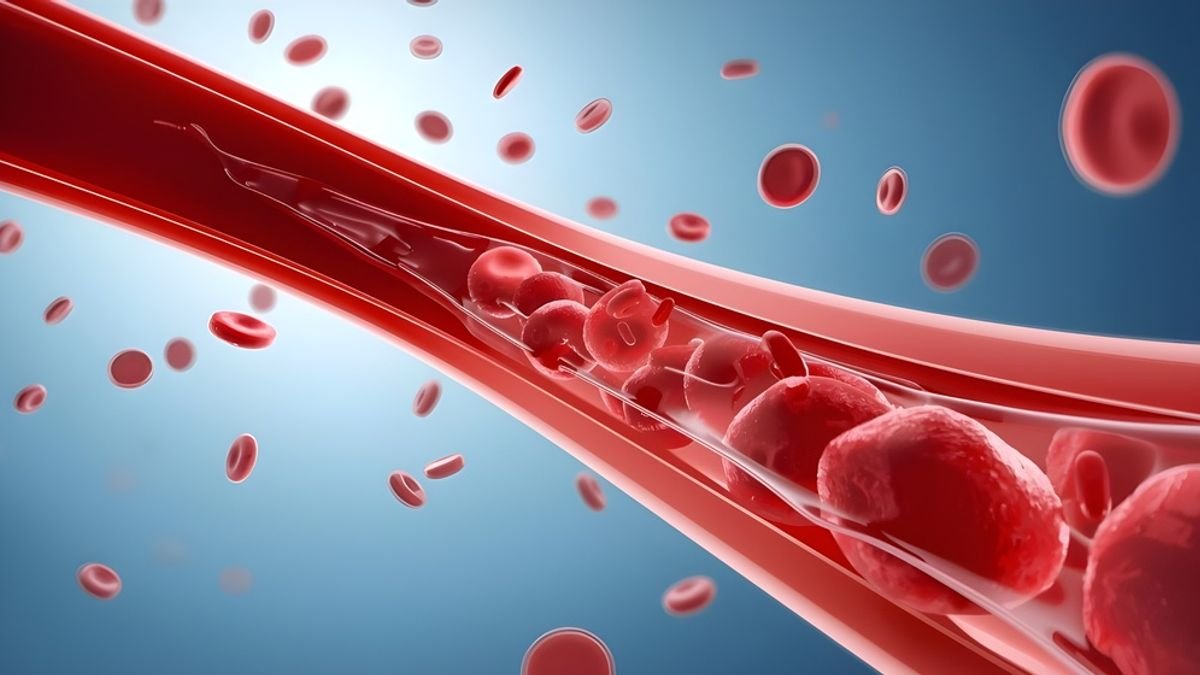
The chip holds a single vessel-like channel, sometimes called the parent vessel, lined with human endothelial cells, embedded in a nutrient-rich gel alongside a tiny magnet. An external magnet tugs on that gel, stretching the vessel in whichever direction and to whatever extent the researchers choose.
A 5 percent stretch was enough to set off a wave of new branching. Push that stretch up to 15 percent, and the number of new branches actually dropped, though each surviving one stretched out longer than before. When researchers switched the direction of the pulling partway through, the vessels didn’t just keep growing the way they’d started. They bent, forming sharp, L-shaped turns toward the new direction instead.
Read More: Lab-Grown Brains Could One Day Help Reawaken Nerve Regeneration
Why a Nobel Prize Talk Helped Explain the Discovery
The explanation traces back to a chance encounter. Raman happened to catch a lecture from Ardem Patapoutian, the biologist whose 2021 Nobel Prize recognized his discovery of PIEZO1 and PIEZO2, a pair of pressure-sensitive channels that let cells physically feel when they’re being squeezed or stretched. She approached him afterward with her lab’s data.
Patapoutian’s hunch was that PIEZO1 was the sensor doing the work, translating the physical tug of the stretch into a biological signal to grow. To test it, Raman’s team knocked down the PIEZO1 gene in some of the vessel’s cells and repeated the experiment. Sprouting dropped, even under the same mechanical stretching that had worked before.
What Programmable Blood Vessels Could Mean for Transplants
This method gives researchers a new way to shape that missing plumbing directly, using movement instead of chemistry. The team is now testing whether the same mechanical approach can help grow better-supplied muscle tissue, a step toward lab-grown organs that might actually survive the trip into a patient’s body.
The cells building these vessels respond to motion much the way muscle does when it’s worked, just at a scale too small to see. Sometimes biology listens to touch as closely as it listens to chemistry.
This article is not offering medical advice and should be used for informational purposes only.
Read More: How a CRISPR Gene Therapy Could Change Life for Young Children With Sickle Cell Disease
Article Sources
Our writers at Discovermagazine.com use peer-reviewed studies and high-quality sources for our articles, and our editors review for scientific accuracy and editorial standards. Review the sources used below for this article: