Breakthrough optical processor lets AI compute at the speed of light

Modern artificial intelligence (AI) systems, from robotic surgery to high-frequency trading, rely on processing streams of raw data in real time. Extracting important features quickly is critical, but conventional digital processors are hitting physical limits. Traditional electronics can no longer reduce latency or increase throughput enough to keep up with today’s data-heavy applications.

Turning to Light for Faster Computing

Researchers are now looking to light as a solution. Optical computing — using light instead of electricity to handle complex calculations — offers a way to dramatically boost speed and efficiency. One promising approach involves optical diffraction operators, thin plate-like structures that perform mathematical operations as light passes through them. These systems can process many signals at once with low energy use. However, maintaining the stable, coherent light needed for such computations at speeds above 10 GHz has proven extremely difficult.

To overcome this challenge, a team led by Professor Hongwei Chen at Tsinghua University in China developed a groundbreaking device known as the Optical Feature Extraction Engine, or OFE2. Their work, published in Advanced Photonics Nexus, demonstrates a new way to perform high-speed optical feature extraction suitable for multiple real-world applications.

How OFE2 Prepares and Processes Data

A key advance in OFE2 is its innovative data preparation module. Supplying fast, parallel optical signals to the core optical components without losing phase stability is one of the toughest problems in the field. Fiber-based systems often introduce unwanted phase fluctuations when splitting and delaying light. The Tsinghua team solved this by designing a fully integrated on-chip system with adjustable power splitters and precise delay lines. This setup converts serial data into several synchronized optical channels. In addition, an integrated phase array allows OFE2 to be easily reconfigured for different computational tasks.

Once prepared, the optical signals pass through a diffraction operator that performs the feature extraction. This process is similar to a matrix-vector multiplication, where light waves interact to create focused “bright spots” at specific output points. By fine-tuning the phase of the input light, these spots can be directed toward chosen output ports, enabling OFE2 to capture subtle variations in the input data over time.

Record-Breaking Optical Performance

Operating at an impressive 12.5 GHz, OFE2 achieves a single matrix-vector multiplication in just 250.5 picoseconds — the fastest known result for this type of optical computation. “We firmly believe this work provides a significant benchmark for advancing integrated optical diffraction computing to exceed a 10 GHz rate in real-world applications,” says Chen.

The research team tested OFE2 across multiple domains. In image processing, it successfully extracted edge features from visual data, creating paired “relief and engraving” maps that improved image classification and increased accuracy in tasks such as identifying organs in CT scans. Systems using OFE2 required fewer electronic parameters than standard AI models, proving that optical preprocessing can make hybrid AI networks both faster and more efficient.

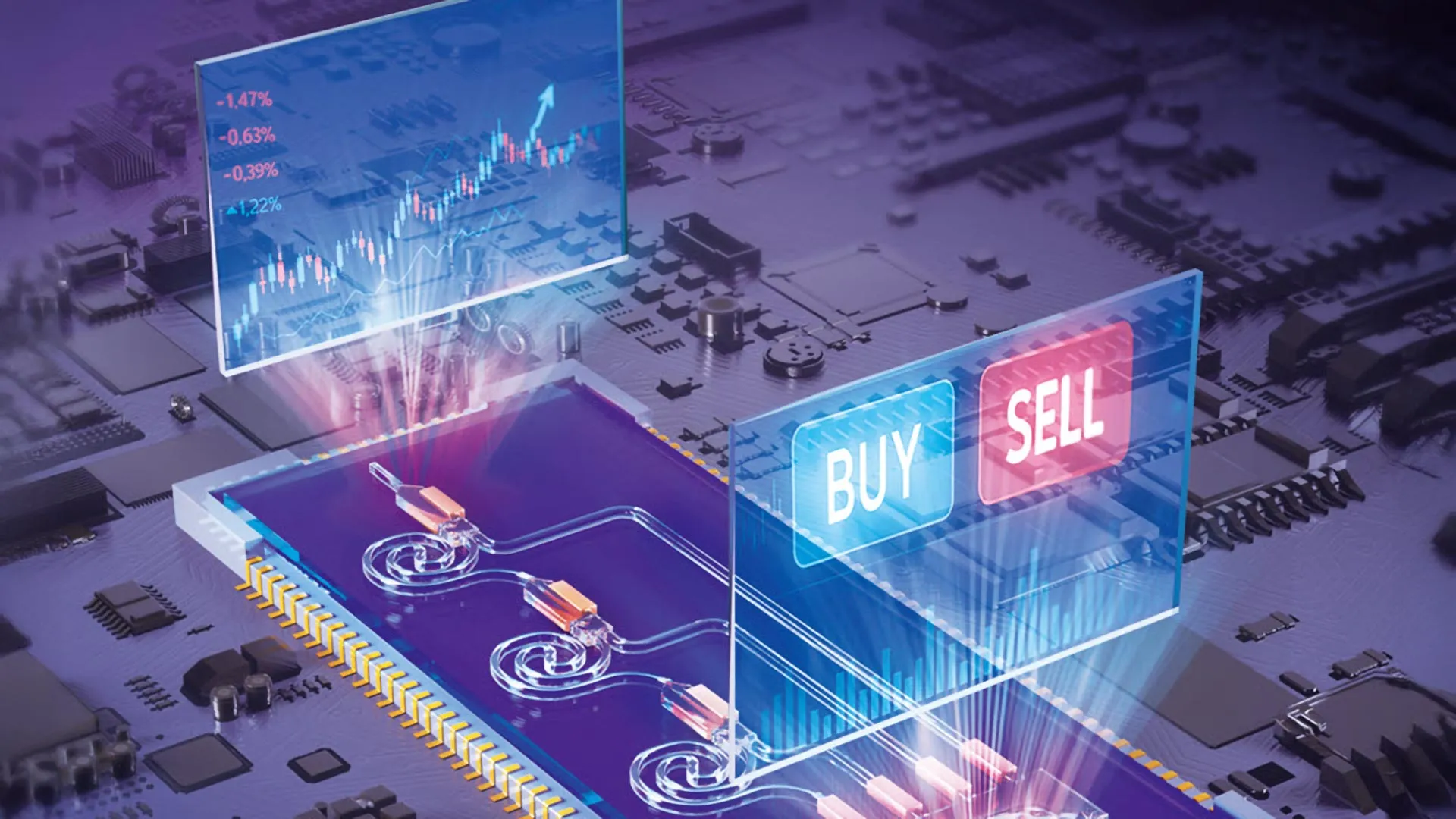
The team also applied OFE2 to digital trading, where it processed live market data to generate profitable buy and sell actions. After being trained with optimized strategies, OFE2 converted incoming price signals directly into trading decisions, achieving consistent returns. Because these calculations happen at the speed of light, traders could act on opportunities with almost no delay.

Lighting the Way Toward the Future of AI

Together, these achievements signal a major shift in computing. By moving the most demanding parts of AI processing from power-hungry electronic chips to lightning-fast photonic systems, technologies like OFE2 could usher in a new era of real-time, low-energy AI. “The advancements presented in our study push integrated diffraction operators to a higher rate, providing support for compute-intensive services in areas such as image recognition, assisted healthcare, and digital finance. We look forward to collaborating with partners who have data-intensive computational needs,” concludes Chen.
Similar Posts

  • OpenAI says rogue AI models broke free from human control. Some see it as a ‘warning shot’

    It is the kind of development once seen only in science fiction: An artificial intelligence system, trained to probe for digital vulnerabilities, breaks free of human control and acts on its own to hack another company. The attack announced this week by OpenAI, which blamed rogue AI models, underscored the blistering growth in the technology’s…

  • Had GPT 5.6 Sol replicate someone’s interactive site from a screen recording, then rebuilt its 3D cells using GPT Image 2 turnarounds and an image-to-3D pass

    Been trying to reproduce someone's interactive site this week, the one with those dense organic cell shapes that swim around and react as you move. Got the first two effects close enough that I wanted to write up how, even though the later ones are still running on placeholder versions. Step one was just handing…

  • Meta’s AI training with keystrokes: Progress or privacy issue

    Meta is looking within to find new training data for its AI models. Its Model Capability Initiative (MCI), announced in April 2026, captures mouse movements, keystrokes and occasionally screenshots to train AI models on how humans navigate around the computer while performing daily tasks. Google, LinkedIn and Wikipedia are among the sites used to…

  • Spain vs. Argentina 2026 livestream: How to watch World Cup final for free

    TL;DR: Live stream Spain vs. Argentina in the 2026 FIFA World Cup final for free on BBC iPlayer or ITVX. Access these free streaming platforms from anywhere in the world with ExpressVPN, an Official Supporter of the FIFA World Cup 2026. The 2026 FIFA World Cup has delivered weeks of electric entertainment. We’ve had controversy,…

  • Reverse Logistics: Optimizing The Flow Of Returned Goods

    Returns are an unavoidable part of modern commerce, but they also present valuable opportunities to improve operational performance. An efficient reverse logistics process allows businesses to recover inventory, reduce unnecessary costs, and gain insight into why products are being returned. When return data is managed effectively, organizations can strengthen customer satisfaction while making better inventory…

  • プロダクトエンジニアの台頭——AIがモダンテックチームを再形成する

    AI調達プラットフォームakirolabsはエンジニアリングチームの変革に成功した。キーワードは共有オーナーシップ。同社によれば、開発スピードは最大45%向上したという。 純粋な専門特化の終焉 長年、ソフトウェア組織は専門特化を中心に最適化されてきた。プロダクトマネージャーが要件を所有し、エンジニアが実装を担い、デザイナーがUXを、QAが品質を受け持つ——このモデルは機能していた。しかし製品の開発速度が四半期単位ではなく週単位で測られる時代。状況は変わった。 AIがさらにその変化を加速させている。それが「プロダクトエンジニア」の台頭だ。Fortune 500企業を顧客に持つAI調達プラットフォーム、akirolabsでは、CTOがエンジニアリングチームの組織を段階的に変革してきた。最初は専門特化のサイロを壊し、次にジェネラリスト型へ移行した。しかしやがて気づいたのは、AI時代に最もパフォーマンスが高いのはスペシャリストでもジェネラリストでもなく、プロダクトとビジネスを深く理解したエンジニアだということだ。 このモデルはプロダクトマネージャーを置き換えるものではない。むしろ優れたプロダクトマネージャーを解放する。プロダクトマネージャーは顧客対応、ロードマップの優先順位付け、要件の検証、戦略的な方向性により集中できるようになる。AIアシストのプロトタイピングやバイブコーディングツールにより、エンジニアリングの実装が始まる前に初期コンセプトや機能的な下書きを作れるようにもなる。 一方エンジニアは、プロダクトドメイン、顧客のワークフロー、ビジネスの優先事項への理解を深め、明確に定義された範囲内で多くのプロダクトレベルの意思決定を独立して行えるようになる。 このモデルは3つの繰り返し可能な原則で構成される。 プロダクトコンテキストのオーナーシップ:エンジニアは技術タスクだけでなく、顧客のワークフローとビジネス目標を深く理解する 分散型意思決定:チームはすべてを上位にエスカレーションせず、小さなプロダクト・実装の意思決定を自ら行う権限を持つ AIネイティブな実行:エンジニアはAIツールを孤立したコーディングタスクのアシスタントとしてではなく、デリバリーサイクル全体を通じた統合されたコラボレーターとして使う プロダクトエンジニア導入により望める変化は? このモデルの運用上の影響は比較的早く現れた。エンジニアリングデリバリーサイクル全体で収集した内部指標によれば、このモデル導入後に開発速度が約15〜25%改善した。エンジニアがすでに機能の「なぜ」を理解しているため、要件確認ミーティングは短く少なくなった。同じスコープでのリリースタイムラインが少なくとも10〜15%短縮された。 AIツールが日常のワークフローに入ってくると、効果はさらに顕著になった。プロダクトエンジニアは技術的な実装とプロダクトの意図の両方を理解しているため、AIコーディングシステムと効果的に協働できる。より良いプロンプトを作り、問題を正しく分解し、プロダクトとエンジニアリングチーム間の複数の変換レイヤーを必要とせずにAI生成のアウトプットを検証できる。 プロダクトエンジニアモデルと最新のAIツールを統合した後、開発・イテレーションサイクルで最大35〜45%の削減を記録し、機能デリバリーのサイクルタイムが数カ月から数週間に短縮された。 しかし最も重要な変化はスピードではなく、オーナーシップだ。 従来のエンジニアリング構造では、エンジニアはプロダクト貢献者ではなくチケットの実行者になりがちだ。曖昧な決定はすべて上位にエスカレーションされ、実行を遅らせ、マネジメントのキャパシティを消耗させる。これに対し、プロダクトエンジニアモデルは意思決定をより効果的に分散させる。これまで幹部の関与が必要だった多くの小・中規模のプロダクト決定を、ドメイン理解の強いエンジニアが直接処理できるようになる。 また、コミュニケーションのオーバーヘッドも組織全体で減少する。要件確認ミーティングが減り、チームは確認や承認を待つ時間が減る。「バスファクター(特定の人物がいなくなると機能しなくなるリスク)」も改善する。品質管理にも顕著な変化があり、実際のオーナーシップを持つエンジニアはプロダクト品質とビジネス成果に大幅に積極的になる。実装から6カ月で本番環境のバグが約25%減少した。 効果的にスケールするには しかしこのモデルの実装は簡単ではない。最大の課題は人材だ。すべてのエンジニアが効果的なプロダクトエンジニアになれるわけではない。技術的な深さ、プロダクトの直感、コミュニケーションスキル、ビジネスの認識、強い自己管理が必要だ。採用はコーディング能力だけで評価できないため難しくなる。 運用上の落とし穴もある。最も危険な間違いの一つは、十分なリーダーシップの監視や組織の成熟度なしに早すぎる段階でプロダクト権限を委任することだ。強いプロダクトエンジニアには強いフレームワークが必要だ——規律あるリリースプロセス、明確な説明責任の境界、信頼性の高いテストインフラ、経験豊富な技術リーダーシップ。マルチステージのテスト環境、構造化されたリリース管理、自動検証パイプライン、本番デプロイ前の多層的な自動・手動レビューによって分散型意思決定のリスクを軽減する管理が必要だ。 AIもまた複雑さをもたらす。AIツールの能力を過大評価し、適切な検証なしに生成されたアウトプットを信頼し始めるエンジニアもいる。逆に過度に懐疑的で生産性を大幅に改善できるツールを十分に活用しないエンジニアもいる。適切なバランスを維持するには、エンジニアリングリーダーシップの積極的な関与と社内のAI専門知識が必要だ。 AIネイティブなエンジニアリング組織の未来 長年、ソフトウェア開発は専門特化を中心に最適化されてきた。人間同士のコミュニケーションコストがシステム間の調整コストより低かったからだ。AIはその方程式を変える。実装がAIによって加速されるにつれ、組織のボトルネック——コーディングそのものではなく——が実行スピードの主な制約になる。最も速く適応する企業は、最大のエンジニアリング部門を持つ企業ではないかもしれない。オーナーシップ、プロダクト理解、AIネイティブな実行を中心にエンジニアリングの役割を再設計する組織かもしれない。 プロダクトエンジニアモデルは、究極的には新しい肩書きの下で責任を組み合わせることではない。プロダクトの判断をエンジニアリングの実行に直接埋め込み、現代の製品が今求めるスピードで考え、決定し、デリバリーできるチームを構築するという、より広いシフトを反映している。

Leave a Reply

Your email address will not be published. Required fields are marked *