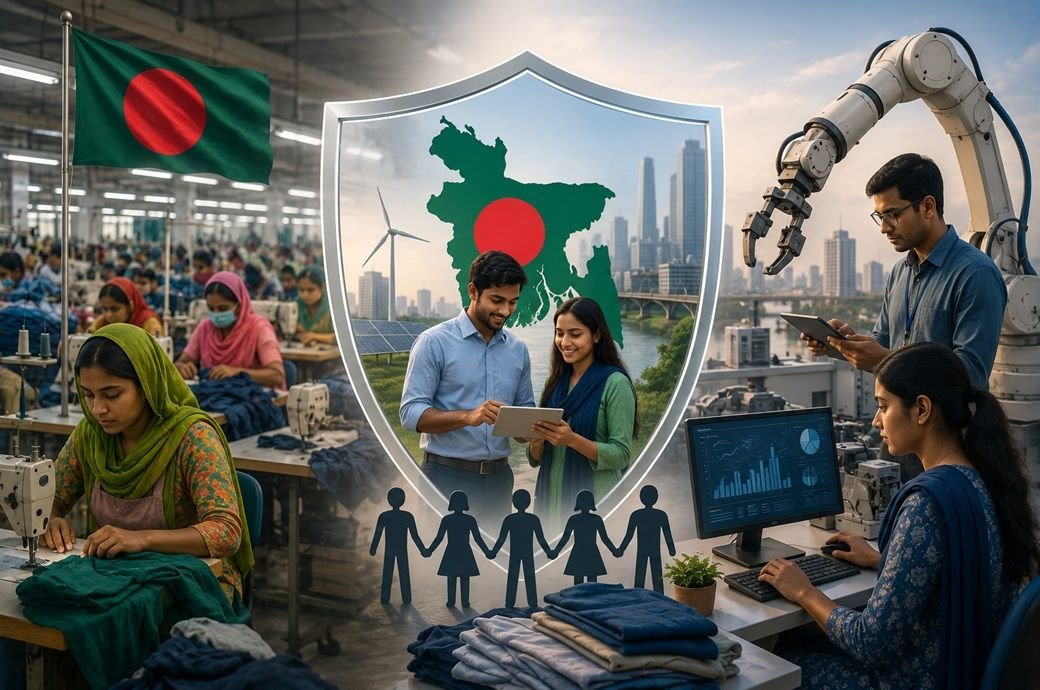
Can Bangladesh protect jobs while embracing AI and automation?
However, as the factories race to embrace smarter technologies to remain globally competitive, a new study suggests the transformation could come at a steep social cost, threatening the livelihoods of more than a million workers unless the country urgently prepares its workforce for the digital era.
AI and automation could eliminate 1.22 million jobs in Bangladesh’s apparel sector by 2041, with women facing the greatest risk, as per a new study.
While smart manufacturing promises higher productivity and competitiveness, experts say only rapid reskilling and policy reforms can prevent technology from becoming a major employment crisis.
As per a new study, nearly 1.22 million jobs in Bangladesh’s apparel sector could disappear by 2041 if automation accelerates without parallel investments in skills, policy reforms, and worker protection. Women, who constitute a significant share of the industry’s workforce, are expected to be disproportionately affected, with as much as 60 per cent of existing female employment at risk as manual operations increasingly give way to automated production systems.
The warning comes at a particularly sensitive moment for Bangladesh, which is preparing for its graduation from least developed country status. The country’s apparel industry has long been one of its largest employers and a key driver of export earnings, making any large-scale disruption to employment a matter of economic and social significance.
The findings paint a picture of a labour market already under strain. National employment reportedly shrank by around 1.3 million jobs in 2024, with women accounting for nearly nine out of every 10 positions lost. At the same time, manufacturing output has continued to rise, yet employment in the sector is said to have remained virtually frozen at about 8.1 million workers.
Meanwhile, researchers examined 27 domestic and global indicators to model multiple labour market scenarios through 2035. Despite varying assumptions, all scenarios converged on similar themes—rapid digitisation, rising demand for higher-value skills, persistent skill shortages, vulnerability to global economic shocks and the need for stronger institutional capacity to manage the transition.
The study also highlights a widening gap between education and industry requirements. Technical and vocational education continues to attract fewer than one-fifth of secondary-level students, while public spending on education and human capital development remains modest relative to the scale of technological change.
Without significant improvements in workforce preparedness, many workers may find themselves ill-equipped for the jobs created by advanced manufacturing.
The challenge is not just limited to factory floors. While technology is expected to generate millions of new digital and technology-oriented jobs globally over the coming years, it is also projected to displace millions of traditional roles.
For Bangladesh, the transition could prove especially tricky because many workers leaving manufacturing may end up in low-paying, informal or gig-based employment with limited social protection.
The study, however, argues that automation should not be viewed solely as a threat. If supported by modern vocational training, continuous reskilling, stronger labour market data systems, incentives for workforce development and better protection for vulnerable workers, technology could enhance productivity without sacrificing inclusivity.
Meanwhile, one of Bangladesh’s leading apparel manufacturers, Ha-Meem Group, has reportedly signed a Memorandum of Understanding (MoU) with a robotics and automation firm to fast-track the adoption of Industry 4.0 technologies and build a future-ready workforce, keeping an eye on the AI and automation era.
According to reports, the collaboration will focus on three key pillars: workforce development, industrial automation, and stronger industry-academia partnerships.
For Bangladesh’s apparel sector, automation, it seems, is shaping up as a classic double-edged sword. On one hand, it promises greater efficiency, competitiveness, and long-term industrial resilience. However, on the other, without swift policy action and sustained investment in people and training, the same technological revolution that powers future growth could also unravel one of the country’s greatest employment success stories.
Fibre2Fashion News Desk (DR)