Can the US and its allies break China’s grip on rare earths and AI technology?
The struggle between the US and China over who will lead in artificial intelligence is one of the defining competitions of our time. In the second part of our exclusive interview with a key player defining Washington’s policy on AI, Jacob Helberg, US undersecretary of state for economic affairs, discusses America’s efforts to rally its allies and cut dependence on China by securing alternative rare earth and critical mineral supply chains.
By the time US President Donald Trump signed his military supply chain executive order on Monday, the need to cut dependence on China for critical minerals was already clear to American allies, according to a senior administration official leading parallel diplomatic efforts to rally partners.
“When it comes to the world, our allies were really put on alert by China’s export controls of minerals that have really come back to bite them in pretty serious ways,” Jacob Helberg, US undersecretary of state for economic affairs, told the South China Morning Post in an exclusive interview days before Trump’s action.
Helberg cited Japan and European countries as among those adversely affected by “supply imbalances” stemming from China’s export controls on seven rare earth elements imposed in April last year in response to US tariffs.
Beijing’s restrictions set off a scramble for supplies and led to factory shutdowns across the developed world, including in the United States.
While a temporary US-China truce in October resumed the flow of exports, countries such as Japan have continued to face shortages.
As Beijing wields its dominance in critical minerals supply chains, Washington is racing to cut its dependence through domestic investments and international partnerships with allies and partners in a daunting global effort to blunt one of China’s main economic levers.
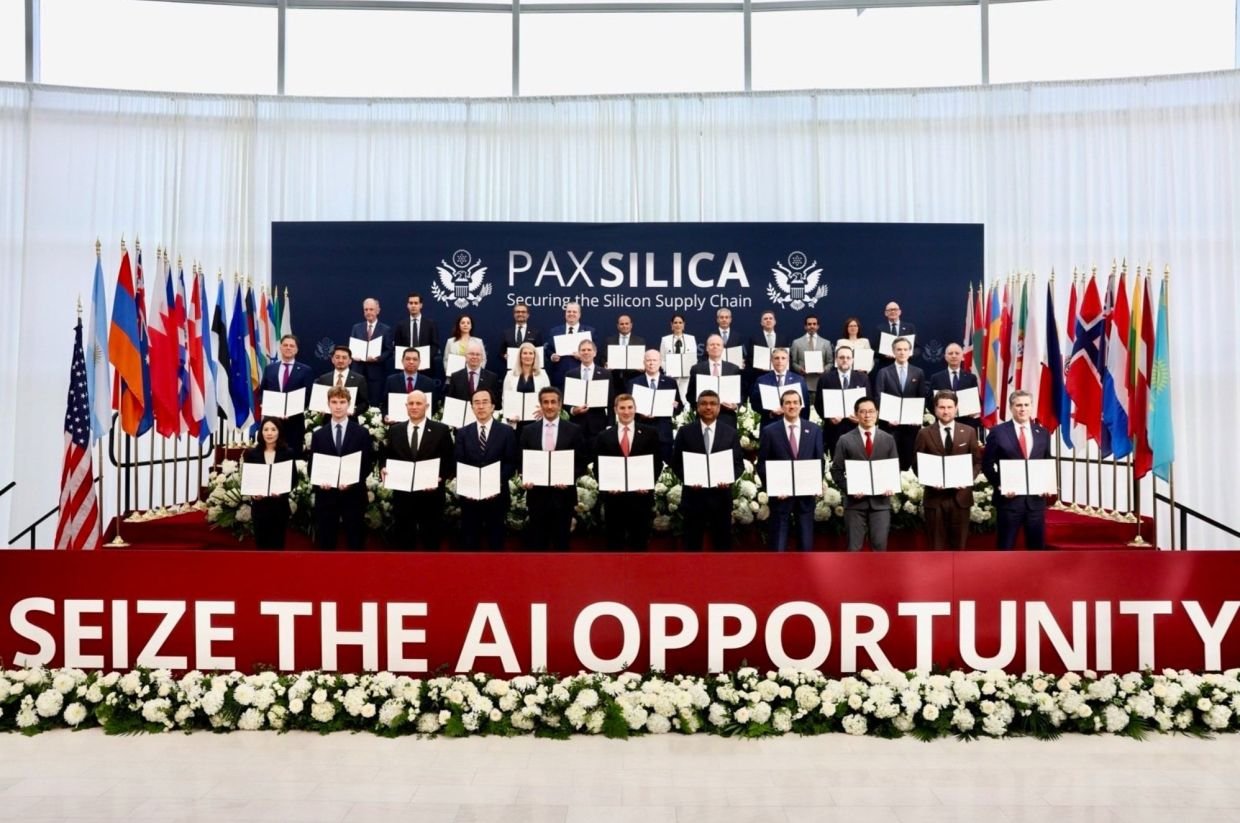
Helberg heads one of those flagship initiatives: Pax Silica, a 24-country coalition designed to build China-free, AI-related supply chains across critical minerals, advanced manufacturing, semiconductors, AI infrastructure and logistics.
“We have been looking at challenges in the supply chain, and frankly, single points of failure,” he said.
In the past seven months, Pax Silica has launched a series of initiatives, including plans for a pilot economic security zone in the Philippines; a US$50 million “Pax Pass” platform to help members move high-value AI supply chain products through the Panama Canal; and a workforce development initiative with Stanford University.
In defending Pax Silica’s expansive mandate, Helberg argued that reducing dependence on China required a whole-of-supply-chain strategy.
“You can’t solve chip capacity unless you have minerals,” he said. “You can’t solve minerals unless you have refining. You also can’t solve refining or minerals unless you have railroads and logistics infrastructure that allow you to transport things around.”
China holds a near monopoly in the processing of major critical minerals such as graphite, gallium, germanium and rare earth elements – metals that are indispensable to military systems, semiconductor manufacturing and robotics.
The Chinese embassy in Washington said that Beijing follows a “responsible and non-discriminatory approach” on its rare earth export controls and the measures are not “targeted at any specific country.”
“Given the dual-use nature of rare earth-related items, China has adopted relevant measures pursuant to its export control regulations,” Liu Chang, the embassy spokesperson told SCMP.
According to David Abraham, principal at Materium Strata, an advisory firm focused on critical minerals, Pax Silica had adopted the correct framework but cautioned that its broad scope could make it harder to address specific supply-chain vulnerabilities.
“Pax Silica has the right framing: identifying vulnerabilities in the supply chain of products that rely on critical minerals, rather than targeting solely mining,” he said.
“But with that focus comes the risk it is overly ambitious and unable to target specific supply-chain vulnerabilities.”
Jack Lifton, co-chairman of the Critical Minerals Institute, a think tank, said the initiative’s success would depend on “specialisation rather than duplication”.
“Every participating country should contribute what it does best instead of trying to recreate an entire supply chain domestically,” he added. “Supply chains are built around customers and qualified suppliers, not around political declarations.”
Describing himself as being “really excited about the progress”, Helberg said Pax Silica members were increasingly recognising the need for more resilient and diversified supply chains.
“They recognise that we need a new geography for our supply chains, and that fundamentally represents an opportunity for them to be a part of this new supply chain that we will build together.”
Alongside the diplomatic push, Washington has moved to bolster domestic measures aimed at securing critical mineral supply chains.
The executive order Trump signed on Monday directed military contractors to shift away from Beijing-linked supply chains beginning in January next year.
While not explicitly naming China, the executive order framed security of supply chains as essential to preserving US military dominance “in an era of renewed great power competition”.
“The United States must secure its supply chains against physical, cyber and economic subversion,” the order said.
The US Department of Defence remains reliant on China-sourced supplies of critical minerals, including rare earth elements, for components in its weapons systems.
A 2025 report by the US-China Economic and Security Review Commission found that 78 per cent of components used in Pentagon weapons systems contained critical minerals sourced from China.
Among the six military services, the US Navy was the most exposed, with nearly 92 per cent of its weapons systems affected.
The push comes as the rare earth truce reached by Washington and Beijing last year faces growing pressure.
Last month, China placed two leading US rare earth companies, MP Materials and USA Rare Earth, along with eight other American firms on its export control list in retaliation for the Pentagon’s blacklisting of dozens of Chinese companies. — SOUTH CHINA MORNING POST