Carnegie Mellon’s AI Science Foundry Selected by NSF To Help Build National Infrastructure for AI-Enabled Scientific Discovery – News
Carnegie Mellon University’s AI Science Foundry(opens in new window), one of the world’s most advanced AI-powered research facilities, has been selected as a node in the U.S. National Science Foundation’s (NSF) Programmable Cloud Laboratory (PCL) Testbed(opens in new window), a national initiative to build a network of AI-enabled laboratories. The CMU facility will receive up to $20 million over four years to help establish a national network of AI-enabled laboratories(opens in new window) that will transform how scientific discoveries are made.
The initiative advances the U.S. government’s broader Genesis Mission, helping build the AI-enabled research infrastructure needed to address national priorities in energy, advanced manufacturing, biotechnology, materials science and other critical fields. Carnegie Mellon is also leading three Genesis Mission projects, with significant participation in projects nationwide.
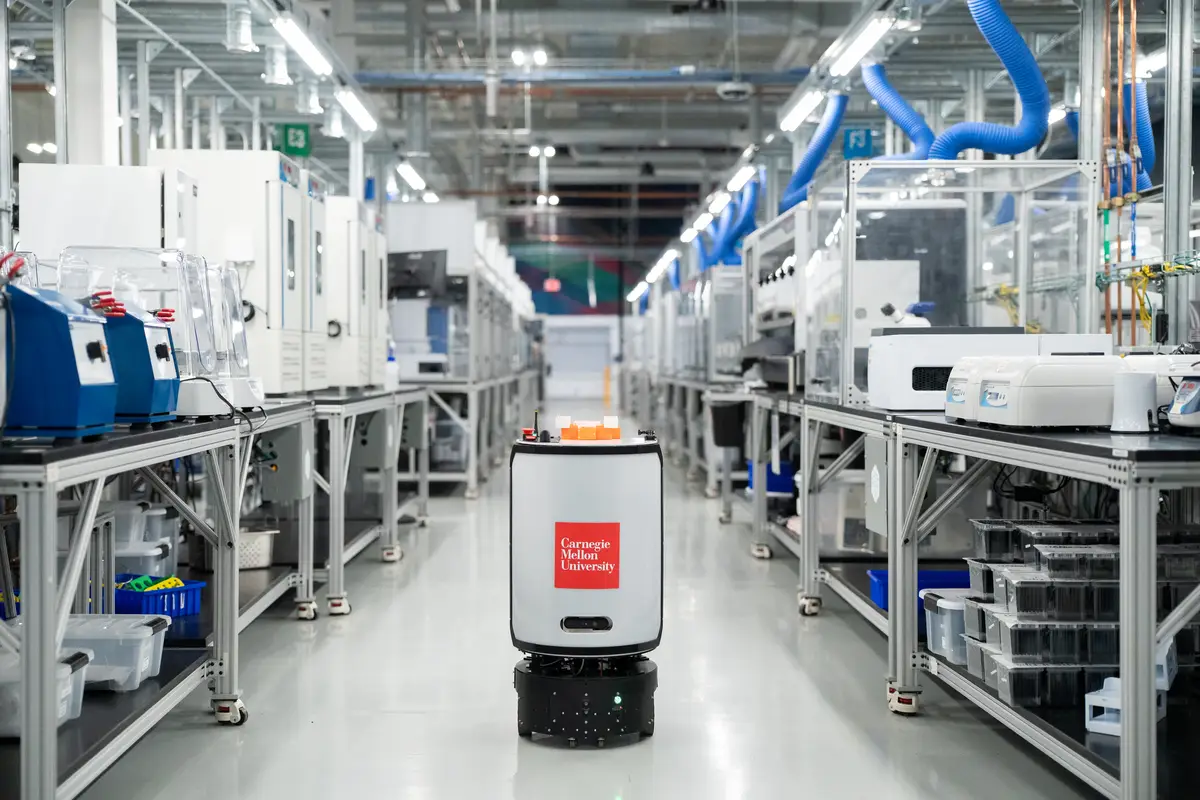
A first-of-its-kind research ecosystem, the Foundry combines artificial intelligence, robotics, automation, advanced scientific instrumentation and high-performance computing into a single intelligent system. Rather than researchers conducting experiments one at a time through traditional trial-and-error methods, they can use the Foundry to remotely design, execute, analyze and continuously improve experiments across dozens of interconnected instruments — an approach that dramatically increases the speed, scale, accessibility and reproducibility of scientific discovery.
At the heart of the Foundry is a specialized autonomous platform that connects more than 80 robotically controlled instruments spanning across biology, chemistry and materials science across two cloud labs into a unified cybersecure platform. By combining AI agents, robotics, advanced imaging and sensing, open data and high-performance computing, the Foundry enables continuous AI-guided design-test-learn cycles that have the potential to reduce scientific discovery timelines from decades to years — or even months.
“The National Science Foundation is building a transformative research infrastructure that will transcend disciplines, distances and institutions,” said CMU President Farnam Jahanian(opens in new window). “Within this initiative, Carnegie Mellon University’s AI Science Foundry sits at the powerful nexus of AI, robotics and the sciences and is poised to serve as a key partner and driver for advancing American innovation in new and unprecedented ways.”
Through the Testbed, CMU will work alongside partner universities, national laboratories, industry and government collaborators to create interoperable AI-enabled laboratories that can serve researchers nationwide. This network will also develop shared standards, open software, data resources and autonomous scientific workflows to accelerate discoveries in key areas such as medicine, biotechnology, energy, advanced manufacturing and transportation.
“The AI Science Foundry represents a new paradigm for scientific research,” said Theresa Mayer(opens in new window), vice president for research. “By integrating artificial intelligence with robotics, autonomous laboratories, advanced instrumentation and high-performance computing, we’re creating an intelligent research environment where scientists can ask bigger questions, explore vastly larger experimental spaces and dramatically shorten the path from idea to discovery.”
The Foundry will initially support AI-guided research in areas including functional polymers for data centers and robotics, microbial biomaterials for sustainable pigments, organoids for personalized medicine and high-temperature aluminum alloys for next-generation aircraft engines. Beyond these initial research targets, the CMU facility is designed as an open platform that can support a broad range of scientific disciplines and applications.
It will also expand opportunities for researchers, students, educators and industry professionals through workshops, hands-on training and AI-guided educational programs that provide experience with autonomous experimentation, robotics, data science and artificial intelligence. By broadening access to these technologies, the Foundry will help prepare scientists and engineers and students to lead the next era of discovery while strengthening U.S. innovation and competitiveness.
The NSF award builds on Carnegie Mellon’s longstanding leadership in AI while establishing the university as a cornerstone of the nation’s emerging AI-powered scientific research infrastructure. Through the Foundry and its partnerships across the national PCL network, Carnegie Mellon is helping create a future in which AI and autonomous experimentation dramatically accelerate discovery, foster collaboration across institutions and enable scientists everywhere to tackle some of the world’s most pressing challenges.