Demand for lithium is surging: here’s how to make mining more sustainable

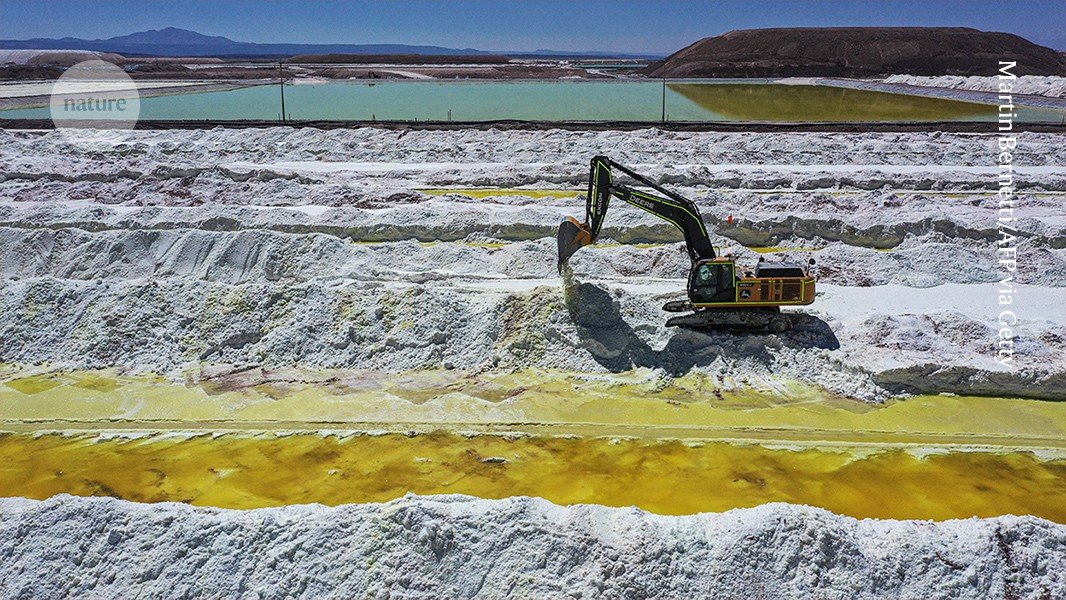
Lithium salts being recovered from brine pools in South America.Credit: Martin Bernetti/AFP via Getty
As more people seek out electric vehicles and batteries to store renewable energy, demand for lithium, the metal at the core of most rechargeable batteries, is intensifying. But mining lithium has substantial impacts on the environment. A wave of innovative technologies could make its extraction more sustainable.
Electric vehicles accounted for more than one-quarter of all global car sales last year, according to the International Energy Agency. The agency projects that demand for lithium for electric vehicles could reach around 665 kilotonnes by 2035. Yet, planned and existing mining projects would produce only about 450 kilotonnes, leaving a substantial gap if production capacity does not increase.
Demand for lithium batteries for energy-storage capacity for renewable electricity will put further pressure on lithium production, says Zhikao Li, a chemical and biological engineer at Monash University.
About 25% of this lithium is projected to come from parts of Chile and Argentina. Here, producers pump naturally occurring lithium-rich brine from underground aquifers into large evaporation ponds. Over a period of months or years, sunlight and wind concentrate the brine until lithium-rich salts can be recovered. The process is effective, but inefficient, say scientists. Brine contains many dissolved salts, each with distinct solubilities. As the water evaporates, the least soluble salts crystallize first, whereas lithium salts are some of the last to separate. Up to 50% of the lithium can be left behind in evaporation ponds, and extra fresh water is often needed to purify the remaining metal.
“The key limitation for existing processes is the fresh water, and also it’s a very slow process,” says Huanting Wang, who is working on alternative extraction methods at Monash University in Melbourne, Australia.
The water use is particularly concerning because brine deposits tend to exist in arid or semi-arid regions where fresh water is already scarce, says Ehsan Vahidi, a who studies metallurgical engineering at the University of Nevada in Reno.
Brine mining has impacts for local Indigenous communities and damages wetland ecosystems, say researchers.
Greener alternatives
Direct lithium extraction is an alternative method that research teams and companies are exploring. These systems use membranes, solvents and electrochemical processes to selectively remove lithium ions from brine.
One possible strategy is being developed by Wang’s team at Monash University. The team began by evaporating the brine so that it formed a solid salt mixture and then used acetone and ethanol to selectively dissolve lithium salts while leaving most other compounds behind. In a laboratory study published last month, they report that the process recovered around 95% of the lithium present1.
The method substantially reduces freshwater use compared to traditional methods, the researchers say. And the method could be coupled with solar-powered systems that capture and condense the evaporated water, allowing it to be recycled instead of being lost to the atmosphere. The solvents could also be recovered and reused.
Wang says that the technique could eventually be used to recover lithium present in industrial waste streams and mining residues, which are otherwise wasted.
Peter Sherrell, a materials scientist at RMIT University, Melbourne, says this approach has several advantages over existing methods, such as the high rate of lithium recovery and the fact that the solvents can be recovered and reused. But whether the industry will invest in the technology so it can be used in the real world remains to be seen, he adds.