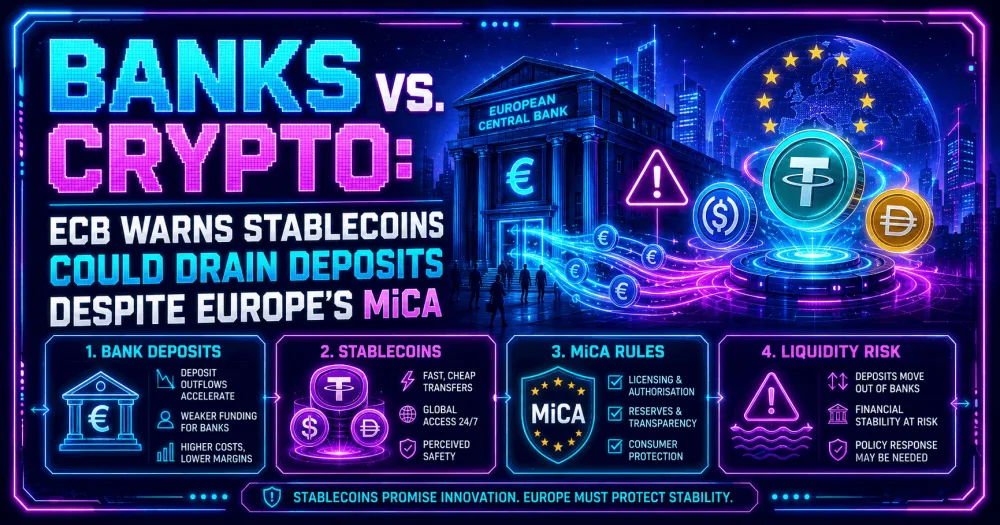
ECB Warns Stablecoins Could Drain Deposits Despite MiCA
Europe has developed a clear crypto regulatory framework, but the ECB warns that this may not be enough to protect the banking system. As stablecoins increasingly encroach on the payments domain, they can divert household deposits away from commercial banks. This means that the banks vs crypto debate is not only about price discovery but also about the balance of deposits, lending and control over digital assets.
Contents
Why the ECB Is Warning About Stablecoins Now
Piero Cipollone’s Latest Comments Explained
ECB Executive Board member Piero Cipollone has warned that the adoption of stablecoins could lead to the loss of retail deposits by commercial banks. His warning reflects concerns that stablecoins can perform some of the critical functions of banks, including payments and transaction settlement.
Related: Top 3 Crypto Exchanges Facing EU Exit as MiCA Rules Take Effect in July 2026
Why Bank Deposits Matter More Than Crypto Prices
Deposits represent a cheap source of funding for a bank, which is used to fund mortgages, loans, and other assets. By channeling deposits into stablecoins, consumers can deprive the banking system of a critical source of cheap funding. This is why the ECB stablecoin debate is about the displacement of bank deposits by crypto assets.
How Stablecoins Became a Systemic Concern for Europe
Stablecoins were once primarily distributed on crypto exchanges, but are now being adopted as media of exchange and settlement. As a result, regulators have to consider the impact on the banking system, including the transmission of monetary policy and the stability of domestic currencies. In the case of dollar-backed stablecoins, their growing presence in the financial system raises concerns about the dominance of one currency over others.
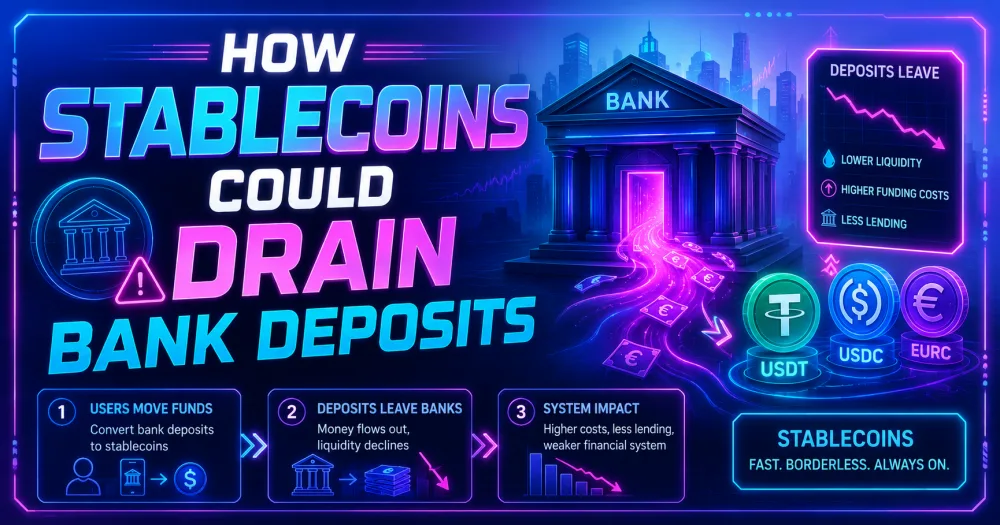
How Stablecoins Could Drain Bank Deposits
Why Consumers May Prefer USDT, USDC and Other Digital Dollars
USDT▲$0.9991, USDC▲$0.9999 and other dollar-backed stablecoins represent an attractive alternative to traditional deposits. They can be transferred instantly, 24/7, across wallets, exchanges, and other platforms. Digital dollars offer the same advantages over traditional cross-border transfers. This combination of benefits explains why stablecoins have become a popular medium of exchange and why they could displace bank deposits in Europe.
What Happens When Deposits Leave Commercial Banks
When a consumer converts fiat money into a stablecoin, the resulting crypto does not necessarily leave the banking system. This is because the issuer of stablecoins can keep the fiat on bank deposits or buy government securities with them. However, the commercial bank that facilitated the conversion can still lose out on the transaction fees and suffer a loss of deposits and customers.
Higher Funding Costs and Reduced Lending Capacity
A bank that has lost retail deposits may have to turn to more expensive funding instruments to maintain its lending capacity. If the shift is large enough, it could lead to higher interest rates and a reduction in the overall lending capacity of the banking system. These are some of the key risks stablecoins impose for banks.
Is Europe Already Losing the Stablecoin Race?
MiCA Was Designed for Regulation—Not Adoption
The EU’s Markets in Crypto-Assets (MiCA) regulation does not necessarily promote the use of stablecoins within the EU. Rather, it focuses on ensuring that crypto assets operate under a clear legal framework. MiCA sets out requirements for crypto-asset issuers, including stablecoins, but it does not promote the adoption of stablecoins as a medium of exchange.
Why Dollar-Backed Stablecoins Still Dominate Europe
Dollar-backed stablecoins are the dominant form of on-chain money. They facilitate most stablecoin transactions on exchanges and are critical to decentralized finance applications. The network effects around dollar stablecoins greatly benefit from their adoption by institutional investors and payment processors. In contrast, there are fewer institutional use cases for euro-backed stablecoins, while the network effects around USDC in Europe are lower than those around USDT.
The Growing Gap Between Regulation and Market Demand
Europe may be set to dominate the global crypto regulation landscape, but it has less of an advantage when it comes to stablecoins. This is because the adoption of stablecoins is driven by their liquidity and network effects, rather than the regulatory environment. The latter can shape the terms of stablecoin issuance and exchanges but cannot promote the use of euro stablecoins over their dollar counterparts.
Read more: What MiCA Still Doesn’t Solve — Europe’s Biggest Crypto Regulation Problems
MiCA vs. Stablecoins: What the Regulation Actually Does

Stablecoin Licensing Requirements Under MiCA
MiCA introduces a bifurcation between exchange tokens and asset-referenced tokens. The latter category covers stablecoins, including e-money tokens. Stablecoins that reference a single currency are subject to the e-money-token regime. Issuers must apply for authorization and are required to meet certain obligations to token holders. This is one of the key aspects of MiCA regulation explained.
Reserve, Liquidity and Transparency Rules
MiCA stablecoin rules require that crypto-asset issuers maintain reserves and meet certain liquidity requirements. In addition, they must be transparent about their operations and allow redemption of tokens. Stablecoins with large market capitalization undergo additional scrutiny, as their failure can trigger systemic consequences. These are some of the essential MiCA requirements for stablecoins.
What MiCA Cannot Prevent
MiCA cannot offset the network effects that make dollar-backed stablecoins more attractive than their euro counterparts. It also cannot prevent a loss of value of stablecoins or a shift of deposits from commercial banks to crypto wallets. The regulation can make stablecoins safer but cannot dictate their adoption.
Why the ECB Wants the Digital Euro
How the Digital Euro Differs From Private Stablecoins
The digital euro is essentially the cash of the future. It differs from private stablecoins in that it is the liability of the central bank, rather than commercial banks. This distinction is critical to understanding the digital euro vs stablecoins debate. The digital euro would allow the ECB to retain control of the money supply as payments digitize.
Why Holding Limits Are Part of the ECB’s Strategy
The ECB does not want the digital euro to absorb retail deposits and act as a cash substitute. This is why the digital euro design includes limits on holdings and no promise of returns. The former feature is intended to prevent disintermediation of commercial banks, while the latter discourages large-scale deposits.
Can CBDCs Really Protect Bank Deposits?
A central bank digital currency (CBDC) cannot prevent the drain of deposits, but it can reduce it. This is because a digital euro would be a safer alternative to private stablecoins. In addition, it would reduce the reliance of the financial system on private money, including dollar-backed stablecoins. The use of holding limits can also reduce the scale of deposits shifted from commercial banks to the central bank.
Related: MiCA Shock on July 1: Over 80% of Europe’s Crypto Firms Still Lack a License — What Happens Next?
US Banks and the ECB Are Sending the Same Warning
Why American Regulators Share Similar Concerns
US regulators are also concerned about the impact of stablecoins on the banking system. In particular, they highlight the risk that deposits may be drained from commercial banks by crypto custodians. The shift can be mitigated if stablecoin issuers hold the deposits as reserves with banks, but individual institutions can still suffer large outflows.
The Rise of Stablecoins After U.S. Regulatory Progress
The US is set to adopt a federal framework for stablecoins, including payment stablecoins. The GENIUS Act promotes the adoption of a uniform federal law for stablecoins, which reduces risks for banks and other financial institutions. As a result, the US may see increased adoption of dollar stablecoins as mediums of exchange, which can lead to greater disintermediation of the banking system.
Are Banks Facing a Global Deposits Battle?
Potentially, but the competition is not necessarily between banks and crypto. For one, banks can issue stablecoins, custodianship products, deposits in stablecoins, or tokenized deposits. The real battle is over the control of the customer’s funds and deposits. The same goes for the broader financial ecosystem, including payments.
Who Wins If Stablecoins Keep Growing?
Stablecoin Issuers
Large stablecoin issuers can benefit from the growth of the market and the adoption of their products. In addition, they can benefit from network effects and a price increase of their tokens. Issuers can also benefit from regulation, including MiCA, as it creates barriers to entry for new competitors. This is especially the case for those who comply with the regulation.
Crypto Exchanges and Fintech Platforms
Exchanges and fintech companies are natural ecosystem partners for stablecoins. They benefit from the liquidity provision and settlement efficiencies that stablecoins enable. In addition, they can offer their users a wider range of products and services. By reducing the need to convert between crypto and fiat, stablecoins can also benefit the bottom line of exchanges and fintech companies.
Consumers and Cross-Border Payments
Consumers can benefit from the faster settlement times and broader adoption of stablecoins. In particular, they can benefit from their use cases as digital dollars or euros. Stablecoins also promote competition in the payments sector, which can lead to lower fees and better services. However, they also expose consumers to counterparty, liquidity, and regulatory risks that are not found in traditional deposits.
Banks and Payment Processors
Banks are not necessarily at the losing end of the competition with stablecoins. For one, they can offer custody and settlement services to crypto custodians. In addition, they can issue their own stablecoins or tokenized deposits. Payment processors can also benefit from the adoption of stablecoins as a means of payment. The weakest banks in the competition with stablecoins are those that fail to adapt to the changing environment.
What This Means for Crypto Investors
Could Stricter Regulation Benefit Compliant Issuers?
Yes, because it creates a regulatory moat over non-compliant competitors. In other words, stricter stablecoin regulations can benefit issuers who comply with them. This is especially the case for those that operate within the EU and issue tokens in accordance with MiCA. They can benefit from a first-mover advantage over other issuers and greater adoption on exchanges and by banks.
Which Stablecoins Are Best Positioned in Europe?
USDC is one of the stablecoins that are well-positioned in Europe, as its issuer has a compliant structure in place. The same goes for EURC, which is designed to operate in accordance with MiCA. USDT, by contrast, has a much larger market value but a lower presence in Europe due to its complicated relationship with regulators. In terms of long-term value, stablecoin investors should consider both liquidity and regulatory risks.
Will Banks Eventually Issue Their Own Stablecoins?
Some banks will issue stablecoins, while others will tokenize their own deposits. In either case, they can participate in the growing stablecoin market without suffering the same disintermediation risks as crypto-native custodians. In the long term, the market can see the co-existence of private stablecoins, tokenized deposits and central bank digital currencies.
FAQ
Why Is the ECB Worried About Stablecoins?
The ECB is concerned that the adoption of stablecoins will lead to the loss of retail deposits by commercial banks. This can increase funding costs and reduce the capacity of the banking system to fund loans and mortgages. In addition, the ECB is concerned that dollar-backed stablecoins will promote the use of foreign currencies in the payments system.
Does MiCA Regulate USDT and USDC?
Yes, MiCA applies to all crypto assets within the EU, including stablecoins. However, there are differences in the regulatory treatment of stablecoins issued by different issuers. In particular, USDC is expected to comply with the requirements of MiCA as a stablecoin issued by a European entity. USDT, by contrast, has faced restrictions on some exchanges due to the lack of regulatory oversight in its corporate governance.
Can Stablecoins Replace Bank Deposits?
Yes, but stablecoins and bank deposits are not interchangeable. Stablecoins can act as a medium of exchange, a store of value, and a means of payment. However, they cannot directly fund loans and mortgages the way deposits can. In addition, deposits offer deposit insurance, whereas stablecoins are subject to counterparty and liquidity risks.
What Is the Digital Euro?
The digital euro is the cash of the future. It is the electronic equivalent of physical euro banknotes and coins and is designed to complement cash rather than replace it. The digital euro would facilitate payments in the digital economy and serve as a safe alternative to private digital currencies and stablecoins.
Are Stablecoins Bad for Banks?
No, but they can compete with them for deposits, payments, and other banking services. In addition, stablecoins can erode the franchise of commercial banks by providing similar services with greater convenience and security. However, banks can also participate in the stablecoin ecosystem by providing custody and settlement services to stablecoin issuers.