Exposed credentials are giving attackers a head start many organizations don’t see
Compromised credentials can remain active long after passwords are created, leaving organizations trying to identify exposed accounts before attackers can use them. The 2026 Credential Risk Report from Enzoic shows growing awareness of the problem, but monitoring and response capabilities continue to lag.
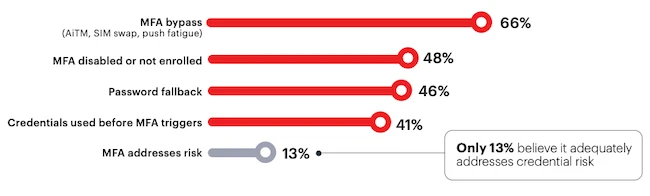
Even with MFA deployed, which credential-related risks remain a concern for your organization? (Source: Enzoic)
The growing risk of exposed credentials
73% of organizations identified employee or contractor credentials in breach data, dark web sources, or infostealer logs during the past year, while nearly one in five lack visibility into whether their credentials have been exposed. More than seven in 10 companies experienced an authentication-related incident during the past year, and two-thirds of the most recent incidents involved attackers signing in with valid credentials.
Exposed credentials often stay active long enough to be exploited, making early identification a key part of reducing credential-based risk.
Infostealer malware expands the attack surface
Infostealer malware has become a major source of stolen credentials, including passwords, browser data, authentication tokens, and session cookies. Attackers can reuse valid session cookies to access accounts without triggering a password prompt or multi-factor authentication (MFA), leaving companies with little time to respond.
The 2026 Verizon Data Breach Investigations Report found that half of ransomware victims with an associated credential leak or infostealer event during the previous year experienced that event within 95 days before the ransomware attack.
39% of organizations identified employee credentials in infostealer logs during the past year, while 43% either do not monitor these datasets or are unsure whether they do. Monitoring breach and infostealer data gives them earlier visibility into exposed credentials before they can be exploited.
Password screening misses later exposure
Organizations primarily screen passwords when they are created or reset, even though credentials are often exposed later through phishing, third-party breaches, or infostealer malware. Continuous monitoring is still limited, with fewer than one in five companies continuously monitoring active credentials and automatically remediating exposed accounts.
The findings align with NIST SP 800-63B guidance, which recommends changing passwords when there is evidence of compromise rather than on a fixed schedule. Despite the prevalence of compromised passwords in Active Directory environments, nearly one in five have never checked for them.
Organizations commonly monitor dark web and breach data, analyze SIEM alerts, and screen for compromised credentials, but many still struggle to identify newly exposed credentials quickly enough to reduce the risk of misuse. About half of respondents confirmed compromised credentials within a week of their most recent authentication-related incident, while many others took longer or could not determine whether credentials were involved.
Forced password resets, user notifications, and account investigations are the most common responses after exposed credentials are identified, while automated response workflows are less widely used.
Who owns credential security?
MFA makes stolen passwords harder to use but does not eliminate credential exposure. Organizations continue to cite attack techniques that can bypass or weaken MFA, including adversary-in-the-middle attacks, users without MFA, password fallback, and credentials being used before an MFA challenge is triggered.
Only 13% of organizations believe MFA adequately addresses credential exposure. Password fallback is still common, and some said they have not implemented credential monitoring because they believe MFA provides sufficient protection.
Credential monitoring remains focused on workforce identity systems, while SaaS accounts, service accounts, machine identities, customer-facing systems, and third-party access receive less coverage. External identities also receive limited attention, leaving additional attack paths with weaker safeguards against exposed credentials.
Companies are investing in credential security, with many planning to expand MFA, passwordless authentication, identity threat detection and response (ITDR), and compromised credential monitoring over the next year. Responsibility for credential security is often split across multiple teams or lacks a defined owner, creating integration challenges and limiting efforts to make automated credential abuse a strategic priority.